
“NFC” and “RFID” get used almost interchangeably in clothing and textile sourcing conversations, but an NFC garment badge and a UHF RFID laundry tag solve different problems. Confusing the two leads to a common and expensive mistake: buying tags rated for one scanning method and then discovering they can’t support the counting workflow the operation actually needs.
Both technologies are, technically, RFID — NFC is a specific implementation of HF RFID. But the practical differences in how each is read make them suited to very different clothing and textile operations. For the wider frequency and system-selection decision, see the RFID for laundry and uniform rental guide.
The Core Difference: How Each Tag Gets Read
An NFC garment badge operates at 13.56 MHz and is built for close-range, one-at-a-time interaction — typically a phone or handheld reader tapped within a few centimeters of the badge. A UHF RFID laundry tag operates at 860–960 MHz and is built for bulk, hands-free reading — a stack, cart, or conveyor of garments passed through a portal or tunnel reader all at once, often from a meter or more away.
| NFC Garment Badge | UHF RFID Laundry Tag | |
|---|---|---|
| Frequency | HF, 13.56 MHz | UHF, 860–960 MHz |
| Typical read range | 0–10 cm | 0.5–2 m (garment-mounted) |
| Scanning method | Tap with phone or handheld reader | Bulk read through portal, tunnel, or handheld at distance |
| Items read at once | One | Dozens to hundreds |
| Reader hardware needed | NFC-enabled smartphone often sufficient | Dedicated UHF reader, antenna, portal, or handheld |
| Best fit | Individual item verification, inspection logs | Bulk counting, sorting, high-throughput laundry cycles |
When an NFC Garment Badge Is the Right Call
NFC makes sense when the workflow is inherently one-item-at-a-time and the goal is confirming identity or logging an event, not counting volume. Common cases:
- Inspection and quality checkpoints. A supervisor taps a badge to confirm a specific garment passed a quality check, alteration, or repair step, with the timestamp logged automatically.
- Low-volume or pilot programs. Operations testing item-level tracking before committing to reader infrastructure can start with NFC and a smartphone app — no portal reader, antenna, or middleware investment required.
- Consumer-facing authentication. Some apparel brands use an NFC garment badge so a customer can tap their own phone against a product to verify authenticity or pull up care and origin information — a use case UHF RFID can’t serve, since consumer phones generally don’t read UHF.
- Small operations without a dedicated reader budget. A single-location workwear shop verifying garments in and out doesn’t need bulk-read infrastructure; a phone and an NFC tag cover the requirement at a much lower upfront cost.
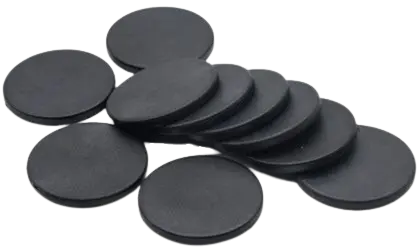
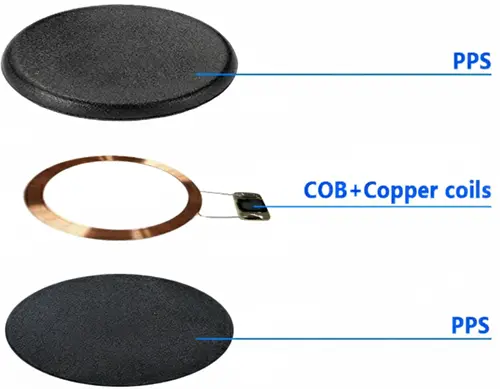
RFIDEcho’s PPS NFC Laundry Tag (No-Hole) is built for exactly this kind of workflow — a compact, durable HF tag for projects where individual-item confirmation, not bulk counting, is the requirement.
When a UHF RFID Laundry Tag Is the Right Call
UHF RFID takes over once the operation needs to count, sort, or reconcile garments in bulk rather than confirm them one at a time. Common cases:
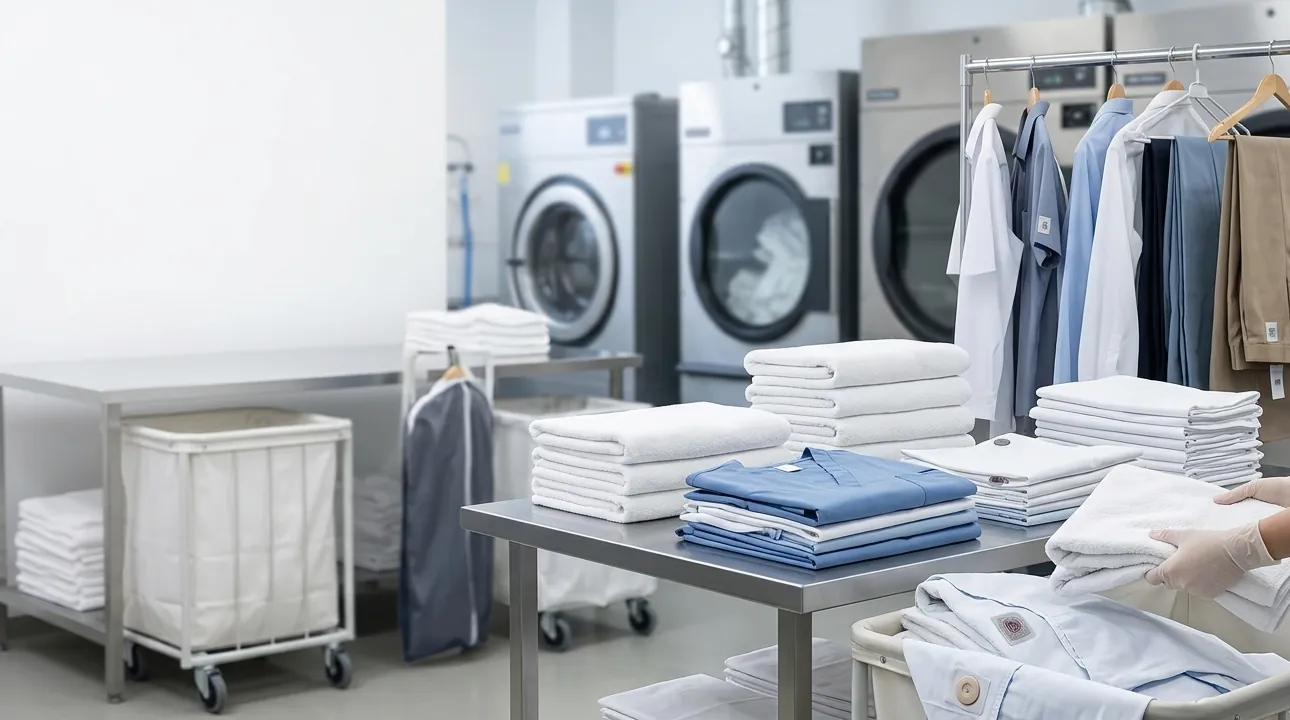
- Industrial and hospitality laundry throughput. A hotel or hospital processing hundreds or thousands of linen items per shift needs a tunnel or portal reader that counts an entire cart or conveyor load in seconds — tapping each item individually isn’t operationally viable at that volume.
- Loss and shrinkage reconciliation. Comparing what went out to the laundry against what came back requires reading full batches at each checkpoint, which is a bulk-read task by definition.
- Uniform and rental garment programs. Tracking hundreds or thousands of workwear items across wash cycles, issue/return events, and inventory counts is far faster with a UHF portal than with tap-based scanning.
- Hands-free, high-speed sorting. Automated sortation lines rely on UHF’s ability to read tags in motion at distance, something HF/NFC’s short range can’t support.
For these workflows, see RFIDEcho’s PPS RFID Laundry Button Tag, 2-Hole and Washable Textile RFID Laundry Tag, both built for UHF bulk-read laundry environments.
Durability: Both Need to Survive the Same Wash Environment
Frequency doesn’t change what the tag physically has to survive. Whether a garment carries an NFC badge or a UHF tag, it still goes through the same heat, detergent, agitation, and pressure exposure in an industrial wash — and the encapsulation has to be rated for that environment either way. A well-built NFC laundry tag and a well-built UHF laundry tag can both be rated for 200+ wash cycles; the frequency choice affects how the tag is read, not how tough its housing needs to be. For what a wash-cycle rating actually verifies and where laundry tags tend to fail first, see How RFID Laundry Tags Survive 200 Wash Cycles. If the same garments also go through steam sterilization, that’s a separate rating on top of wash resistance — see RFID Autoclave Tags: Buyer’s Guide.
Cost Considerations
NFC garment badges are often, though not always, cheaper per unit than UHF laundry tags, and the reader-side cost is usually much lower since many operations can start with existing smartphones instead of purchasing portal or handheld UHF readers. But total cost depends on volume: an operation processing thousands of items per day will spend far more in labor tapping each item individually than it would recover in lower per-tag cost, making UHF the cheaper choice at scale despite the higher tag and reader price. Get a quote matched to your actual volume and workflow through RFIDEcho’s custom RFID laundry care labels guide, which covers encoding, printing, and attachment options across both formats.
Can You Start With NFC and Move to UHF Later?
Yes, and it’s a common path for growing operations. A pilot program or single-location rollout often starts with NFC tags and a phone app to prove out the tracking workflow with minimal upfront investment. If volume grows to the point where tap-based scanning becomes a bottleneck, the operation can transition specific checkpoints — or the whole tagging program — to UHF RFID without changing the underlying garment identification concept, just the frequency and reader hardware. Some operations run both permanently: NFC badges at quality/inspection checkpoints where one-at-a-time confirmation adds value, and UHF tags for the bulk wash-cycle counting in between.
Quick Reference: Choosing Between NFC and UHF RFID
| Your situation | Recommended technology |
|---|---|
| Need to verify individual garments at inspection or quality checkpoints | NFC garment badge |
| Want consumers to tap their own phone against the product | NFC garment badge |
| Piloting a tracking program with no reader infrastructure yet | NFC garment badge |
| Counting hundreds or thousands of items per laundry cycle | UHF RFID laundry tag |
| Need hands-free reading through a portal, tunnel, or conveyor | UHF RFID laundry tag |
| Reconciling loss/shrinkage across large batches | UHF RFID laundry tag |
For a wash-cycle-rated tag matched to your specific reading requirement, browse RFIDEcho’s full RFID laundry tags range or see how tagging fits into a complete linen management program at RFID Laundry Management.
FAQ
Is an NFC garment badge the same thing as an RFID tag?
Yes, technically — NFC is a standard built on HF RFID (13.56 MHz). What matters for buyers isn’t NFC vs RFID as rival technologies, it’s read range and scanning method: NFC is short-range and one-at-a-time, while UHF RFID (860–960 MHz) is longer-range and built for bulk reading.
Can NFC tags be bulk-read like UHF RFID tags?
Not practically. NFC’s short read range (0–10 cm) means each tag must be tapped individually. UHF RFID tags can be read in batches of dozens to hundreds through a portal or tunnel reader — which is why high-volume laundry and sorting operations use UHF rather than NFC.
Do NFC laundry tags survive the same wash conditions as UHF RFID tags?
A properly constructed tag of either frequency can be rated for the same wash, heat, and pressure exposure — durability comes from the housing and encapsulation, not the radio frequency. Always confirm the specific wash-cycle, temperature, and pressure rating for the exact tag construction rather than assuming frequency implies durability.
Which is cheaper, NFC or UHF RFID?
NFC is usually cheaper upfront, since many workflows can use existing smartphones instead of dedicated UHF hardware. But at high item volumes, UHF’s bulk-read speed cuts labor cost enough to outweigh its higher per-tag and reader price, making UHF more cost-effective at scale.
Can I switch from NFC to UHF RFID after starting a pilot?
Yes. Many operations start with NFC tags for a low-cost pilot, then move to UHF RFID once volume justifies the reader infrastructure investment. Some keep both permanently, using NFC for individual-item checkpoints and UHF for bulk counting.