
“Rated for 200 wash cycles” is the single most common durability claim on an RFID laundry tag datasheet, and also the most misunderstood. It sounds like one number, but it’s actually shorthand for a bundle of separate tests — washing, drying, ironing, and pressure extraction — each with its own temperature, duration, and cycle count. A tag that survives 200 wash cycles but was never tested through a tunnel finisher or a hydraulic press can still fail in a real industrial laundry within a few weeks.
This guide breaks down what a wash-cycle rating actually verifies, why construction determines how a tag fails, and what to ask a supplier before you trust a “200 cycle” number on a spec sheet. If you are still scoping the wider system rather than a single spec line, start from the RFID for laundry and uniform rental guide or our RFID laundry management solution overview.
What a “200 Wash Cycle” Rating Actually Tests
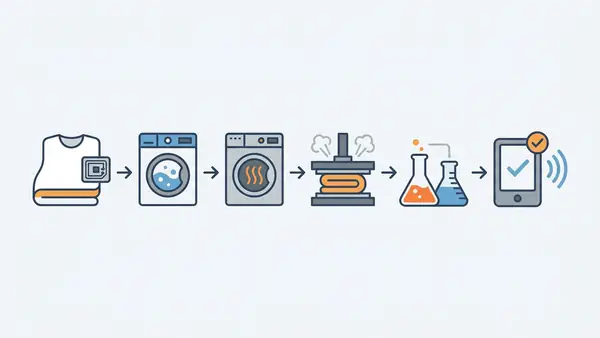
A real wash-cycle rating is not one pass/fail test. It’s a set of separate stress tests, each run for the stated number of cycles, because a tag can pass one and fail another:
| Test | What it measures | Typical spec on a rated laundry tag |
|---|---|---|
| Washing resistance | Heat + detergent + agitation exposure | ~100°C for 200 minutes total, up to 200 cycles |
| Dryer resistance | Sustained high heat exposure | ~180°C for 15 minutes, up to 200 cycles |
| Ironing / tunnel finishing resistance | Short, very high heat contact | ~210°C for 60 seconds, up to 200 cycles |
| Pressure / dewatering resistance | Mechanical crushing force during extraction | Up to 60 kg/cm² (or 60 bar on button-style tags) |
These numbers come from RFIDEcho’s own washable textile and PPS button laundry tag specifications. If a supplier only quotes “200 washes” without separate drying, ironing, and pressure numbers, ask for them — a tag that never goes through an industrial tunnel finisher or hydraulic extractor hasn’t actually been tested for a commercial laundry workflow.
Why “Washable” Isn’t the Same as “Laundry-Ready”
Consumer-grade “washable” electronics are usually rated for splash or immersion resistance at room temperature. Industrial laundry is a different environment entirely: sustained heat well above 90°C, alkaline detergents, mechanical agitation, high-pressure water extraction, and — for healthcare and hospitality back-of-house items — sometimes autoclave sterilization on top of normal washing. A tag needs to be built for that specific combination, not just “waterproof.”
For textiles that also go through steam sterilization, wash-cycle resistance and autoclave resistance are tested and rated separately — see RFID Autoclave Tags: Buyer’s Guide for how that additional rating works and why a 200-wash tag isn’t automatically autoclave-safe.
Construction Determines How (and Whether) a Tag Fails
Wash-cycle survival depends heavily on how the chip and antenna are encapsulated and attached. Three common laundry tag constructions handle 200-cycle environments differently:
| Construction | Typical rating | Where it tends to fail first | Best fit |
|---|---|---|---|
| Woven/textile laundry tag (e.g. Washable Textile RFID Laundry Tag) | 200+ wash cycles, 200°C+ short-term exposure | Stitching or heat-seal edge if installed with the wrong seam placement | Linen, sheets, towels, garments needing a soft, low-profile tag |
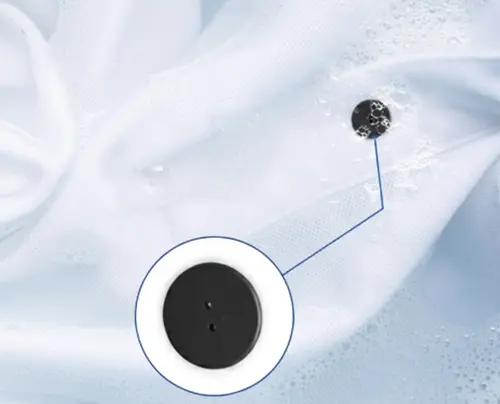
| PPS button tag (e.g. PPS RFID Laundry Button Tag, 2-Hole) | Up to 200 wash cycles, IP68, heat resistance to 220°C, pressure to 60 bar | Sewing thread wear at the anti-rotation holes if thread gauge is too light | Uniforms, workwear, rental garments needing rugged, tamper-resistant attachment |
| Silicone-encapsulated tag (e.g. Heat-Resistant Silicone RFID Laundry Tag) | Up to 200 wash cycles plus a separate autoclave rating (130°C / 5 min) | Rare — encapsulation is the most sealed of the three, but adhesive bonding at the sew line can loosen over time | Medical and hospitality items needing both wash and sterilization durability |
The common failure mode across all three isn’t the RFID chip itself — passive chips are extremely durable electrically. It’s almost always a mechanical or encapsulation failure: a cracked seal letting in moisture, a snapped antenna trace from repeated flexing at a fold line, or thread/adhesive fatigue at the attachment point.
The Failure Mode a Cycle Count Won’t Catch: Read-Range Drift
A tag can physically survive 200 washes and still be a practical failure if its read range quietly degrades before then. Repeated flexing and heat exposure can micro-fracture an antenna trace long before the encapsulation itself cracks, cutting read range from several meters down to a few centimeters without any visible damage. A wash-cycle rating that only reports “still functions” without a read-range or RSSI check at intervals (e.g., every 50 cycles) is an incomplete test.
When requesting test data from a supplier, ask specifically whether read range was measured at intervals throughout the cycle count, not just confirmed once at the end.
How to Verify a Supplier’s Wash-Cycle Claim
Before accepting a “200 cycle” rating at face value:
- Ask for the test protocol, not just the number. Request the temperature, duration, and detergent/chemical conditions used for washing, drying, and ironing — each tested separately.
- Ask whether pressure/dewatering resistance was tested. Many commercial laundries use hydraulic extraction between washing and drying; a tag that skips this test may fail in the exact step most laundries actually run.
- Ask if read range was checked at intervals, not just pass/fail at the end of the cycle count.
- Match the rating to your real chemical exposure. Confirm the test used detergents and alkalis comparable to what your laundry facility actually uses — bleach, disinfectants, and industrial alkalis vary in aggressiveness.
- Request physical samples and run your own pilot through your actual laundry equipment before bulk ordering. A tag rated for a generic 200-cycle lab test can still behave differently on your specific washer, extractor, and dryer settings.
For the fuller specification and RFQ checklist — encoding, printing, attachment method, and sizing — see Custom RFID Laundry Care Labels: Buyer’s Guide.
Wash-Cycle Rating Quick Reference
| Item | Confirmed spec (RFIDEcho laundry tags) |
|---|---|
| Wash cycles | Up to 200 (some constructions warrantied to 250) |
| Washing resistance | ~100°C, 200 minutes total exposure |
| Dryer resistance | ~180°C, 15 minutes |
| Ironing/tunnel resistance | ~210°C, 60 seconds |
| Pressure/dewatering resistance | Up to 60 kg/cm² (60 bar) |
| Operating temperature range | -25°C to +150°C (varies by construction) |
| Write cycles | 100,000 |
| Data retention | Up to 50 years |
For sample testing or a wash-cycle specification matched to your laundry environment, use RFIDEcho’s contact page with your textile type, wash conditions, and target cycle count. For the operational side — linen loss, PAR levels, and vendor reconciliation — see How RFID Cuts Hotel Linen Loss and Laundry Labor, and for the full product range, browse RFID laundry tags.
FAQ
How many times can an RFID laundry tag actually be washed?
Most industrial-grade RFID laundry tags are rated for up to 200 wash cycles, with some silicone and PPS constructions warrantied to 250 cycles depending on encapsulation. The real-world number depends on wash temperature, detergent chemistry, drying and ironing exposure, and pressure extraction — not washing alone.
Does a 200-wash rating include drying and ironing?
Not automatically. Washing, drying, ironing/tunnel finishing, and pressure/dewatering resistance are typically tested as separate specifications, even when they share the same cycle count. Always ask for all four numbers, not just the wash rating.
What usually fails first on an RFID laundry tag — the chip or the tag itself?
Almost always the physical construction, not the RFID chip. Common failure points are a cracked seal letting in moisture, a fractured antenna trace from repeated flexing, or thread or adhesive fatigue at the attachment point — not chip failure.
Can a wash-durable RFID tag also survive an autoclave?
Not automatically. Wash-cycle durability and autoclave (steam sterilization) durability are tested and rated separately. A tag rated for 200 washes needs a specific, separately confirmed autoclave rating before it’s used in a sterilization cycle — see RFID Autoclave Tags: Buyer’s Guide.
Which RFID laundry tag construction lasts longest?
There’s no single winner — it depends on the item. Woven textile tags suit soft linen and garments; PPS button tags suit rugged workwear needing IP68 and high pressure resistance; silicone tags suit medical and hospitality items that also need sterilization. Full comparison: Custom RFID Laundry Care Labels: Buyer’s Guide.