
“Which frequency should I use?” sounds like a single question, but it’s really three: how far does the tag need to be read from, how many tags need to be read at once, and does the tag need a battery. HF and UHF answer the first two differently, and active vs. passive answers the third — independently of frequency. Getting this wrong is the single most common reason a pilot underperforms, because range and read-style problems can’t be fixed later with a firmware update or a different antenna angle; they require a different tag.
HF vs. UHF: Read Range and Read Style
| HF / NFC (13.56 MHz) | UHF (860–960 MHz) | |
|---|---|---|
| Typical range | Centimeters to about 1 meter | Up to several meters |
| Read style | Deliberate, usually one tag at a time | Bulk — dozens to hundreds of tags in one pass |
| Line-of-sight sensitivity | Lower — tolerates close proximity to metal/liquid better | Higher — needs anti-metal or liquid-rated construction near those surfaces |
| Common hardware | Handheld readers, smartphone NFC, fixed short-range readers | Handheld readers, fixed portal/gate readers, conveyor-mounted readers |
The practical filter is read style, not raw range. If the workflow is “an operator taps or scans one specific item on purpose” — item authentication, a small pilot, a consumer-facing NFC tag someone scans with a phone — HF does the job and usually costs less per tag. If the workflow is “read everything passing through this doorway or sitting on this pallet without touching each item” — warehouse receiving, asset audits, retail inventory counts — UHF is the only band built for that, because HF’s short range makes bulk reads impractical at any real volume.
When HF Is the Right Choice
- Item-level authentication or serialization where a person or scanner deliberately reads one tag at a time
- Consumer-facing tags meant to be read by an ordinary smartphone’s NFC radio, with no dedicated RFID reader involved
- Small pilot programs validating a use case before committing to UHF infrastructure (portal readers, antennas, RF-surveyed read zones)
- Environments packed with metal or liquid at close range, where HF’s shorter range and different antenna behavior can be more forgiving than UHF without anti-metal construction
When UHF Is the Right Choice
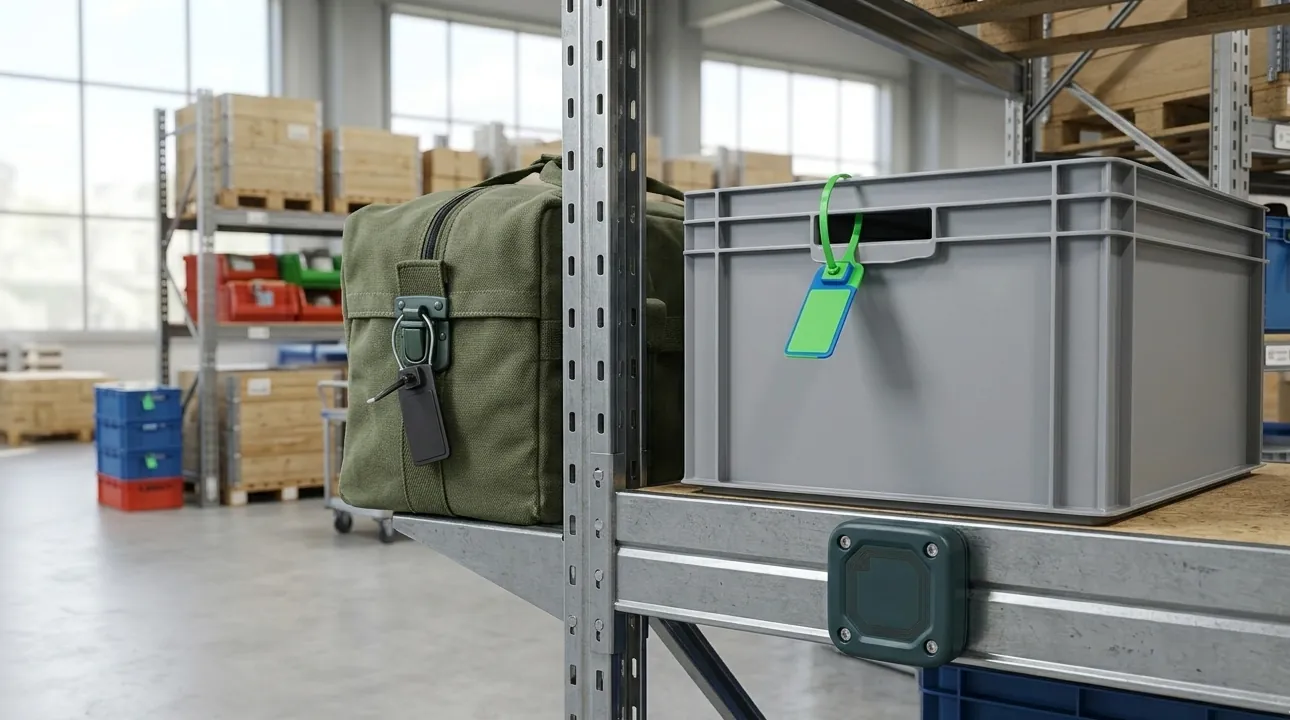
- Warehouse and logistics — reading a pallet or a rack of bins without unpacking them
- Asset and tool tracking — a portal or handheld sweep across a storage area or a job site
- Retail inventory counts — cycle counts across a sales floor in minutes instead of hours
- Any program past a handful of pilot units, where read speed and labor cost start to matter more than per-tag price
For the surface- and environment-specific construction that goes with a UHF tag (anti-metal, liquid-rated, high-heat), see the RFID tag spec sheet decoder.
Gen2v2 vs. “Gen2X”: What the Chip Generation Actually Means
Most UHF tags on the market run an EPC Gen2 chip, and buyers who dig into spec sheets run into two labels that get used inconsistently: Gen2v2 and “Gen2X.”
Gen2v2 is a real, standardized designation — it’s the ISO/IEC 18000-63 revision of the Gen2 air-interface protocol, and it adds capabilities the original Gen2v1 baseline didn’t have: an untraceability mode that lets a tag reduce what it reveals to unauthorized readers, file-based memory addressing, and additional access-control commands. If a spec sheet says Gen2v2, that’s a specific, checkable feature set.
“Gen2X” is not a standards-body term — you won’t find it in the ISO or GS1/EPCglobal specifications. It shows up as vendor marketing shorthand for chips that add manufacturer-specific extensions on top of a Gen2v2 baseline: extra memory banks, faster read rates, or proprietary security commands that don’t interoperate with other vendors’ readers or chips the same way. Two chips both marketed as “Gen2X” from different manufacturers are not necessarily comparable or interchangeable.
The practical takeaway: don’t buy on the generation label alone. Ask for the exact chip model and its datasheet, confirm which specific features you actually need (untraceability mode, a particular memory size, a specific access-control command), and verify those features are present — rather than assuming “newer-sounding generation” means “has the feature I want.”
Active vs. Passive: A Different Axis Than Frequency
Frequency and power source are two separate decisions that get conflated. Passive tags — the vast majority of HF and UHF tags, including everything in most industrial and retail deployments — have no battery; they draw power from the reader’s RF field, which is why their range is capped by reader power and antenna design. Active tags carry their own battery and broadcast on their own schedule, which enables longer range and continuous or periodic signal even when no reader is nearby — but at meaningfully higher cost per tag, a finite battery life, and physically larger form factors.
Active RFID (and battery-assisted variants) fits real-time location systems (RTLS) tracking a smaller number of high-value, mobile assets continuously across a large area — a use case closer to BLE or UWB tracking than to typical passive inventory or asset tagging. If the requirement is “know where this pallet, tool, or garment is when it passes a read point,” passive UHF is almost always the right and more economical answer; reserve active RFID for the narrower case of continuous, battery-powered location tracking on a limited set of assets.
Quick Reference: Matching the Combination to the Job
| Combination | Fits |
|---|---|
| Passive HF | Deliberate one-at-a-time reads, smartphone-readable tags, small pilots |
| Passive UHF | Bulk reads at volume — warehouse, retail, asset, and tool-tracking programs |
| Active (any frequency) | Continuous real-time location for a limited set of high-value mobile assets |
Once the frequency and power source are settled, chip/encoding, material, and cost follow from there — see the full RFID tag selection framework for the next steps, or go straight to custom RFID tags to start narrowing the spec with a supplier.
FAQ
Should I choose HF or UHF RFID?
Choose based on read style, not range alone. HF fits deliberate, one-at-a-time reads at close range. UHF fits bulk reads — dozens to hundreds of tags in one pass — which is what most warehouse, retail, and asset-tracking programs beyond a small pilot actually need.
What does Gen2v2 mean on an RFID chip spec sheet?
Gen2v2 is the ISO/IEC 18000-63 revision of the EPC Gen2 standard, adding features like an untraceability mode, file-based memory, and expanded access-control commands over the original Gen2v1 baseline.
Is “Gen2X” a real RFID standard?
No — it’s not a designation used by ISO or GS1/EPCglobal. It’s vendor marketing shorthand for chips with manufacturer-specific extensions beyond Gen2v2, and features vary between vendors, so always check the exact chip’s datasheet rather than the label.
When does active RFID make more sense than passive?
Active RFID fits continuous, real-time location tracking of a limited number of high-value mobile assets across a large area. For most inventory, asset, and tool-tracking programs where a read point (not continuous tracking) is enough, passive UHF is more economical.