Can You Encode a URL in a RAIN RFID Tag?
Yes, a URL can be encoded into a RAIN RFID tag if the selected chip has enough writable memory and the encoding workflow supports the chosen data format. But for most industrial, logistics, retail, and asset-tracking projects, storing the full URL directly on the tag is not the best design.
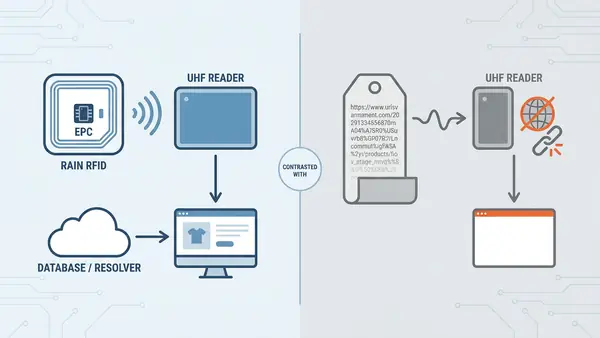
RAIN RFID is passive UHF RFID based on standards such as ISO/IEC 18000-63 and GS1 UHF Gen2. In normal use, a compatible UHF RFID reader captures a compact identifier from the tag, then the buyer’s database, middleware, or resolver uses that identifier to retrieve product, asset, shipment, or service information. This is different from NFC, where a phone can often read an NDEF URL record directly.
For RAIN RFID, the usual recommendation is simple: encode a unique identifier in the tag, then map that identifier to a URL or record outside the tag. A printed QR code can provide a phone-readable fallback, while the RAIN tag supports fast non-line-of-sight reads by compatible UHF RFID equipment.
If you are comparing data carriers for product pages, Digital Product Passport pilots, or consumer access, see RFIDEcho’s guide to RFID and NFC data carriers for digital product passports.
RAIN RFID Data Basics: EPC, User Memory, and URL Length
A RAIN RFID chip is organized into memory banks. The key ones for URL-connected tags are EPC/UII memory and user memory. EPC/UII memory is the primary identity field. User memory is optional and varies by chip.
Typical simple RAIN tags carry a 96-bit or 128-bit identifier. That is efficient for serialized IDs, but short for URLs. A 128-bit area equals 32 hexadecimal characters or only 16 ASCII characters. A full URL such as https://example.com/items/ABC123?batch=2026 can exceed that quickly, especially when reserved characters must be percent-encoded.
| Storage option | Best use | Buyer consideration |
|---|---|---|
| EPC/UII memory | Unique item, asset, carton, or product identifier | Best for fast reads and database lookup |
| User memory | Extra data such as lot, date, or short custom values | Requires a chip with enough memory and compatible encoding |
| Resolver database | URL, product page, service record, or DPP lookup | Easy to update without rewriting tags |
| Printed QR code | Smartphone-accessible URL fallback | Must be paired correctly with the same item ID |
The more data you store on the tag, the more you must consider read time, chip cost, verification, and future changes. If a URL changes after shipment, a direct URL stored in tag memory may require rewriting tags. If the tag stores an identifier, the URL mapping can be updated in the buyer’s database or resolver.
For broad tag selection across label, hard tag, anti-metal, seal, zip-tie, and laundry formats, RFIDEcho’s RFID tags page is the right starting point.
Standards-Based Numbering for URL-Connected RAIN Tags
URL-connected RAIN tags should still start with standards-based numbering. The tag is not just a place to store text; it is a machine-readable identity carrier that may enter warehouses, factories, retail stores, logistics hubs, repair centers, or recycling streams.
The RAIN Alliance explains that RAIN systems depend on ISO/IEC 18000-63 / GS1 UHF Gen2 technology and globally unique encoded identifiers. Without unique identifiers, tags can collide with other tag populations, create duplicate records, and add tag clutter to read zones.
GS1 EPC schemes such as SGTIN-96 or SGTIN-128 are common when items must align with trade-item or supply-chain identifiers. ISO numbering and RAIN CIN may fit other applications. GS1 also notes that an EPC can point to additional data in a database and can be converted into a URL using GS1 Digital Link, which is especially relevant when the buyer wants a web-connected identity rather than a raw URL on the tag. See GS1 RFID standards for the standards family behind EPC/RFID.
Avoid arbitrary duplicated IDs, raw SKU-only values, or simple incrementing numbers unless the application is truly closed and controlled. Even then, document the scheme so future batches do not collide.
Encoding Workflow: From Serialization File to Verified Tags
A reliable workflow starts before production. Prepare a serialization file that lists each EPC or UII value, the corresponding printed serial number, the QR code or URL fallback if used, and any user-memory data. Then define whether the tag should be locked, which memory areas remain writable, and what verification report is required.
A practical production sequence looks like this:
- Choose the tag format and chip memory based on the application surface, read range, environment, and data requirement.
- Confirm the numbering scheme, serial range, and URL or resolver mapping.
- Encode EPC/UII memory and user memory if required.
- Print human-readable text, logo, barcode, QR code, or visible serial number.
- Read back the RFID data and compare it with the print file or database.
- Void, reject, or rework failed tags.
- Lock memory only after verification, if locking is required.
- Pack tags by roll, carton, sequence, or project batch.
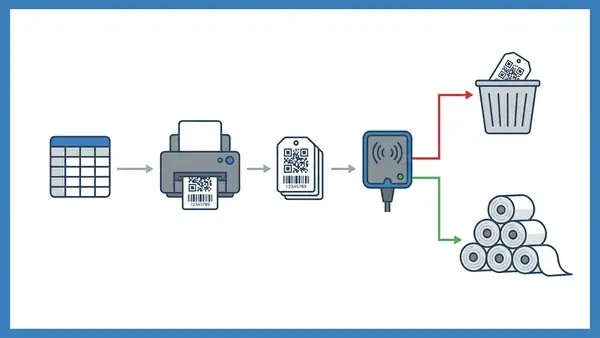
Small batches may be encoded with RFID printers. Higher-volume projects may use inline encoding or a factory encoding process. For related practical guidance, read RFIDEcho’s RAIN RFID tag encoding best practices.
Tag Selection Factors for URL and Resolver Workflows
The data plan affects the tag choice, but it is not the only factor. A URL-connected RAIN tag still has to perform on the real item.
For cartons, packaging, and general assets, a standard UHF label may be enough. For metal assets, tools, reusable containers, or equipment, an anti-metal construction may be required. For garments, laundry, seals, cables, or outdoor assets, the tag format, encapsulation, attachment method, and durability become just as important as memory.
Specify these details before asking for pricing:
- Application surface: cardboard, plastic, glass, metal, textile, cable, or mixed materials.
- Environment: indoor, outdoor, moisture, heat, chemicals, washing, UV exposure, or abrasion.
- Read target: close-range station read, portal read, handheld scan, or bulk inventory.
- Memory: EPC length, user memory, access password, and locking needs.
- Printing: visible serial, QR code, barcode, logo, and language requirements.
- Pairing: whether the printed QR, visible serial, and EPC must all map to the same record.
RFIDEcho can support tag material, chip, frequency, size, printing, encoding, numbering, color, and packaging options. The tags can work with compatible RFID readers and management software selected by the buyer or integrator. For serialized asset workflows, see RFID asset tracking tags.
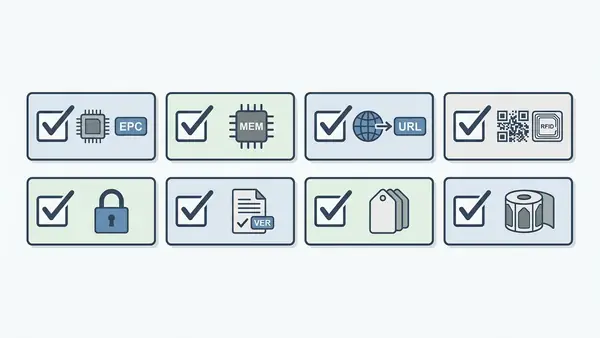
RFQ Checklist for URL Encoding in RAIN RFID Tags
Do not send an RFQ that only says “encode URL in RFID tag.” Use a checklist that separates the identity, URL mapping, memory, print, and verification requirements.
| RFQ area | What to specify |
|---|---|
| Numbering system | GS1 EPC, ISO/RAIN CIN, or controlled internal serialized format |
| EPC data | Prefix, serial range, sample values, hex/binary/ASCII expectations |
| URL mapping | Full URL, short URL, GS1 Digital Link, or buyer-owned resolver table |
| User memory | Whether extra data is needed, memory size, format, and update rules |
| Print pairing | QR code, barcode, visible serial, logo, and human-readable text |
| Locking | Access password, kill password, lock/permalock requirements |
| Verification | Read-after-write check, duplicate detection, print/RFID match report |
| Packaging | Roll direction, core size, sequence, carton labels, batch separation |
| Samples | Pre-production samples with test data and final material construction |
If you need factory-encoded RAIN RFID tags with printed QR codes or serialized packaging, contact RFIDEcho with your tag format, application surface, expected quantity, data structure, and sample records.
FAQ
Can a phone read a URL from a RAIN RFID tag?
Ordinary smartphones generally do not read UHF RAIN RFID tags directly. If phone access is required, add a printed QR code or use an NFC tag design. RAIN RFID is usually read by compatible UHF RFID readers.
Should the full URL go into EPC memory?
Usually no. EPC/UII memory should carry a compact, unique identifier. Use a database, resolver, or GS1 Digital Link workflow to connect that identifier to a URL.
Is EPC encoding enough for authentication?
Basic EPC encoding is identification, not strong authentication. If anti-counterfeit or tamper-resistant validation is required, discuss secure chip features and system-side validation with your technical team.
Can RFIDEcho encode tags before shipment?
Yes, RFIDEcho can support factory encoding and printing requirements for custom RFID tags, including serialized EPC values, visible numbering, barcode or QR printing, and packaging by sequence when the required data file and specifications are provided.