RAIN RFID tag encoding best practices start before any data is written to a chip. Buyers need to define the numbering standard, memory requirement, serialization rules, print data, and verification method before ordering tags, especially when labels or hard tags will be pre-encoded by a manufacturer.
Encoding mistakes show up later as read failures — duplicate EPCs, unreadable serials, tags that a partner’s system rejects. Memory capacity depends on the chip, so the encoding scheme and the physical tag have to be chosen together; see the full range of RFID tags for what each format can carry.
What RAIN RFID Tag Encoding Should Achieve
RAIN RFID encoding writes a meaningful identifier into the tag chip, normally in the EPC/UII memory bank. The goal is not simply to make the tag readable. The goal is to make every tag uniquely identifiable, compatible with the intended data standard, and usable by the buyer’s existing readers, software, or partner workflow.
Good encoding should answer four questions:
- What object does this tag identify?
- Is the number unique within the required business scope?
- Can other authorized systems interpret the number correctly?
- Does the physical tag have enough memory and performance for the application?
For example, a warehouse asset label may only need a unique asset ID in a closed internal workflow. A retail item, foodservice carton, or logistics unit may need a standards-based EPC so trading partners can interpret it without custom translation.
Use Standards-Based Numbering When Tags Leave a Closed System
Standards-based numbering is the safest default when RAIN RFID tags may move outside one controlled facility. The Impinj overview of standards-based numbering explains that non-standard data can create duplicate identifiers, unwanted reads, and tag clutter when multiple deployments overlap.
The practical decision path is:
| Situation | Numbering option to evaluate | Buyer note |
|---|---|---|
| Retail, foodservice, healthcare, or barcode-linked supply chain | GS1 EPC schemes such as SGTIN | Aligns RFID data with GTIN, barcode, and partner requirements. |
| Aviation, automotive, defense, or regulated industry ecosystem | Relevant ISO or industry-specific standard | Follow the standard required by the trading network or mandate. |
| Closed-loop asset tracking or internal logistics without a GS1/industry standard | RAIN Alliance ISO numbering with CIN | Provides a registered company prefix while allowing flexible internal serialization. |
| Purely internal prototype | Customer-defined encoding | Acceptable only when tags will not leak into shared read environments. |
The RAIN Alliance CIN guidance recommends using GS1 where applicable, checking ISO-based industry standards next, and using the RAIN Alliance ISO numbering system for other closed-loop or organization-specific use cases.
For buyers, the key point is simple: do not ask a tag supplier to encode “SKU + serial” or “starting at 000001” unless the format has been checked against the wider deployment context. A number that looks convenient in a spreadsheet may create collisions or decoding problems later.
Match the Encoding Scheme to Tag Memory and Serial Format
Memory choice is one of the most common sourcing mistakes. A low-cost chip may be fine for a 96-bit EPC but unsuitable for alphanumeric serials, leading zeros, additional data, or a lock policy that requires extra memory planning.
GS1’s serialization guidance for EPC on RAIN RFID tags notes that shorter binary schemes use fewer bits but restrict serial values. Longer schemes and newer TDS 2.x encodings support broader serial formats but require more memory.
| Requirement | Encoding implication | Tag buying impact |
|---|---|---|
| Numeric serial, no leading zeros, within 96-bit limit | SGTIN-96 or similar 96-bit scheme may work | Lower EPC memory can be acceptable. |
| Fixed-length serial with leading zeros | Avoid schemes that cannot preserve leading zeros | Specify longer or newer variable encoding. |
| Alphanumeric serials | 96-bit schemes may not be enough | Confirm EPC memory size before production. |
| Additional AIDC data after EPC | May need TDS 2.x variable encoding or User memory | Choose chip capacity based on full data map. |
| Batch, lot, expiry, or maintenance data on tag | May require User memory | Specify User memory capacity and encoding format. |
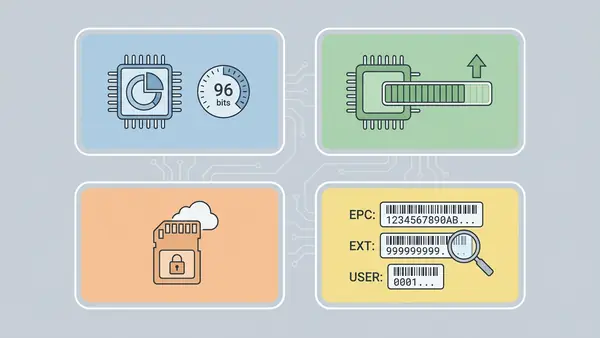
A useful rule is to treat the data plan as part of the tag specification. When sourcing RFID tags, define the EPC scheme, serial range, memory bank, and any User memory requirement before selecting the final chip.
Define the Encoding Process Before Tag Production
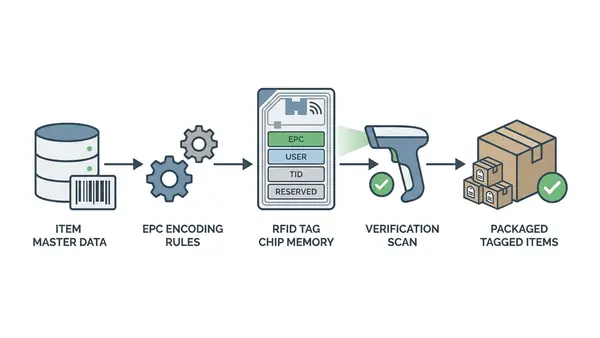
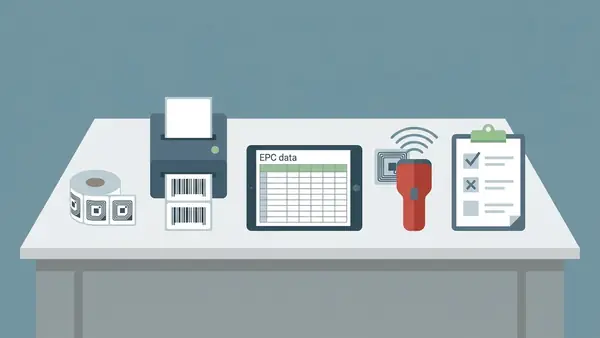
Encoding can happen at several points: in-house with an RFID printer, through a service bureau, by a label converter, or by the tag manufacturer before shipment. The right choice depends on volume, data control, error tolerance, and how tags will be applied.
| Encoding process | Best fit | Watch-outs |
|---|---|---|
| In-house RFID printer | Low-volume, frequent SKU changes, on-demand labels | Requires trained staff, data control, printer setup, and duplicate prevention. |
| Service bureau | Buyers without equipment who need printed and encoded labels | Confirm data security, sample approval, and verification reporting. |
| Manufacturer or converter pre-encoding | Planned production runs, source tagging, custom labels or hard tags | RFQ must define data file, serialization, print layout, and packaging sequence. |
| Inline high-volume encoding | Large-scale tag production with continuous verification | Setup only pays off when volume and quality requirements justify it. |
For custom orders, pre-encoded tags can reduce handling and prevent local printing errors. This is especially useful for serialized asset tags, logistics labels, sealed cable tie tags, or printable flexible on-metal UHF RFID tags where the printed label, encoded EPC, and physical material must match.
If the tag will be used on metal assets, the encoding plan should be paired with a suitable anti-metal construction such as RFID anti-metal tags. Encoding accuracy cannot compensate for a tag that detunes on the mounting surface.
Verify Encoded Tags Before Deployment
Verification should cover the data and the physical tag. A tag can look normal but contain the wrong EPC, a duplicate EPC, no data, or a damaged inlay. At high volume, those mistakes are expensive because they are usually discovered after labels are applied.
Ask for verification evidence before accepting a custom encoded order:
- EPC sample file or scan report from the production batch.
- Duplicate check across the ordered serial range.
- Confirmation of numbering standard and EPC scheme.
- Memory bank check: EPC/UII, TID reference, User memory if used.
- Printed text and barcode comparison against encoded data.
- Lock status and password policy, if requested.
- Failed-tag handling method: rejected, marked, replaced, or over-supplied.
- Roll, bag, or carton sequence that matches the data file.
For applications such as RFID asset tracking or RFID logistics tracking, also test the tag after it is attached to the real item. Metal, liquids, dense cartons, label adhesive, and orientation can change read performance.
Common Encoding Mistakes to Avoid
| Mistake | Why it causes trouble | Better practice |
|---|---|---|
| Encoding duplicate EPCs | Multiple items appear as one item in reads | Use controlled serial allocation and duplicate checks. |
| Treating ASCII text as a standard EPC | Other systems may not decode or filter it correctly | Use a defined EPC or ISO numbering scheme. |
| Stripping leading zeros | Changes the serial identity | Choose a scheme that preserves required serial format. |
| Buying too little memory | Data cannot fit or must be shortened later | Confirm EPC and User memory before ordering. |
| Encoding in the wrong memory bank | Readers or software may ignore the data | Put the primary identifier in EPC/UII unless the standard says otherwise. |
| Locking tags before final inspection | Errors become harder or impossible to correct | Verify first, then apply the agreed lock policy. |
| Mismatching print and EPC data | Barcode scans and RFID reads disagree | Generate print and EPC data from the same controlled source file. |
Security and privacy also matter. If tags are used in retail, consumer-facing products, or controlled assets, define whether EPC memory should remain writable, be password-protected, or be locked. Do not leave this decision to the last production step.
RFQ Checklist for Custom Encoded RAIN RFID Tags
A complete RFQ helps a supplier quote the right tag, chip, encoding process, and quality check. Include:
- Application: asset tracking, logistics, retail, laundry, tool control, animal identification, or another use case.
- Tag format: label, hard tag, anti-metal tag, cable tie tag, laundry tag, seal tag, or custom housing.
- Tagged item: material, size, surface, curvature, metal/liquid exposure, temperature, and cleaning conditions.
- Frequency region and target read distance.
- Chip preference or required EPC/User memory capacity.
- Numbering standard: GS1, RAIN CIN, ISO industry scheme, or approved internal format.
- EPC scheme and serial rules, including leading zeros or alphanumeric values.
- Data file format: CSV, Excel, JSON, or another agreed format.
- Print layout: logo, human-readable text, barcode, QR code, serial number, or color coding.
- Lock/password policy and whether User memory must be encoded.
- Verification report requirements and sample approval quantity.
- Packaging order: rolls, sheets, bags, cartons, serial sequence, or SKU grouping.
- Quantity, delivery schedule, and overage/replacement policy.
If you need custom encoded tags, contact RFIDEcho with the application, data format, and tag environment. RFIDEcho can help confirm tag material, chip, frequency, printing, encoding, numbering, and packaging options for compatible RFID readers and management software.
FAQ
Can I encode RAIN RFID tags with my own serial numbers?
Yes, but the serials should fit a defined numbering scheme. If tags may leave your facility or be read near other RFID deployments, use GS1, ISO, or RAIN CIN-based numbering rather than an informal proprietary pattern.
Is SGTIN-96 always enough?
No. SGTIN-96 is common and efficient, but it has serial restrictions. If you need leading zeros, alphanumeric serials, or extra data, confirm whether a longer or newer EPC encoding is required.
Should tags be locked after encoding?
Locking can protect data from accidental or unauthorized changes, but it should happen only after verification. Define who controls passwords and whether future rewriting is required.
Do I need User memory for RAIN RFID tag encoding?
Not always. The EPC memory bank usually stores the primary identifier. User memory is useful when the tag must carry extra data such as batch, maintenance, expiry, or process information, but it increases chip selection requirements.