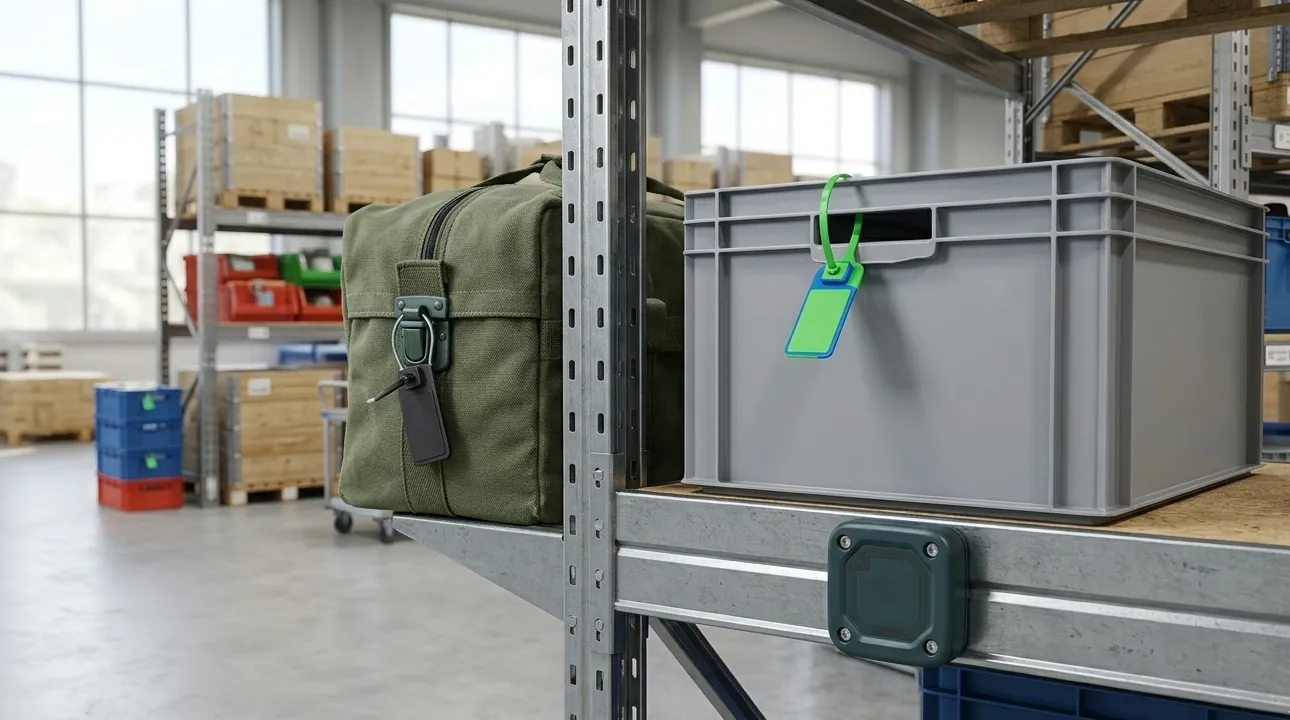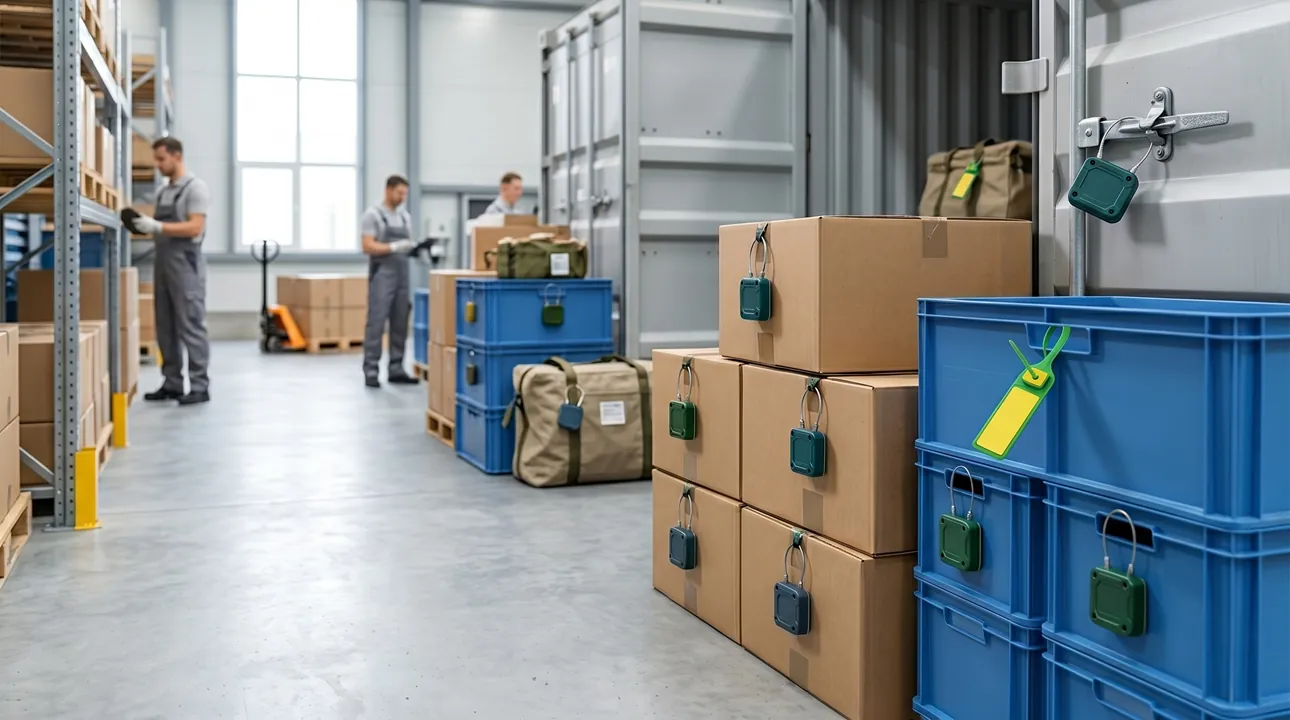

RFID tracking tags and RFID asset tags are not always two separate product categories. In most buying conversations, “asset tags” means a durable identity tag for a fixed or reusable asset, while “tracking tags” emphasizes movement, scan events, and status changes across locations.
That distinction matters because a supplier cannot recommend the right tag from the phrase alone. A laptop, steel tool, returnable tote, cable, security seal, and warehouse carton may all be “tracked,” but they need different tag formats, read ranges, attachment methods, and pilot tests.
This guide explains how to use both terms correctly when planning an RFID asset tracking project, choosing samples, or writing an RFQ.
RFID Tracking Tags vs RFID Asset Tags
Use this table to separate the procurement meaning from the operational meaning.
| Question | RFID asset tags | RFID tracking tags |
|---|---|---|
| Main meaning | Tags that give an asset a durable electronic identity | Tags used to capture movement, location, custody, or status events |
| Common object | Tools, IT assets, machines, fixtures, instruments, office equipment | Containers, totes, tools, inventory, vehicles, parcels, seals, equipment |
| Buyer intent | ”I need to identify and audit assets" | "I need to know where items move or when status changes” |
| Data focus | Asset ID, owner, department, serial number, maintenance record | Read event, zone, timestamp, process step, custody, exception status |
| Typical read workflow | Check-out, return, cycle count, audit, maintenance scan | Portal read, handheld sweep, transfer scan, receiving/shipping event, patrol point |
| Common tag format | Anti-metal tag, hard tag, flexible on-metal label, NFC label, zip-tie tag | UHF label, rugged tag, zip-tie tag, seal tag, anti-metal tag, item-level label |
| System dependency | Asset register, CMMS, ERP, tool-room or IT asset software | Reader zones, middleware filters, event logic, WMS, TMS, ERP, asset software |
| RFQ priority | Durability, attachment, surface material, printed ID, encoding sequence | Read point, read distance, movement speed, zone control, event accuracy |
In practice, many projects need both concepts. An RFID tag on a torque wrench is an asset tag because it identifies the tool. It is also a tracking tag when the system records that the wrench left the tool room, returned late, or moved to a job site.
For tools and equipment specifically, the related buying guide to RFID asset tracking for tools and equipment covers surface selection, tool-room workflows, and pilot tests in more depth. For cartons, store stock, and reusable inventory, the warehouse and retail guide to RFID inventory visibility explains read-zone planning and inventory tag mapping.
The Real Difference Is the Workflow
The words “tracking” and “asset” often describe the same physical RFID tag from different angles:
- Asset view: What object is this? Who owns it? What is its serial number, calibration due date, or assigned department?
- Tracking view: Where was it read? When did it move? Which process step, zone, reader, user, or exception is linked to the event?
That means the tag choice should start with the workflow, not the label on the product page. A small anti-metal tag may be perfect for identifying a steel tool during check-out, but it may not read far enough for a wide dock-door tracking event. A low-cost paper UHF label may work well on cartons moving through receiving, but it may fail quickly on reusable equipment exposed to impact, oil, or outdoor handling.
Scenario Map: Which Term Fits Your Project?
| Scenario | More useful term | Why |
|---|---|---|
| Tool crib, workshop, or maintenance room | RFID asset tags | The main challenge is durable identity on tools, kits, and equipment |
| Warehouse receiving and shipping | RFID tracking tags | The main challenge is capturing movement events through read zones |
| Retail item-level inventory | RFID tracking tags or RFID inventory tags | The program tracks item presence across sales floor, backroom, and fulfillment workflows |
| IT assets and office equipment | RFID asset tags | Laptops, monitors, servers, and fixed assets need serialized identity and audit records |
| Reusable totes, cages, pallets, and containers | RFID tracking tags | Movement, custody, and return loops are usually more important than static ownership |
| Security seals and tamper-evident closures | RFID tracking tags | The tag identifies the shipment or closure state and supports exception review |
| Calibration instruments and high-value equipment | RFID asset tags | Maintenance status, ownership, and audit trail usually drive the requirement |
| Cables, hoses, pipes, and irregular assets | RFID asset tags | Attachment method and readability on awkward surfaces are the first constraints |
If the item is a long-life object owned by your company, start your RFQ with “RFID asset tags.” If the item moves through process steps, customer sites, logistics lanes, or temporary custody, start with “RFID tracking tags” and describe the read events.
Decision Checklist: Which Do You Need?
Use this checklist before ordering samples.
| If your answer is yes… | Specify this first | Likely tag direction |
|---|---|---|
| Is the item metal, curved, oily, small, or high-impact? | Asset surface and attachment | Anti-metal RFID tag, hard tag, epoxy tag, ceramic tag, or flexible on-metal label |
| Does the item move through portals, docks, gates, or zones? | Read point and zone control | Passive UHF tracking tag tested in the intended read zone |
| Is the goal a room, rack, tool crib, or store-floor audit? | Handheld read distance and density | UHF asset tag or inventory tag with enough sensitivity for bulk counts |
| Is the workflow intentional one-at-a-time verification? | Close-range scan method | NFC, HF, or short-range UHF format with printed backup ID |
| Does the tag attach around a cable, handle, pipe, cage, or loop? | Mechanical attachment | RFID zip tie tag or cable-tie format |
| Does the item also need closure or tamper evidence? | Seal function and break strength | RFID seal tie tag or tamper-evident tag |
| Does the asset require human-readable audit support? | Printing and encoding | Printed serial number, barcode, QR code, logo, EPC, UID, or asset ID sequence |
| Will tags be installed across many sites or departments? | Packaging sequence | Tags packed by asset list, site, department, roll sequence, or installation batch |
A useful rule: if the main risk is the tag failing on the object, think like an asset-tag project. If the main risk is the system missing or misclassifying an event, think like a tracking-tag project.
Tag Format Mapping by Use Case
There is no universal RFID tracking tag or universal RFID asset tag. The same project may combine several formats.
| Use case | Typical RFID tag format | Selection notes |
|---|---|---|
| Metal tools, molds, fixtures, and machines | Anti-metal hard tag, PCB tag, ceramic tag, or flexible on-metal label | Direct metal mounting needs a tag designed for metal; standard labels usually lose range |
| IT assets, laptops, racks, and servers | Slim on-metal label, printable flexible tag, or compact hard tag | Needs readable identity without blocking vents, ports, labels, or service access |
| Toolboxes, bins, carts, and kits | Hard tag, UHF label, zip-tie tag, or on-metal tag depending on surface | The container may be tracked as one asset even when tools inside have separate tags |
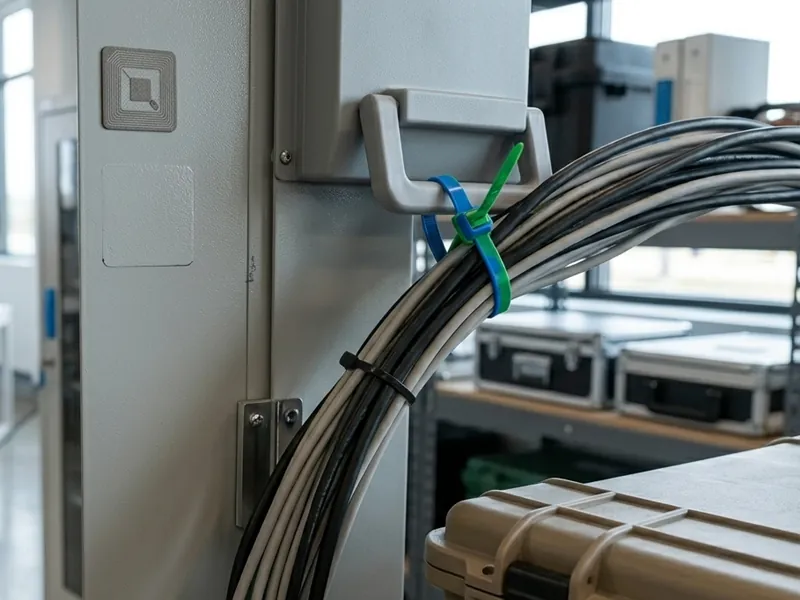
| Cables, hoses, pipes, cylinders, and handles | Zip-tie tag, wrap tag, or flexible label | Mechanical attachment is often more reliable than adhesive alone |
| Warehouse cartons and master cases | Printable UHF label | Cost and conversion speed matter for high-volume inventory flows |
| Reusable totes, cages, pallets, and RTIs | Rugged tag, zip-tie tag, seal tag, or hard label | Must survive repeated handling, nesting, forklift contact, and return cycles |
| Sealed bags, cages, and high-risk shipments | RFID seal tie tag | Combines electronic ID with physical closure control |
| Office furniture and non-metal fixed assets | Standard UHF label, NFC label, or printed asset label | Rugged construction may not be necessary if handling risk is low |
| Apparel, textiles, and uniforms | UHF hang tag, sewn-in tag, or laundry-resistant tag | Retail and textile workflows need brand, wash, or customer-handling considerations |
For mixed programs, ask suppliers to help build a tag map by object family. The deliverable should say which tag goes on which asset type, where it should be mounted, what is encoded, what is printed, and how pilot success will be measured.
UHF, HF, NFC, and Active Tracking: Avoid Mixing Concepts
Most searches for RFID tracking tags or RFID asset tags refer to passive RFID. Passive tags do not contain a battery and do not broadcast their location continuously. They create an identification event when read by a compatible reader.
| Technology | Best fit | Important limitation |
|---|---|---|
| Passive UHF RFID | Bulk reads, handheld sweeps, portals, warehouse movement, tool-room counts, item-level inventory | Read performance depends on tag placement, material, orientation, reader setup, and zone design |
| HF RFID | Close-range industrial or library-style workflows with existing HF readers | Shorter range than UHF and less suited to fast bulk counts |
| NFC | Smartphone tap workflows, service access, customer-facing or one-at-a-time verification | Not a bulk tracking method; normally requires intentional close-range tapping |
| Active RFID / BLE / UWB | Real-time location or continuous beacon-style tracking | Different hardware, battery maintenance, infrastructure, cost model, and software expectations |
If a buyer asks for “real-time RFID tracking tags,” clarify whether they mean passive RFID scan events or continuous RTLS-style location. Many asset tracking projects do not need continuous location. Tool rooms, warehouses, and retail stores often get enough value from check-out scans, handheld counts, portals, and exception reports.
What the Software Must Know
The RFID tag is only the data carrier. Tracking behavior comes from how the software interprets reads.
For an asset-tag workflow, software usually needs:
- Asset ID, EPC or UID, visible serial number, and ownership record
- Asset type, department, assigned user, site, room, or cost center
- Maintenance, inspection, calibration, or warranty fields
- Last seen location and audit history
For a tracking-tag workflow, software usually needs:
- Reader ID, antenna zone, timestamp, and process step
- Expected route, allowed zone, or handoff rule
- Duplicate-read filtering and exception logic
- Relationship to order, shipment, tote, container, SKU, or work order
This is why two identical tags can support different projects. The same UHF tag might be an asset tag in a tool register and a tracking tag in a logistics workflow. The difference is the object, read event, and software rule.
Pilot Test Matrix
Before bulk ordering, test the tag in the hardest real conditions.
| Test | Asset-tag question | Tracking-tag question |
|---|---|---|
| Mounting test | Does the tag stay attached to the actual asset surface? | Does the tag remain readable after movement, stacking, or handling? |
| Read range test | Can staff read the asset during the planned audit or check-out workflow? | Does the tag read at the intended portal, bench, gate, or handheld distance? |
| Orientation test | Does the tag read when the asset is rotated, hanging, stacked, or inside a kit? | Does movement direction or pallet/cart orientation create missed reads? |
| Neighbor test | Can the reader identify the intended asset without excessive stray reads? | Can the read zone capture the event without reading nearby zones? |
| Durability test | Does the tag survive impact, abrasion, oil, cleaning, heat, outdoor exposure, or handling? | Does repeated movement damage the tag, adhesive, or cable-tie closure? |
| Data test | Do printed numbers, barcodes, QR codes, EPCs, and asset-register fields match? | Do read events map correctly to the right process step, order, user, or location? |
| Packaging test | Are tags supplied in the same sequence as the installation list? | Are tags batched by site, lane, route, container group, or rollout wave? |
A pilot should include failure cases on purpose: direct metal, dense stacks, liquid products, curved assets, crowded shelves, moving carts, and real user handling. Passing only a clean desk test does not prove the deployment will work.
RFIDEcho Tag Directions
RFIDEcho supplies RFID tags and customization support. The reader, middleware, RTLS platform, WMS, ERP, asset management system, or integration layer is normally selected by the buyer, integrator, or solution provider.
| Project need | RFIDEcho tag direction |
|---|---|
| Durable identity for metal tools, machines, racks, or IT equipment | RFID anti-metal tags including PCB, ABS, epoxy, ceramic, flexible, and NFC on-metal options |
| Slim printed tags for IT assets or metal equipment | Printable flexible on-metal UHF RFID tags with custom size, printing, encoding, and packaging support |
| Cables, handles, reusable containers, cages, and irregular objects | RFID zip tie tags for non-adhesive attachment around loops or handles |
| Tamper-evident logistics, sealed bags, cages, or high-risk movement | RFID seal tie tags for identification plus closure control |
| Warehouse cartons, retail items, and inventory flows | Passive UHF labels or item-level tag formats with printing and encoding support |
| Mixed asset and tracking deployment | A mapped sample set by asset family, read workflow, environment, and encoding requirement |
For custom projects, contact RFIDEcho with photos, material details, mounting area, target read workflow, reader information, encoding format, printing artwork, sample quantity, and expected rollout volume.
RFQ Checklist: What to Tell a Supplier
A clear RFQ should explain both the object and the event. Include:
- Object list — tools, equipment, IT assets, cartons, totes, pallets, containers, cables, seals, retail items, or mixed assets.
- Surface and material — metal, plastic, rubber, cardboard, glass, liquid, fabric, painted surface, powder coating, or mixed materials.
- Photos and dimensions — especially mounting area, curve, available space, exposure points, and how items are stacked or handled.
- Read workflow — handheld audit, check-out station, receiving scan, dock-door portal, packing bench, gate, room sweep, smartphone tap, or maintenance scan.
- Target read distance — realistic range in the actual workflow, not only the longest possible lab read.
- Environment — indoor/outdoor, oil, coolant, washdown, dust, abrasion, impact, heat, cold, UV, chemicals, or customer handling.
- Attachment method — adhesive, screw, rivet, cable tie, seal, embedded mount, recessed mount, hang tag, or sewn-in placement.
- Data and printing — EPC, UID, asset ID, barcode, QR code, human-readable number, logo, department, site, batch, or route code.
- Reader and software details — reader model, frequency region, antenna type, existing asset system, WMS, ERP, or integration requirement if known.
- Pilot plan — sample quantity by object family, pass/fail criteria, test locations, difficult materials, and rollout timeline.
- Packaging sequence — whether tags should be delivered by asset list, department, site, route, roll number, or installation wave.
The more specific the workflow, the easier it is to avoid the wrong tag. “RFID tracking tags for assets” is a starting point. “Passive UHF anti-metal tags for steel tools, read by handheld readers during weekly audits and tool-room check-out” is a specification.
FAQ
Are RFID tracking tags and RFID asset tags the same thing?
They can be the same physical tag, but the terms emphasize different goals. RFID asset tags identify long-life assets such as tools, IT equipment, machines, or instruments. RFID tracking tags emphasize movement, location, custody, or status events. Many asset tracking systems use tags that do both.
Which RFID tag is best for asset tracking?
The best tag depends on the asset surface, read workflow, environment, and attachment method. Metal tools and equipment usually need anti-metal RFID tags. Cables or handles may need zip-tie tags. Office assets may only need standard labels or NFC tags. A pilot should test each asset family before bulk ordering.
Can passive RFID tracking tags show real-time location?
Passive RFID tags do not continuously transmit location by themselves. They create read events when a handheld, fixed, portal, or close-range reader scans them. Real-time location usually requires reader infrastructure and may use active RFID, BLE, UWB, or another RTLS technology depending on accuracy and cost requirements.
Should RFID asset tags use UHF or NFC?
Use UHF when the project needs longer read range, faster audits, bulk counts, portals, or handheld sweeps. Use NFC when the workflow is intentional one-at-a-time tapping with a smartphone or close-range reader, such as opening a maintenance record for one asset.
Do RFID asset tags need printed numbers or barcodes?
Often yes. Printed serial numbers, barcodes, QR codes, logos, or department codes give staff a visual backup when RFID scanning is unavailable or when an exception must be resolved manually. The printed data should match the encoded RFID sequence and the asset register.
What should I test before ordering RFID tracking tags in bulk?
Test final mounting, read distance, orientation, neighboring objects, movement speed, durability, printed and encoded data, and software event mapping. The pilot should use the actual object, actual reader, actual read zone, and the hardest materials in the deployment, not only a sample tag on a desk.