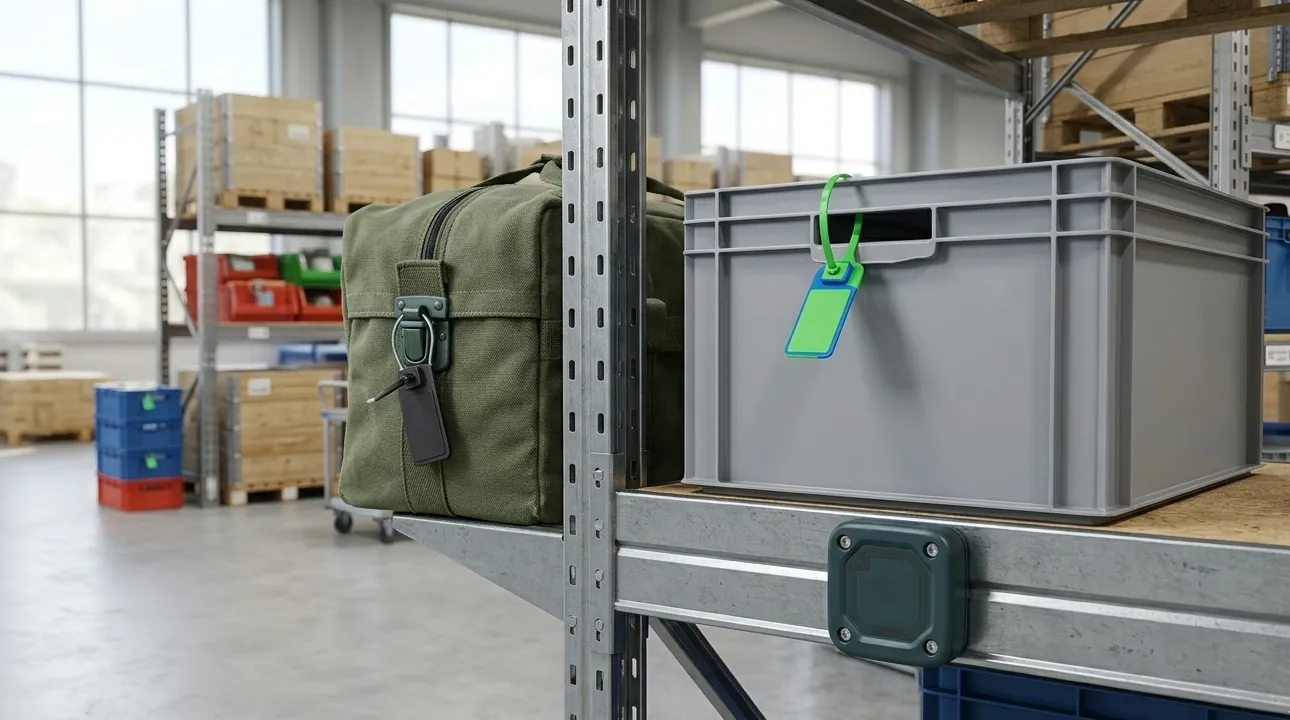

RFID for warehouse and retail inventory visibility is not only a reader or software decision. The visibility data starts at the tag. If RFID inventory tags are matched to the item, packaging, shelf environment, and scan workflow, warehouse and retail teams can count stock faster and find exceptions earlier. If the tag is wrong, the dashboard may look modern while the data remains incomplete.
This guide focuses on passive RFID tags for warehouse and retail inventory workflows: cartons, pallets, bins, reusable containers, apparel, packaged goods, store backrooms, sales floors, and inventory audit zones. It is written for buyers, integrators, and operations teams who need to specify tags before ordering samples or launching a pilot.
Start With the Visibility Gap, Not the Reader Demo
The best first question is not “which reader has the longest range?” It is “where does inventory visibility break today?” The answer determines what should be tagged and how the tag must perform.
| Visibility gap | Typical location | What RFID must prove |
|---|---|---|
| Inbound quantity mismatch | Receiving dock, staging lane, cross-dock area | Tagged cartons, pallets, or items can be read before stock enters the system |
| Put-away delay | Warehouse aisles, rack locations, backroom shelves | Stock identity can be captured when items move to storage or replenishment zones |
| Slow cycle counts | Aisles, bins, retail sales floor, stockroom | Workers can read many items without scanning every barcode one by one |
| Pick or shipment exception | Picking cart, packing bench, dock door, outbound pallet | The right SKU, carton, or item is confirmed before shipping |
| Store stockout with stock on hand | Backroom, sales floor, fitting room, display area | Item-level inventory can be counted often enough to expose location errors |
| Reusable container loss | Returnable bins, totes, cages, pallets, carts | Durable tags survive repeated handling and support check-in/check-out events |
A general article about RFID inventory management efficiency explains why RFID can reduce manual scanning. This guide goes one level deeper: how to choose RFID inventory tags and read zones for warehouse and retail visibility. If the same program also tracks tools, IT assets, or equipment, see the related guide to RFID asset tracking for tools and equipment.
RFID Inventory Tags: Match the Tag to the Object
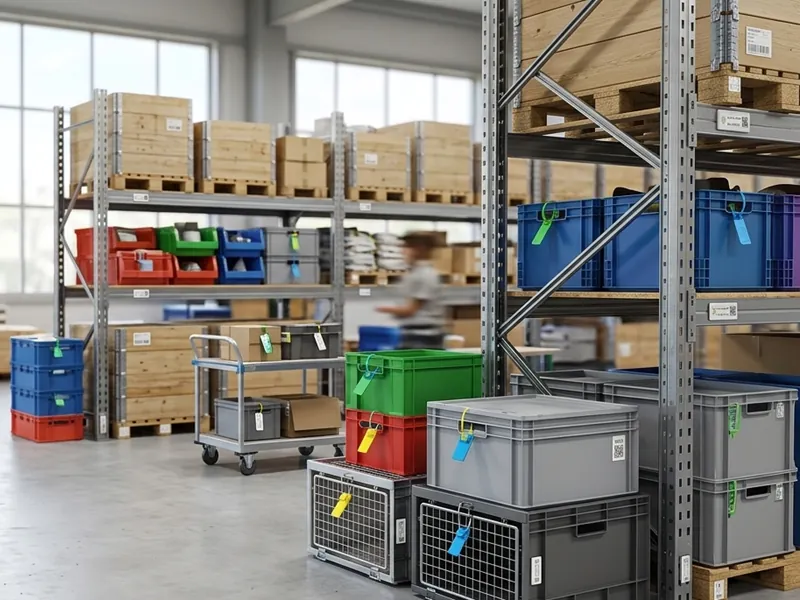
RFID inventory tags can be paper labels, synthetic labels, hang tags, on-metal labels, hard tags, laundry tags, cable-tie tags, or seal tags. A warehouse or retail program often needs more than one format because products, cartons, shelves, and reusable assets behave differently.
| Inventory object | Common RFID tag direction | Why it matters |
|---|---|---|
| Corrugated cartons and master cases | Printable passive UHF label | Cost-effective for high-volume carton reads at receiving, picking, and shipping |
| Retail apparel and soft goods | UHF hang tag, care label, or sewn-in tag | Supports item-level counts on racks, shelves, fitting rooms, and backrooms |
| Plastic bins, totes, and reusable containers | Adhesive label, rugged tag, or cable-tie tag | Needs repeated handling durability and stable attachment |
| Pallets and returnable transport items | UHF label, rugged tag, or seal tag | Must survive forklift handling, stacking, and dock-door reads |
| Metal racks, cages, tools, or fixtures | Anti-metal RFID tag or on-metal label | Standard labels may lose read range when mounted directly on metal |
| Bottles, liquids, cosmetics, and dense products | Tuned UHF label tested near liquid or dense material | Liquids and dense product stacks can absorb or detune RF energy |
| Cables, pipes, handles, and irregular assets | RFID zip tie tag | Attachment around the object may be more reliable than adhesive |
| Sealed bags, cages, or high-risk shipments | RFID seal tie tag | Combines identification with tamper-evident closure |
For warehouse and retail visibility, passive UHF is usually the first technology to evaluate because it supports longer read range and bulk reads. HF or NFC may still be useful for intentional close-range checks, customer engagement, or service workflows, but most inventory visibility projects need the speed of UHF.
Warehouse Workflows: Where the Read Event Happens
A tag specification should name the read event. “We need RFID inventory tags” is too broad. “We need to identify cartons at receiving with a handheld reader from 1.5 meters” or “we need to read item-level apparel on store racks during cycle counts” is much more actionable.
Receiving and inbound verification
Receiving is often the first warehouse read point because it connects supplier shipments to inventory records. Tags may be applied by the supplier, at the distribution center, or during repacking. The tag should be visible to the RF field before the carton is stacked too densely or wrapped in materials that block reads.
For receiving workflows, test:
- Whether the carton label reads while cartons are on a pallet, cart, or conveyor
- Whether mixed SKUs can be separated without too many stray reads
- Whether the printed barcode and human-readable ID match the encoded EPC
- Whether the tag still reads after shipping abrasion, stretch wrap, or corner damage
Put-away and location movement
RFID can support better visibility only if stock movement is captured at the right points. Some operations scan items when they enter a storage zone. Others perform more frequent cycle counts and reconcile location later. Tag placement should support the expected motion: carried by hand, moved on carts, stacked in bins, placed on shelves, or lifted by forklift.
Cycle counts and audits
Cycle counts are where RFID often creates the clearest labor benefit. A worker can move through an aisle, stockroom, or retail floor with a handheld reader and capture many tags without touching every item. The tag must still be readable in the real density: folded apparel, stacked cartons, bins full of products, or shelves with mixed materials.
Picking, packing, and shipping
Outbound visibility is about reducing exceptions. RFID can confirm that the right tagged carton, tote, item, or pallet is present before it leaves. For packing benches and dock doors, the read zone must be controlled carefully. Too much power can capture neighboring items; too little power can miss items inside the intended zone.
The RFID warehouse management solution page gives the broader workflow context. Tag selection should be planned together with read-zone design, not after software and readers are already selected.
Retail Workflows: Item-Level Visibility Has Different Pressure
Retail inventory visibility often depends on item-level tags, especially for apparel, footwear, accessories, cosmetics, electronics, and high-value goods. The business problem may be stock accuracy, replenishment, omnichannel fulfillment, shrink review, or faster store audits.
| Retail workflow | Tag requirement | Practical note |
|---|---|---|
| Sales-floor cycle count | Item-level UHF tag or hang tag with stable orientation | Test reads on racks, shelves, folded stacks, and display fixtures |
| Backroom replenishment | Item-level or carton-level tag depending on process | Decide whether the system must know item location or only stock quantity |
| Fitting room and display movement | Item-level tag with durable attachment | Tag position should survive customer handling and store operations |
| Omnichannel pick from store | Accurate item identity plus barcode fallback | Staff still need visual backup when resolving exceptions |
| Returns and reverse logistics | Tag survives customer handling and repackaging | Confirm whether the tag remains attached after sale or is removed at checkout |
| High-risk goods | Durable label, concealed tag, or tamper-evident format | Balance loss-prevention value with packaging and customer experience |
Retail has a different constraint than many warehouses: the tag may be visible to shoppers, touch product packaging, or become part of brand presentation. The tag must be operationally useful and commercially acceptable. For some items, a printed hang tag is ideal. For others, a small label, sewn-in textile tag, or packaging-integrated inlay is better.
Read-Zone Planning Matrix
The unique element for many failed pilots is not the tag datasheet; it is the read zone. A tag that reads well on a table can fail in a busy receiving dock or retail stockroom if the read zone is undefined.
Use this matrix before choosing samples:
| Read zone | Reader style | Tag implication | Main failure to test |
|---|---|---|---|
| Handheld aisle sweep | Handheld UHF reader | Tags need enough sensitivity for variable angles and worker movement | Missed reads in dense shelves or folded stacks |
| Receiving bench | Fixed or handheld close-range reader | Tags should read reliably at short to medium range without cross-reading nearby stock | Duplicate or neighbor reads from staging lanes |
| Dock door / portal | Fixed reader and antennas | Tags must read while moving through the portal, often on pallets or carts | Missed reads due to speed, orientation, stretch wrap, or liquids |
| Retail sales floor | Handheld reader | Item-level tags must survive customer handling and mixed display conditions | Weak reads from racks, metal fixtures, or tag orientation |
| Packing station | Fixed reader, antenna mat, or handheld | Tags may need controlled short-range performance | Reading items outside the current order |
| Reusable container return point | Fixed or handheld reader | Rugged, cable-tie, seal, or hard tags may be needed | Tag damage, detachment, or duplicate reads from nested containers |
This matrix helps procurement teams avoid overbuying long-range tags where controlled short-range reads are safer, and underbuying weak labels where bulk reads are required.
Tag Placement Rules for Better Inventory Visibility
Placement matters as much as the chip. RFID tags are antennas, so the object around the tag changes performance.
Use these practical rules:
- Keep standard labels away from direct metal contact. If the item, fixture, cage, or returnable asset is metal, start with on-metal testing or an anti-metal construction.
- Avoid liquid-dense zones when possible. Products with liquid, foil, or dense contents should be tested in real packaging and stack patterns.
- Choose a repeatable placement location. If every tag is placed in a different position, read performance becomes harder to predict.
- Protect the tag from abrasion and handling. Carton corners, pallet edges, forklift contact, and customer handling can damage labels.
- Plan for visual backup. Printed text, barcode, QR code, or SKU information helps workers resolve exceptions when RFID is not enough.
- Test in final density. A single tagged item on a table is not the same as 80 tagged items in a tote or 300 garments on racks.
For mixed programs that include fixed assets, reusable tools, IT equipment, and inventory, combine warehouse tagging with RFID asset tracking rules so each asset family gets the correct format.
Pilot Test Plan for Warehouse and Retail RFID Tags
A good pilot proves visibility in the actual workflow, not only tag readability in isolation.
| Pilot step | Pass/fail question |
|---|---|
| Object test | Does the tag read on the actual carton, item, package, tote, rack, or pallet? |
| Placement test | Does the chosen tag position stay readable after handling, stacking, and movement? |
| Density test | Does it work when items are packed, folded, stacked, hung, nested, or wrapped? |
| Read-zone test | Does the reader capture the intended zone without excessive neighbor reads? |
| Movement test | Does the tag read while cartons, pallets, or items move at the expected speed? |
| Exception test | Can staff resolve missed reads, duplicate reads, and barcode/RFID mismatches? |
| Data test | Do EPC values, SKU records, printed IDs, barcodes, and software fields match? |
| Durability test | Does the tag survive shipping, shelving, customer handling, cleaning, or reuse cycles? |
| Packaging test | Are tags supplied in the right roll, sheet, sequence, or batch for installation? |
For a first pilot, include both easy and difficult items: standard cartons, dense cartons, liquid products, metal fixtures, retail display items, reusable totes, and high-value goods. The goal is to create a tag map, not force one tag to solve every inventory problem.
RFIDEcho Tag Directions for Inventory Visibility
RFIDEcho supplies RFID tags and customization support for warehouse and retail projects. The reader, middleware, and inventory software are normally selected by the buyer, integrator, or solution provider.
| Need | RFIDEcho tag direction |
|---|---|
| High-volume cartons, retail items, and general inventory | Passive UHF RFID labels with printing, encoding, numbering, and packaging options |
| Metal racks, cages, tools, or reusable assets | RFID anti-metal tags or printable on-metal label formats |
| Reusable bins, totes, cable assets, handles, or irregular objects | RFID zip tie tags or rugged attachment formats |
| Tamper-evident bags, cages, containers, or logistics flows | RFID seal tie tags for identification plus closure control |
| Apparel, textiles, uniforms, and washable inventory | Textile or PPS-style RFID laundry tags where washing or heat exposure is part of the workflow |
| Mixed warehouse and retail rollout | A mapped combination of labels, on-metal tags, rugged tags, and special attachment formats by object family |
The most useful output from a supplier discussion is often a sample plan: which tag formats to test on which objects, how they should be encoded, what should be printed, and how pilot results will be judged.
RFQ Checklist for RFID Inventory Tags
When requesting samples or a quote, include enough operational detail for the supplier to recommend the correct tag construction.
Include the following:
- Inventory object list — cartons, pallets, bins, retail items, apparel, bottles, reusable containers, cages, fixtures, or mixed assets.
- Photos and dimensions — item size, packaging material, mounting area, curve, label location, and stacking method.
- Material and contents — cardboard, plastic, metal, foil, liquid, powder, dense goods, textiles, or mixed materials.
- Read workflow — handheld cycle count, receiving scan, dock-door portal, packing bench, retail floor count, or backroom audit.
- Target read distance — realistic range for the actual workflow, not only the maximum lab range.
- Read-zone limits — whether nearby items should be ignored, and how close neighboring stock may be.
- Environment — indoor/outdoor, temperature, humidity, dust, abrasion, customer handling, cleaning, or reuse cycles.
- Attachment method — adhesive label, hang tag, sewn-in tag, cable tie, screw, rivet, embedded tag, or seal closure.
- Data format — EPC, SKU relationship, serialized ID, barcode, QR code, human-readable number, department, or batch code.
- Reader details — handheld/fixed reader model, antenna type, region, power limits, or software requirement if known.
- Quantity and rollout plan — sample quantity by object family, pilot size, expected bulk volume, and delivery schedule.
- Packaging sequence — roll size, core size, sheet format, bag count, encoded sequence, or packing by store/site/department.
For custom warehouse or retail projects, contact RFIDEcho with photos, target workflows, reader information, sample quantities, and any printing or encoding files. If your program also includes fixed assets, tools, totes, or reusable equipment, the guide to RFID tracking tags vs asset tags can help separate asset identity requirements from movement-event tracking requirements. A short video of the real scan workflow can also help narrow the sample list.
FAQ
Can RFID be used for inventory management?
Yes. RFID is widely used for inventory management because tags can be read without line of sight and hundreds of items can be counted in one pass. It suits receiving, put-away, cycle counts, picking, and store replenishment where manual or barcode counting is too slow.
How do you use RFID tags for inventory?
Tag each item, carton, or pallet with an encoded RFID label, then read tags at defined points: receiving, put-away, cycle counts, picking, and dispatch. A handheld or fixed reader captures the identifiers and passes them to inventory software, which updates stock records automatically.
What is an RFID tag for inventory tracking?
An RFID inventory tag is a label or hard tag containing a chip and antenna, encoded with a unique identifier that maps to a SKU, batch, or location in inventory software. Passive UHF tags are the usual choice because they need no battery.
What RFID tags are best for warehouse inventory visibility?
Passive UHF RFID labels are usually the best starting point for cartons, pallets, bins, and general warehouse inventory because they support bulk reading and longer read range. If the item is metal, reusable, outdoor, high-impact, or irregularly shaped, an anti-metal, rugged, zip-tie, or seal tag may be more reliable.
Is RFID better for warehouses or retail stores?
RFID can help both, but the workflow is different. Warehouses often focus on receiving, put-away, cycle counts, picking, packing, and shipping. Retail stores often focus on item-level counts, backroom-to-sales-floor replenishment, omnichannel fulfillment, and shrink review. The tag format should follow the workflow.
Can one RFID inventory tag work for every product?
Usually no. A flat UHF label may work well on cartons but fail on metal racks, liquid products, reusable totes, or washable textiles. A pilot should map tag format by object family so the deployment does not depend on one universal tag.
Do RFID inventory tags need barcodes too?
Often yes. A printed barcode, QR code, SKU, or human-readable serial number gives workers a backup when RFID is not available, when an exception must be resolved visually, or when existing barcode workflows remain in use.
Why do RFID tags miss reads in warehouses or stores?
Common causes include metal, liquids, dense stacking, poor tag placement, weak attachment, reader power settings, antenna orientation, undefined read zones, and software filtering rules. Testing must use the real item, real density, and real scan workflow.
What information should be encoded on RFID inventory tags?
Most UHF inventory workflows encode a unique EPC or serialized identifier that maps to SKU, batch, location, or asset data in software. The exact format depends on the inventory system, GS1/EPC requirements, customer mandate, and whether printed labels must match the encoded sequence.