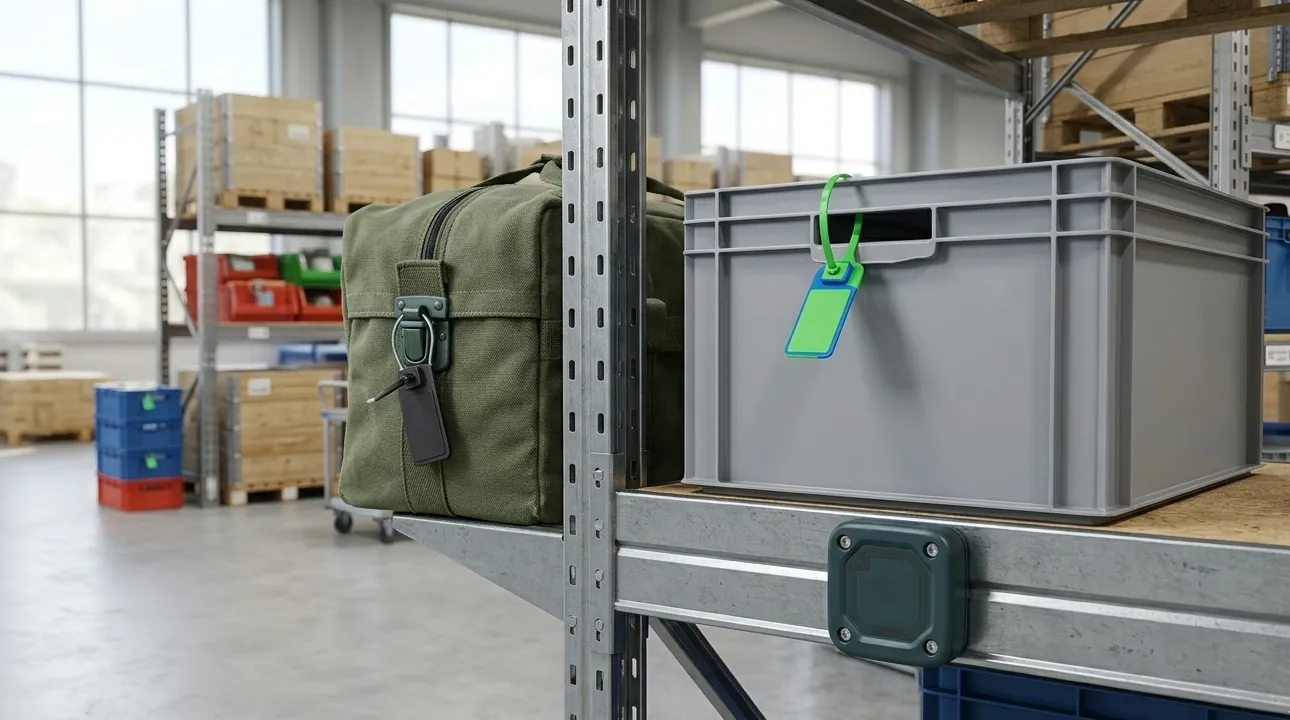
A Digital Product Passport depends on a small but critical physical link: the data carrier on the product, packaging, or document. For buyers specifying RFID, NFC, QR, or hybrid labels, the right choice is not simply the cheapest label or the newest chip. It is the carrier that can keep the product identity readable through the product’s real lifecycle.
Once the carrier type is decided, the remaining work is a tag specification — chip, memory, material, encoding, and printing. Those options are covered on our custom RFID tag page.
What a DPP Data Carrier Must Do
A Digital Product Passport data carrier is the machine-readable bridge between a physical item and its digital product record. Under the EU Ecodesign for Sustainable Products Regulation, a data carrier can include a linear barcode, two-dimensional symbol, or another automatic identification data capture medium readable by a device. In practice, buyers usually compare QR codes, NFC tags, RAIN RFID/UHF RFID tags, barcodes, and hybrid labels.
The carrier normally does not need to store the full passport. It often stores or points to a persistent identifier, URL, or GS1 Digital Link that resolves to product data in a brand, supply-chain, or compliance platform chosen by the buyer.
For tag sourcing, the carrier must identify the right item, remain readable in the expected environment, support the intended user, and match the data system so printed codes, NFC content, RFID EPCs, and encoded URLs do not conflict with the DPP record. Getting that data layer right depends on a disciplined EPC and serialization scheme — see RAIN RFID tag encoding best practices.
For the regulatory baseline, buyers should read the official EU Ecodesign for Sustainable Products Regulation and then check the delegated rules for their specific product category.
RFID, NFC, QR, or Hybrid: Which Carrier Fits the Product?
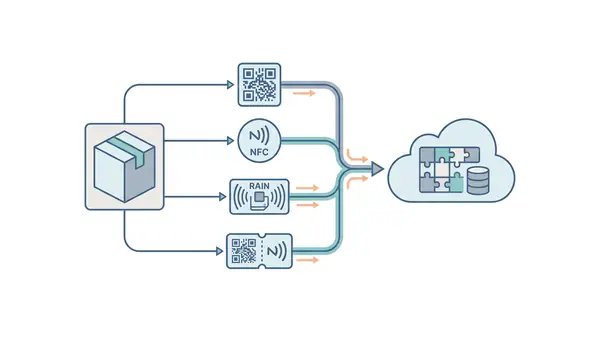
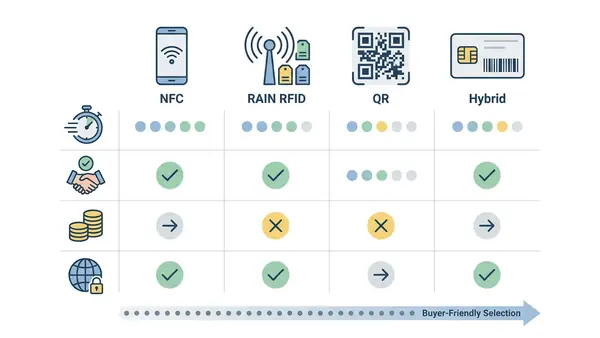
The best DPP carrier depends on access method, durability, automation needs, security requirements, and cost. QR codes are often the easiest starting point because they are inexpensive to print and can be scanned by almost any smartphone. NFC tags are useful when the DPP access point should be embedded, tap-readable, or harder to replace with a fraudulent sticker. RAIN RFID is strongest when the product must be identified automatically across operations, not only by one consumer scan.
| Carrier type | Best fit | Strengths | Watchouts |
|---|---|---|---|
| QR code | Low-cost consumer access, packaging, hangtags, documents | Universal camera access, simple printing, low unit cost | Needs line of sight, visible contrast, physical access, and protection from scratches or replacement |
| NFC tag | Tap access, product-integrated identity, authentication, premium goods | Smartphone tap experience, can be embedded, supports NDEF, locking, privacy, and authentication options | Requires correct chip, antenna, placement, and testing on the product material |
| RAIN RFID / UHF RFID | Item-level logistics, inventory, sorting, reuse, recycling | Bulk reads, non-line-of-sight identification, operational visibility | Most consumers cannot read UHF tags with standard phones; reader infrastructure is needed |
| Hybrid label | Consumer access plus supply-chain automation | Combines printed QR, NFC, and/or RAIN RFID in one identity strategy | Requires careful serialization and verification so all carriers resolve to the same item record |
A buyer choosing between these options should start from the workflow, not from the technology. QR may be enough for short-life packaging. NFC fits reusable assets, garments, tools, or premium products that need a long-term embedded access point. RAIN RFID fits lifecycle visibility through manufacturing, warehousing, retail, repair, or end-of-life sorting.
Many DPP projects use a hybrid approach: QR or NFC for people, and RAIN RFID for automated operations. Buyers can review RFIDEcho RFID tags to compare physical formats before narrowing chip and encoding requirements.
Choose NFC When Consumer Access and Product Experience Matter
NFC is often the best DPP data carrier when the user should tap the product with a common smartphone. It is well suited to apparel, accessories, electronics, cosmetics, tools, furniture, reusable packaging, and other products where the access point should stay with the item rather than only with disposable packaging.
Compared with a printed QR code, NFC does not need camera alignment, lighting, or visible contrast. A tag can sit under a label, inside a product area, behind a badge, or in a more durable construction.
NFC also helps when the DPP carrier needs more trust than a printed code. Depending on the chip family, NFC tags can support NDEF records, URL redirection, locking, privacy features, tamper evidence, or authentication. The NFC Forum sustainability data management work shows why NFC is being treated as more than a convenience feature for product passports.
NFC is not automatically correct for every surface. Metal, liquid, carbon fiber, very small tag size, and poor antenna placement can reduce read performance. For metal housings, batteries, tools, or electronics, an anti-metal NFC construction may be required; RFIDEcho’s custom NFC anti-metal tag page shows the type of format buyers may need to discuss in an RFQ.
Choose RAIN RFID When Operations Need Item-Level Visibility
RAIN RFID, also called UHF RFID in many sourcing discussions, is the better DPP carrier when the passport must connect to operational events. It allows tagged items to be read without line of sight and, depending on the environment and reader setup, many items can be identified quickly in bulk.
This makes RAIN RFID valuable for DPP use cases such as:
- apparel and footwear inventory visibility;
- serialized components in manufacturing;
- reusable transport items and returnable packaging;
- tires, batteries, tools, and industrial goods;
- repair, refurbishment, resale, and recycling workflows;
- automated checks that confirm whether a physical item matches its digital record.
RAIN RFID is not primarily a consumer tap experience. Most consumer phones do not read UHF RFID tags directly. Its value is operational: confirming movement, building lifecycle history, supporting sorting, and reducing manual one-by-one scanning. For consumer-facing DPP access, it is often paired with QR or NFC.
RAIN RFID requires more RFQ detail than a printed code. Buyers should define frequency region, read distance, target read rate, attachment surface, product orientation, metal or liquid exposure, reader environment, encoding format, and durability requirements. For apparel projects, RFID laundry tags may be more realistic than a standard label if the DPP identity must survive care cycles.
Specify the Tag, Memory, Encoding, and Attachment
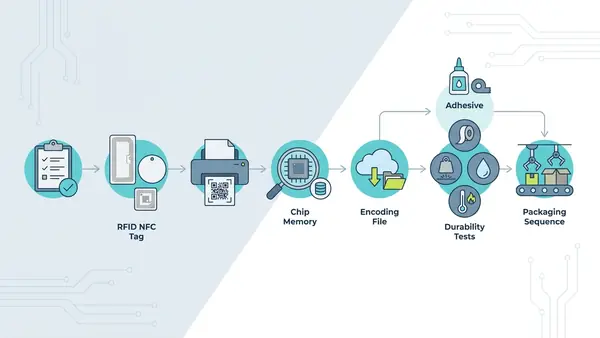
A DPP sourcing request should translate compliance goals into tag specifications. “Need an NFC tag for DPP” or “need an RFID label for passport data” is not enough for a supplier to choose the right chip, antenna, material, adhesive, print process, or encoding workflow.
For NFC tags, specify:
- chip family or required memory;
- NDEF content, URL format, or GS1 Digital Link structure;
- whether the tag will be locked after encoding;
- authentication, tamper, or privacy requirements;
- product material and mounting location;
- expected read behavior with common smartphones;
- whether any limited offline/on-tag data is required.
For RAIN RFID tags, specify:
- UHF frequency region and compliance needs;
- EPC format, GS1 identifier, or custom serialization rule;
- whether TID capture is required;
- User memory requirements, if any;
- encoding file format and duplicate-check process;
- read distance, bulk-read needs, and reader environment;
- performance after attachment to metal, textiles, packaging, or product housing.
For printed QR or hybrid labels, define how the visible code maps to the RFID/NFC identity. If the QR code resolves to one item URL but the RFID EPC points to another identifier, the DPP record can become fragmented. The GS1 Digital Link standard is one common way to connect identifiers and web access in a more interoperable structure.
Physical construction is just as important as data structure. A tag for paper packaging is different from a tag for a metal tool, washable garment, reusable crate, tire, or battery module. Metal products may require anti-metal RFID tags, while authentication projects may need tamper-evident labels, seal tags, or encoded numbering.
RFQ Checklist for DPP-Ready RFID and NFC Tags
A strong RFQ should make the supplier’s job concrete. Include the product context, the lifecycle environment, and the data model before asking for samples or pricing.
| RFQ field | What to define |
|---|---|
| Product and surface | Product category, material, size limits, metal/liquid/textile exposure, flat or curved surface |
| DPP purpose | Consumer access, compliance lookup, authentication, repair, resale, recycling, inventory, or hybrid workflow |
| Carrier type | QR, NFC, RAIN RFID, dual-frequency, or printed/RFID hybrid label |
| Identifier structure | GS1 Digital Link, EPC, UID, serialized URL, batch code, or buyer-defined format |
| Encoding data | NDEF record, URL, EPC memory, User memory, TID capture, printed QR content |
| Durability | Wash, heat, chemicals, UV, abrasion, outdoor use, tamper evidence, expected product lifetime |
| Application process | Factory applied, converter applied, embedded, sewn, adhesive mounted, tied, sealed, or molded in |
| Verification | Sample tests, NFC tap tests, RFID read tests, duplicate checks, barcode/QR print grading, encoding report |
| Packaging | Roll sequence, carton labels, serialized packing list, failed-tag handling, replacement rules |
Before mass production, request pre-production samples and test them on the actual product, not only in free air. NFC tags should be tested with representative phones, RAIN RFID tags with the expected reader setup, and printed QR codes for contrast, size, quiet zone, and durability.
RFIDEcho can support this part of the project as a tag customization partner: material, antenna/tag format, chip selection, printing, numbering, encoding, and packaging can be aligned to the buyer’s DPP data structure and chosen platform. For broader workflows, the RFID logistics tracking page shows common tag-selection contexts.
FAQ
Does a Digital Product Passport require RFID or NFC?
Not always. EU-level guidance defines data carriers broadly, and product-category rules will determine the exact requirements. QR codes, NFC tags, RAIN RFID tags, barcodes, and other AIDC media may all be relevant depending on the product, user, and lifecycle environment.
Is DPP data stored directly on the tag?
Usually only part of it. Many carriers store an identifier, URL, NDEF record, EPC, or GS1 Digital Link that resolves to a digital product record. Some NFC use cases may store limited on-tag or offline data, but the full passport commonly lives in an external product data system.
Can one carrier support both consumers and supply-chain operations?
Sometimes, but many projects use two access methods. NFC or QR is usually better for consumers with smartphones, while RAIN RFID is better for bulk operational reads. A hybrid label can keep both access paths tied to the same product identity.
What should buyers send before asking for a DPP tag quote?
Send product photos, surface material, size limits, expected environment, carrier purpose, identifier format, encoding requirements, print artwork, serialization rules, sample quantity, and verification expectations. To translate those details into a tag RFQ, use the RFIDEcho contact page.