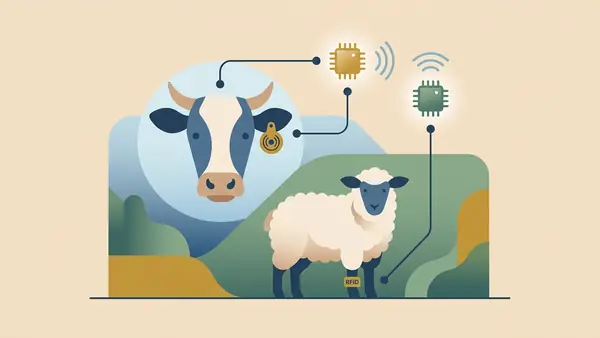

RFID for livestock and animal tracking works by pairing a small chip-and-antenna tag — an ear tag, leg band, or ring — with a unique ID number that a compatible reader picks up by radio signal and matches to an animal record: health history, breeding data, ownership, or movement. The tag itself does not store a full database; it stores an ID that links to whatever system the farm or program uses. Choosing the right tag means matching frequency, format, attachment method, and durability to the species, the environment, and any regulatory program the animal must comply with.
How RFID Works for Livestock and Animal Tracking
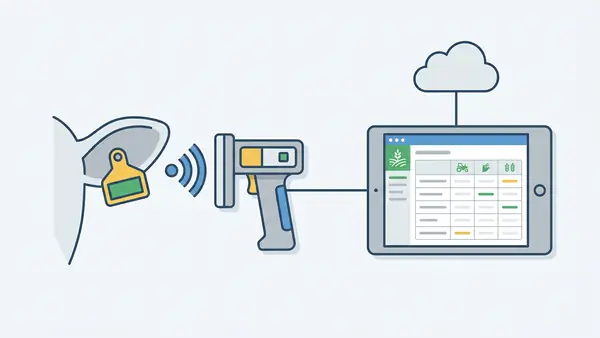
The workflow is the same across species: a transponder embedded in an ear tag, leg band, or ring is scanned by a handheld wand or a stationary panel reader — at a gate, chute, scale, or coop entrance — without needing line of sight or physical contact. The reader captures the tag’s unique number and passes it to whatever record-keeping system the farm uses, whether that’s a spreadsheet, dedicated livestock software, or a government traceability database.
It’s worth being precise about scope here: the tag is the identification layer. It works with a buyer’s own RFID reader and farm or veterinary management software — it does not replace either one. Getting tag selection right is what determines whether the rest of that system reads cleanly for the animal’s full working life.
LF vs HF vs UHF: Choosing the Right Frequency for Animal Tracking
Frequency choice is the first fork in the decision, and it is largely driven by whether the tag needs to satisfy an official traceability program or simply support farm-level efficiency.
| Frequency | Typical Read Range | Governing Standard | Best Use Case |
|---|---|---|---|
| LF (125–134.2 kHz) | Up to ~10 cm | ISO 11784/11785 (FDX-B) | Official USDA/EU traceability, regulated EID programs, single-animal handheld scans |
| HF/NFC (13.56 MHz) | Up to ~1 m | ISO 15693 / ISO 14443 | Short-range handheld checks, supplementary scanning |
| UHF (860–960 MHz, EPC Gen2) | Up to 10 m+ | EPC Gen2 / ISO 18000-6C | Hands-free gate, chute, or feeding-station counting; bulk reads |
LF ISO 11784/11785 is the safe default whenever a tag must count as official identification: it’s the standard behind USDA AIN “840” cattle tags, the EU’s sheep and goat EID rules under Regulation 21/2004, and the ICAR registry that certifies animal RFID devices globally. UHF tags using EPC Gen2 are USDA-approved for some applications, but no global encoding standard yet exists for UHF animal numbering — USDA currently runs on an interim Tag Data Standard, so a UHF tag intended for official use needs explicit confirmation that the encoding matches current USDA requirements, not just generic EPC Gen2 compliance.
Many operations use both: an LF chip for regulatory identification and a UHF chip in the same tag for fast, hands-free herd counting at gates or feeding stations.
RFID Tag Selection by Animal Type
Frequency is only half the decision. Tag format and attachment method need to match the animal’s anatomy, handling routine, and environment.
| Animal | Recommended Format | Attachment | Typical Read Range | Why |
|---|---|---|---|---|
| Cattle | Large ear tag (e.g. 102×76 mm) | Ear-piercing applicator | UHF up to 10 m / LF up to 10 cm | Large surface for printing/visual ID; UHF range supports gate counting |
| Sheep / goats | Compact ear tag (e.g. 45×17 mm) | Ear-piercing applicator | UHF up to 8 m / LF up to 10 cm | Smaller ear cartilage needs a lighter, narrower tag |
| Swine | Round tag (e.g. 30 mm) | Copper stud pin | UHF up to 8 m / LF up to 10 cm | Minimal snag risk in pen environments; stud suits thinner pig ears |
| Poultry | Adjustable leg band (16–20 mm ID) | Snap-clasp, no applicator | UHF up to 5 m / LF up to 10 cm | No ear structure; band must fit a range of leg sizes |
| Racing pigeons | Closed ring (7–10 mm ID) | Applied at squab stage, permanent | Up to 10 cm at ETS landing pad | Tamper-evident by design; lightweight for flight performance |
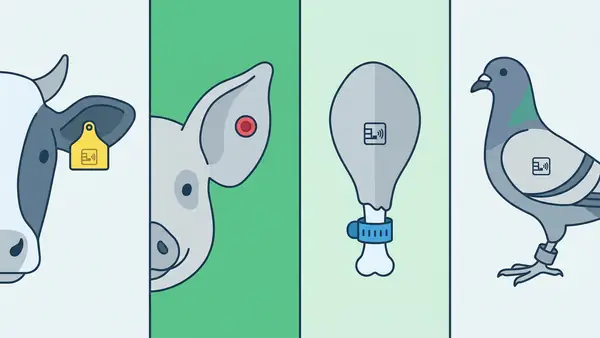
A few practical notes behind this table: swine tags commonly come in single-use locking versions for slaughter-bound animals, which preserves traceability all the way to harvest, and reusable open-clasp versions for breeding stock that may be re-tagged or moved between groups over a longer lifecycle. Poultry bands need multiple inner-diameter options because chickens, ducks, and turkeys of different breeds and ages have meaningfully different leg sizes. Pigeon rings are applied while the bird is still a squab, before the foot is fully grown, which is what makes the closed-ring format permanently tamper-evident for its racing career — and any ring intended for competitive use needs to be ISO 11784/11785 (FDX-B) compatible, since that is the format read by Benzing, Bricon, Deister, and similar Electronic Timing Systems.
Buyers working across the full range of species can review the dedicated RFID animal tags category for cattle, sheep/goat, swine, poultry, and pigeon-specific tag options, or see how tag selection fits into a broader identification program on the RFID animal identification solutions page.
Built for the Environment: Durability, Attachment, and IP Rating
Vague claims like “durable” or “rugged” aren’t a substitute for checking three specific numbers: IP rating, operating temperature range, and base material.
The most common point of failure inside any RFID tag is the bonding glue between the chip and the antenna. Ear tags, leg bands, and rings flex constantly with the animal’s movement, which stresses that bond over time — this is why a sealed, flexible construction matters more for animal tags than for static asset tags. IP67/IP68-rated tags are built to survive mud, slurry, dipping baths, pressure washing, and the ammonia-rich humid air common in poultry housing, where an open-backed label-style tag would fail quickly. Material choice compounds this: flexible TPU resists cracking in cold and tearing from snagging on fences or feeders, while smooth ABS/PP is preferred for poultry bands that need to be lightweight and easy to clean between flocks.
Operating temperature range matters for any outdoor application. A -40°C to +85°C rating covers nearly every farm climate worldwide, though it’s worth asking whether that’s a continuous rating or a limited-exposure rating, since prolonged exposure near the upper or lower bound can still degrade bonding adhesive even within a tag’s nominal range.
Common Mistakes When Choosing RFID Tags for Livestock
- Choosing UHF only, where a program requires LF. USDA and EU regulatory programs are generally built on LF ISO 11784/11785; a UHF-only tag that isn’t also registered for the applicable standard may not count as official identification even though it is genuine RFID.
- Treating “RFID-capable” as equivalent to “officially approved.” USDA’s 2024 cattle/bison rule only accepts specific APHIS-approved AIN “840” devices — other RFID tag series do not qualify, regardless of frequency.
- Misjudging read-range needs. A tag chosen for long-range bulk gate counting will underperform in a single-animal handheld workflow, and vice versa; match the tag’s rated read range to the actual handling routine, not just the species.
- Ignoring attachment failure modes. Tag pull-out from fences, feeders, or vegetation is one of the most common causes of lost identification; tamper-evident, high-retention designs and correct placement (away from cartilage and major ear arteries) reduce this risk significantly.
- Assuming one format fits a mixed operation. A farm running cattle, sheep, and poultry together typically needs three different tag formats, not one universal tag, since ear anatomy, leg size, and handling environment all differ by species.
RFQ Checklist: What to Specify Before You Order
Before requesting a quote, have these details ready:
- Species and approximate age/size — determines tag dimensions and attachment method
- Frequency / standard required — LF ISO 11784/11785 for regulatory programs, UHF EPC Gen2 for hands-free counting, or both
- Attachment method — ear-piercing applicator, copper stud, adjustable clasp, or permanent closed ring
- IP rating and operating temperature range — matched to washdown, climate, and housing conditions
- Single-use vs reusable — slaughter traceability typically calls for single-use locking tags; breeding stock often uses reusable designs
- Printing, numbering, and color coding — sequential IDs, farm/flock codes, logos, or batch color segmentation
- MOQ and lead time — confirm sample availability before committing to a bulk order
Buyers can browse the RFID animal tags category page for current cattle, sheep/goat, swine, poultry, and pigeon tag specifications, or contact a supplier directly with the checklist above to scope a custom quote. For a closer look at what drives unit pricing on cattle tags specifically, see RFID Ear Tags for Cattle: Pricing, Specs, and What Affects Cost, and for a deeper comparison of when to choose LF versus UHF for your operation, see RFID Ear Tags for Livestock: LF vs UHF Buying Guide.
For standards background, see the USDA APHIS Animal Disease Traceability program and the ICAR Registry of RFID Devices in Conformance with ISO 11784/11785.
FAQ
What frequency is required for USDA or EU livestock traceability?
USDA’s official cattle “840” AIN devices and EU sheep/goat EID programs are both built on LF ISO 11784/11785. UHF EPC Gen2 tags are approved for some USDA applications but currently run on an interim encoding standard, so confirm current requirements before ordering UHF tags for official use.
Can the same RFID tag work for multiple animal species?
Generally no. Ear tags sized for cattle are too large for sheep or goats, swine need a round stud-pin format because of thinner ear cartilage, and poultry and pigeons use leg bands or rings instead of ear tags. Match tag format to species, not to one standard design.
How long do RFID animal tags typically last in the field?
Passive RFID tags have no battery, so lifespan depends on physical durability — bonding glue integrity, IP rating, and resistance to UV, moisture, and mechanical stress. A well-specified IP67/IP68 tag rated -40°C to +85°C is built to last the animal’s working life under normal farm handling.
What is the difference between single-use and reusable animal tags?
Single-use tags use a locking pin or closed ring that cannot be removed intact, preserving traceability through to slaughter or the end of a racing career. Reusable tags use an open-clasp design that can be removed and reapplied, suited to breeding stock or animals that get regrouped.