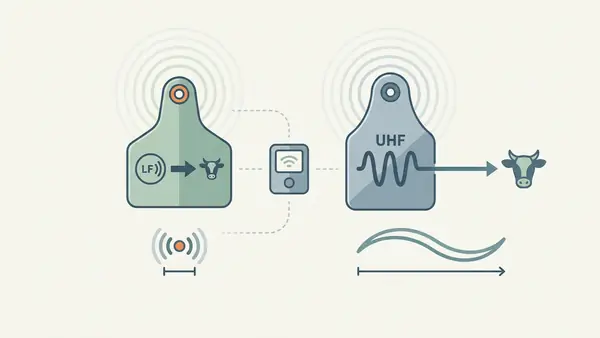

Most RFID ear tags for livestock run on LF (low frequency), the standard behind official USDA and EU identification programs — but UHF and dual-frequency tags exist for a reason, and picking the wrong one means re-tagging animals or buying readers twice. This guide breaks down the LF vs UHF decision so you can match the tag format to your herd, your handling routine, and your compliance requirement before you order.
LF vs UHF Ear Tags for Livestock: The Core Tradeoff
LF and UHF ear tags solve different problems, and the difference comes down to read range versus compliance maturity.
| Factor | LF (125–134.2 kHz) | UHF (860–960 MHz, EPC Gen2) |
|---|---|---|
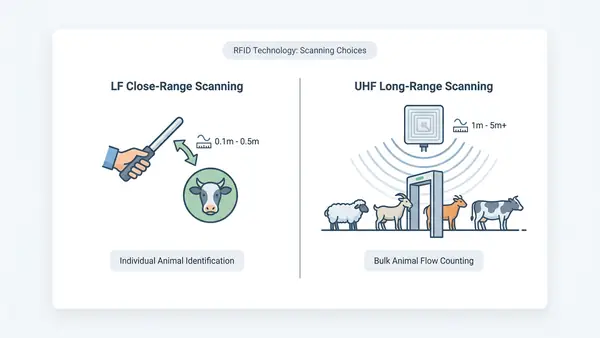
| Read range | Up to ~10–46 cm (single animal, wand or panel) | Several feet up to 15–24 ft+ (hands-free, gate/chute) |
| Governing standard | ISO 11784/11785 — mature, globally recognized | EPC Gen2/ISO 18000-6C; no finalized global animal-numbering standard |
| Official compliance | Basis for USDA 840 AIN and EU Reg. 21/2004 sheep/goat EID | Only one UHF tag currently approved as standalone USDA official ID |
| Signal in tissue/water/metal | No absorption — reliable near animals and metal equipment | Strong absorption — degrades near tissue, water, metal |
| Reader/setup complexity | Low — simple, low-cost wand or panel reader | High — requires more complex antenna/reader setup |
LF’s read range is short because that’s what official identification programs were built around: scan one animal at a time, reliably, even in wet or muddy conditions. UHF trades that close-range reliability for speed and distance — useful when the goal is counting a herd hands-free as it moves through a chute, not individually wanding each animal. Neither format is “better” outright; they’re built for different jobs. For a full breakdown of how LF, HF, and UHF compare across all animal-tracking use cases, see our guide on RFID for livestock and animal tracking.
How to Choose Between LF and UHF for Your Operation
Frequency choice should follow your handling routine and compliance need, not the other way around.
| If your operation needs… | Choose |
|---|---|
| Official USDA/EU identification compliance | LF — it’s the standard nearly all official programs are built on |
| Hands-free counting as animals pass a gate or chute | UHF — built for fast, multi-tag reads without individual handling |
| Individual-animal scanning at close range (dairy, vet checks) | LF — wand or handheld scanning is the standard workflow |
| Both compliance and hands-free counting on the same animal | Dual-frequency — see the next section |
| A mixed herd already using one reader type | Match the existing reader — LF and UHF readers are not interoperable |
| The lowest-cost, simplest setup for a small operation | LF — lower-cost readers and tags, well-proven for small to mid-size herds |
Dairies that manage cattle individually for milking and health records tend to stay on LF, while beef producers managing animals in groups are more likely to find UHF’s distance and multi-read capability worth the added cost. Whichever you choose, confirm reader compatibility before ordering tags — LF readers cannot read UHF tags, and vice versa, so switching formats mid-herd means replacing reader hardware, not just tags.
Dual-Frequency Ear Tags: Getting Both in One Tag
Dual-frequency tags combine a UHF inlay with an LF chip in one housing, so a single tag covers both jobs: the LF side carries the compliant official ID, and the UHF side supports hands-free, longer-range counting. This avoids applying two separate tags — and two separate handling events — to the same animal.
The cost case is straightforward: a dual-frequency tag costs more per unit than either single-frequency option alone, but for an operation that genuinely needs both official LF compliance and UHF-style gate counting, that premium is usually offset by eliminating a second tag purchase and a second ear-piercing event. For an operation that only needs one capability — say, a small herd with no compliance requirement and no plan to scale group handling — paying for dual-frequency adds cost without a matching benefit.
A real example of this format: the UHF RFID Ear Tag for Cattle is built as a dual-frequency tag — UHF read range up to 10 m alongside an LF option at up to 10 cm, in a 102×76 mm TPU housing rated IP68 and -40°C to +85°C. Dual-frequency tags also need a more rigid, larger construction than a basic single-frequency inlay to survive field handling, which is reflected in the housing spec, not just the chip cost. For a closer look at how frequency choice affects unit pricing specifically for cattle, see RFID Ear Tags for Cattle: Pricing, Specs, and What Affects Cost.
Beyond Cattle: LF/UHF Fit Across Species (and the RFID Pet Tags Question)
The LF/UHF tradeoff applies across species, but tag format and attachment method still need to match the animal — a cattle-sized ear tag doesn’t fit a sheep, and poultry use leg bands rather than ear tags at all. Our RFID for livestock and animal tracking guide covers the full species-by-format breakdown for cattle, sheep/goats, swine, poultry, and pigeons; the RFID animal tags category lists current specifications for each.
One adjacent question worth a direct answer: do RFID pet tags use the same technology as livestock ear tags? Mostly yes, at the standard level. Companion-animal identification almost universally runs on the same 134.2 kHz, ISO 11784/11785, FDX-B standard that underlies USDA 840 livestock tags and the ICAR global animal ID registry — which is why a vet’s universal scanner can read a pet’s chip and a livestock LF tag with the same underlying protocol. Where it differs is format and use case: pet identification is almost always an implantable glass microchip, injected once and never removed, while livestock identification is almost always an external ear tag, leg band, or bolus chosen for visual+electronic dual ID, batch handling, and the ability to apply or replace tags without veterinary intervention. The shared standard is useful background for any buyer sourcing animal ID tags broadly, but the two are different product categories, not interchangeable formats.
Common LF/UHF Selection Mistakes
The most expensive mistakes come from treating frequency choice as a spec-sheet detail instead of an operational decision.
- Buying UHF and assuming it counts as official ID. Only one UHF tag is currently approved as a standalone official USDA identification device; any other UHF tag typically needs a second, separate compliant LF tag to satisfy the program — doubling tag cost and handling per animal.
- Assuming UHF’s rated range holds in real field conditions. UHF signal is heavily absorbed by tissue, water, and metal; a tag rated for 15+ feet in open air can underperform significantly near processing equipment or in a crowded pen.
- Not confirming reader compatibility before ordering. LF and UHF readers are not interoperable — switching frequencies or mixing herds without checking this means buying new reader hardware, not just new tags.
- Paying for dual-frequency when single LF would do. If there’s no gate-counting or hands-free workflow need, the dual-frequency premium adds cost without a matching operational benefit.
- Treating “RFID-capable” as equivalent to “officially approved.” Regulatory programs accept specific approved devices, not any tag that happens to be RFID and the right frequency.
What to Specify in Your RFQ
A complete RFQ gets an accurate quote on the first pass:
- Frequency required — LF, UHF, or dual, and whether official compliance status is needed
- Species and herd/flock size — for tag sizing and MOQ planning
- Scanning method — handheld wand vs. gate/panel reader, to confirm reader compatibility
- Environment exposure — water, mud, metal equipment, and operating temperature range
- Printing and encoding — numbering scheme, color coding, logo, or farm code
- MOQ and lead time — sample availability before committing to a bulk order
Buyers can review the RFID animal tags category page for current species-specific tag specifications, or see how tag selection fits into a broader identification program on the RFID animal identification solutions page.
For standards background, see the USDA APHIS Animal Disease Traceability program and the ICAR Registry of RFID Devices in Conformance with ISO 11784/11785.
FAQ
Is UHF or LF better for livestock ear tags?
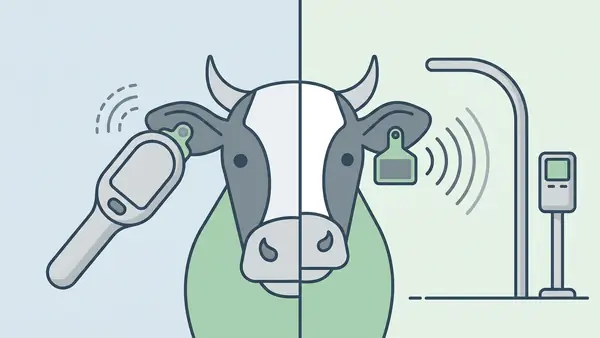
Neither is universally better — they’re built for different jobs. LF is the standard for official compliance and individual-animal scanning; UHF is built for hands-free, longer-range reading at a gate or chute. Choose by whether compliance or handling speed is the priority, or use a dual-frequency tag.
Can I use a UHF tag for official USDA or EU livestock identification?
Generally no by itself. Official USDA and EU programs are built on LF ISO 11784/11785, and only one UHF tag currently qualifies as a standalone official USDA ID. A UHF tag used for operational purposes typically still needs a separate compliant LF tag if official identification is required.
Do RFID pet tags use the same frequency as livestock ear tags?
Yes, at the standard level — both typically use 134.2 kHz, ISO 11784/11785, FDX-B. The difference is format: pet identification is almost always an implantable microchip, while livestock identification is almost always an external ear tag or leg band.
Does RFIDEcho supply RFID readers along with the tags?
RFIDEcho manufactures and customizes RFID ear tags — frequency, chip, printing, encoding, color, and packaging — and our tags work with compatible RFID readers and management software. We don’t sell readers or software directly; contact us to confirm tag specifications for your existing reader setup.