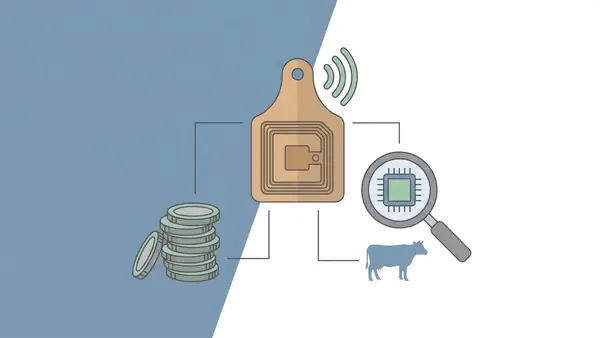

There’s no single price for an RFID ear tag for cattle — the same class of tag can be quoted very differently depending on channel, frequency, encoding, durability rating, and order volume. This guide breaks down what actually drives the cost of an RFID ear tag for cattle, so you can evaluate a quote instead of comparing SKUs that aren’t really comparable.
Why Cattle RFID Tag Pricing Varies So Much
Cattle RFID tag pricing splits along two axes: channel (wholesale/distributor versus small-pack retail) and format (official compliance tag versus custom UHF or dual-frequency tag). The same underlying tag class can land at very different price points depending on which of those the buyer is actually in.
| Tag class | Relative price position | Notes |
|---|---|---|
| USDA 840 LF/HDX/FDX single tag (wholesale/distributor) | Lower | Most common official ID tag for cattle, bought through a distributor channel |
| USDA 840 matched-pair set (RFID + visual) | Lower-to-mid | Per set, wholesale/distributor |
| Small-pack retail single tag | Highest of the compliance-tag options | Same spec as wholesale, farm-supply retail markup |
| UHF or dual-frequency cattle ear tag (custom/bulk) | RFQ-based | Frequency, IP rating, MOQ, and customization set the price — there is no list price |
| EID reader (handheld) | Priced separately | A hardware purchase, not a tag cost |
One factor that skews how “market price” looks: USDA’s APHIS agency has run a no-cost RFID ear tag program for cattle producers, supplying official 840 tags through approved manufacturers at no direct charge in many cases (a similar no-cost program for swine launched in 2025). That keeps basic compliance-only tags artificially cheap to source for many U.S. producers — but it doesn’t apply to custom, bulk, or UHF/dual-frequency tags sourced directly from a manufacturer for export, integration, or large-herd deployment, which is where most of the “what affects cost” questions actually come from, and where pricing is quote-based rather than list-based.
Six Factors That Actually Affect Ear Tag Price
Every price list above hides the same six variables. Knowing them lets you evaluate a quote instead of just comparing a number.
| Factor | Why it moves the price |
|---|---|
| Frequency (LF / UHF / dual) | LF chips and antennas are the lowest-cost, most mature option; UHF and dual-frequency tags cost more per unit but enable longer read range |
| Chip & encoding | Pre-programmed EPC or LF codes, sequential numbering, and custom data schemes add a setup cost per batch |
| Material & IP/temperature rating | IP68 submersion-rated, wide-temperature-range housings cost more to mold and assemble than basic indoor-grade tags |
| Printing & customization | Logos, barcodes, farm-specific numbering, and custom color increase cost versus a blank stock tag |
| Order volume (MOQ) | Customization and tooling costs are largely fixed per batch — spreading them over more tags lowers the per-unit price significantly |
| Bundled hardware | Readers, applicators, and printers are priced separately from tags and should never be confused with per-tag cost |
Passive LF chips for animal tracking are inexpensive at the bare-component level; the finished ear tag costs substantially more once housing, encapsulation, and printing are added to make it field-ready — which is why a finished, IP-rated cattle ear tag runs well above the underlying chip cost even though the chip itself is a small part of that total.
LF vs UHF Cattle Ear Tags: Which Affects Your Budget More
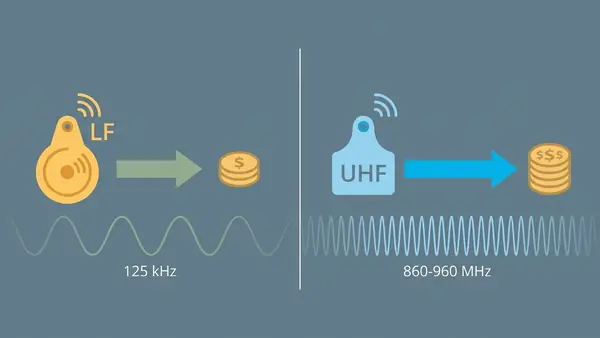
LF (125–134.2 kHz) is the established standard for cattle identification and the only frequency with a mature ISO 11784/11785 numbering scheme for livestock — which is why official USDA 840 tags are LF. Read range is short, typically 35–46 cm (13–18 inches), so each animal is scanned individually with a wand or panel reader. LF components are also the lowest-cost option, which keeps LF-only tags at the lower end of the price ranges above.
UHF tags read from several feet up to 15–24 feet under good conditions, enabling hands-free, gate-mounted scanning as cattle move through a chute — useful for herd-level counting without wanding each animal. The tradeoff: UHF signal does not penetrate tissue, water, or metal well, the reader/antenna setup is more complex, and currently only one UHF tag is accepted as official USDA ID. Using any other UHF tag means applying a second, separate compliant LF tag — which doubles both the tag cost and the handling event per animal.
Dual-frequency tags combine a UHF inlay with an LF chip in a single housing, giving you long-range herd counting and short-range individual ID without buying or applying two tags. The UHF RFID Ear Tag for Cattle is built this way: UHF read range up to 10 m alongside an LF option at up to 10 cm, in a 102×76 mm TPU tag rated IP68 and -40°C to +85°C. For buyers comparing the full range of tag formats across species, the RFID animal tags category covers cattle, sheep, swine, and poultry formats side by side.
Bulk and Custom Pricing: What Changes at Volume
Manufacturers structure custom RFID ear tag pricing around minimum order quantity (MOQ), sample lead time, and customization depth rather than a single fixed catalog price. The typical pattern: a short sample run (around 5 days) lets a buyer confirm frequency, chip, encoding, and color before committing to a bulk production run (typically around 2–3 weeks), since customization setup — printing templates, programming jigs for pre-encoding — is largely a fixed cost per batch. Spreading that fixed cost over a larger order is what drives the per-unit price down at volume; it’s also why wholesale/distributor pricing sits so far below small-pack retail pricing for what is functionally the same tag.
Typical bulk customization options to specify in a quote request:
- Laser or UV-resistant inkjet printing for sequential numbers, barcodes, or farm logos
- Custom color for herd or batch segmentation
- Pre-encoding to EPC (UHF) or LF numbering schemes before shipment
- Dual-frequency chip combinations where both long-range and close-range reading are needed
A 500-unit MOQ with a 5-day sample lead time and an 18-day bulk lead time is a realistic baseline for a customized cattle ear tag order — useful as a planning reference even before a manufacturer returns a formal quote.
Common Mistakes That Inflate Cattle Tag Costs
The biggest cost driver isn’t the unit price on a quote — it’s having to re-tag an animal. A handful of avoidable mistakes account for most of that extra cost:
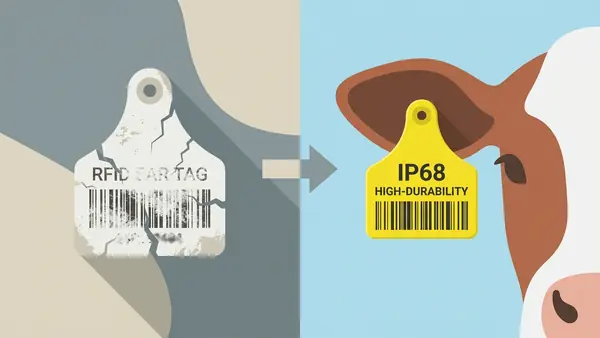
- Choosing price over durability. A cheaper tag without the right IP and temperature rating fails in the field, and replacing it means running the animal through a chute again — a labor cost that quickly erases any savings on the tag itself.
- Skipping environmental-rating checks. Moisture, mud, UV exposure, and temperature swings degrade tags that weren’t specified for the actual operating conditions.
- Buying UHF without confirming official-ID status. Only one UHF tag currently qualifies as USDA official ID; any other UHF tag requires a second compliant LF tag, effectively doubling cost and handling.
- Not checking reader compatibility before ordering. LF and UHF use separate, non-interoperable reader hardware — confirm compatibility with your existing reader fleet before placing a bulk order.
- Leaving encoding undefined. Deciding on a numbering scheme after tags are already produced usually means a rework fee or a second production run.
What to Include in Your RFID Cattle Tag RFQ
A complete RFQ gets you an accurate quote on the first pass instead of a back-and-forth that delays your tagging schedule. Include:
- Species and herd size, for MOQ and volume-pricing planning
- Required frequency — LF, UHF, or dual — and whether official USDA-ID compliance is needed
- IP rating and operating temperature range for your climate and handling conditions
- Color and printing/numbering scheme
- Encoding standard (EPC Gen2 / ISO 11784-11785) and whether pre-encoding is required
- Applicator and reader compatibility
- Target ship date, since sample and bulk lead times are quoted separately
For herd-wide identification programs, it’s also worth reviewing how RFID ear tags fit into a broader traceability setup — see our guide on RFID for livestock and animal tracking and the animal identification solutions overview for how tag selection connects to herd management workflows. If you’re still deciding between frequencies rather than budgeting a known format, see RFID Ear Tags for Livestock: LF vs UHF Buying Guide.
FAQ
Do RFID cattle ear tags need to meet USDA 840 standards?
Only if the animal needs official USDA identification — interstate movement, shows, or disease-program compliance. Since November 5, 2024, official tags for those purposes must be visually and electronically readable. Cattle that never move under these programs don’t need an 840 tag, though many producers tag the whole herd anyway.
Is UHF or LF cheaper for a cattle herd?
LF tags are generally the lower-cost option per tag and are the standard for official USDA ID. UHF tags cost more per unit but reduce labor by enabling hands-free, gate-mounted reading — the better choice depends on whether your priority is per-tag cost or scanning labor at scale.
What’s the typical MOQ for custom RFID cattle tags?
A 500-unit minimum order is a common baseline for customized cattle ear tags with printing, color, and encoding options, with a short sample run available first to confirm specifications before the bulk order ships.
Does RFIDEcho sell readers along with the tags?
RFIDEcho manufactures and customizes RFID ear tags — frequency, chip, printing, encoding, color, and packaging — and our tags work with compatible RFID readers and management software. We don’t sell readers or software directly; contact us to confirm tag specifications for your existing reader setup.