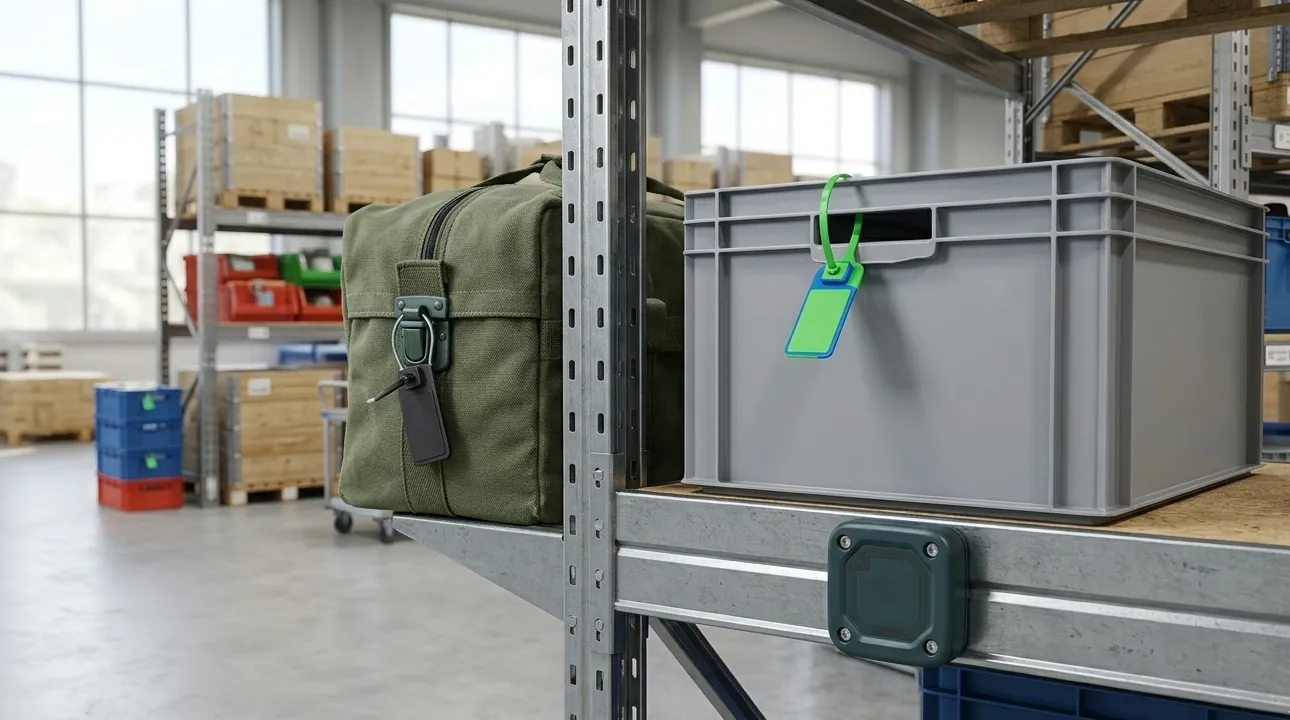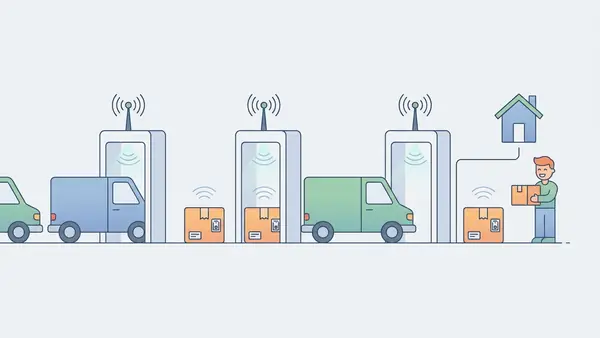

RFID package tracking for last mile delivery is most useful when it turns package movement into reliable checkpoint events: picked up, received, sorted, loaded, handed off, returned, or flagged as an exception. For buyers, the key question is not whether RFID is “better than tracking,” but which RFID tag format will survive the parcel environment and work with compatible readers and logistics software.
Parcels are one case of a broader problem — attaching a durable identity to an item that moves. The surface, environment, and read-workflow logic below follows the same framework set out in our guide to RFID asset tracking for tools and equipment.
What RFID Package Tracking Means in the Last Mile
In last-mile logistics, RFID identifies a tagged package, tote, cage, or seal when it passes a reader zone. A passive UHF label on a carton, for example, can be read automatically at a dock door or loading point without a worker aiming a scanner at a barcode.
That makes RFID different from barcode tracking, but it is also different from GPS. Barcode scans are visual and usually manual. RFID is wireless and can capture many tags in a controlled read zone. GPS, cellular, and carrier platforms are better for live vehicle location, route changes, driver communication, and customer-facing maps.
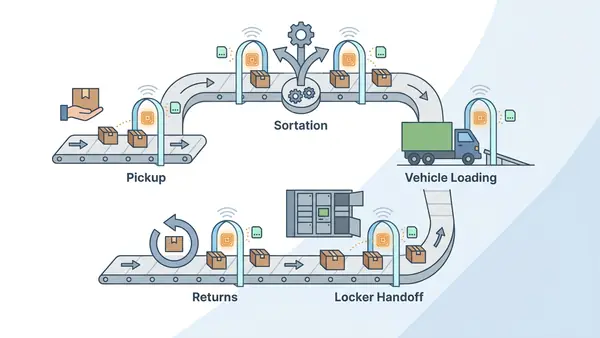
A practical RFID workflow usually looks like this:
- The parcel, tote, or cage receives an RFID tag with a unique encoded ID.
- Compatible readers are installed at pickup, sortation, loading, locker, or return points.
- The read event is sent to the buyer’s WMS, TMS, carrier platform, or integrator software.
- The business uses that event to confirm chain of custody, detect exceptions, or update delivery status.
If your team is still comparing the identification layer, RFIDEcho’s guide to barcode vs RFID tags is a useful starting point.
Where RFID Adds the Most Value in Delivery Workflows
RFID performs best where parcels move through predictable checkpoints. It is less useful when the goal is to know the exact outdoor position of a package every second. The strongest use cases include:
- Pickup confirmation: Prove that a tagged parcel or return has entered the carrier’s possession.
- Depot and sortation reads: Reduce missed manual scans when packages enter or leave a facility.
- Vehicle loading verification: Confirm that the right parcels, totes, or roll cages are loaded for the correct route.
- Locker and drop-point handoffs: Capture automated identity events at micro-fulfillment, locker, or pickup points.
- Returns intake: Identify returned parcels faster and reduce manual reconciliation.
- Reusable asset control: Track totes, cages, trays, and delivery containers across repeated cycles.
UPS’s 2026 RFID rollout is a useful industry signal: the company described moving from manual scanning toward package sensing across stores, vehicles, and facilities, while emphasizing clearer visibility during pickup and delivery events in its official RFID sensing announcement. Smaller logistics operators do not need the same network scale, but the principle is similar: define the handoff events first, then select tags that support those events.
For broader application planning, see RFIDEcho’s RFID logistics tracking solution page.
Choose the Right RFID Tag Format for Packages, Totes, and Cages
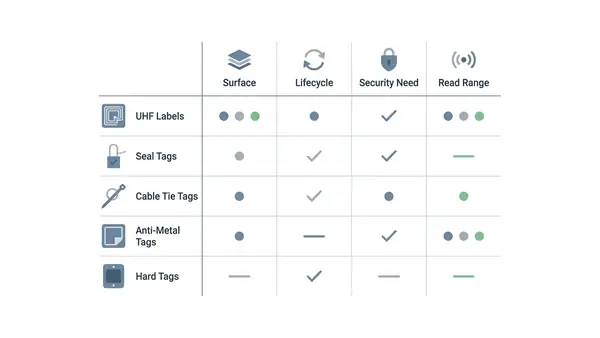
The right tag depends on the item being tracked, the surface, the lifecycle, and the security requirement.
| Delivery item | Recommended tag format | Why it fits | Watch-outs |
|---|---|---|---|
| Cardboard parcel | UHF RFID label | Low cost, printable, easy to apply | Contents such as liquids, foil, or metal can reduce reads |
| Poly mailer | Flexible UHF label | Conforms to bags and soft packaging | Adhesive and bending stress matter |
| Reusable tote | Durable UHF label or hard tag | Supports repeated cycles | Cleaning, stacking, impact, and abrasion |
| Roll cage or metal cart | On-metal tag or cable-tie tag | Better performance near metal frames | Placement and orientation must be tested |
| Tamper-evident shipment | RFID seal or zip-tie tag | Combines identity and security evidence | Usually higher cost and often one-time use |
| Cold-chain parcel | Label with suitable adhesive/material | Maintains identification through temperature changes | Condensation and adhesive selection are critical |
For disposable cartons, passive UHF labels are often the first option. For reusable logistics assets, a stronger housing or attachment method is usually worth the higher tag cost. For cages, carts, or metal return assets, do not assume a standard label will work: metal can detune ordinary UHF tags.
RFIDEcho supplies RFID tags and tag customization options for logistics use cases, including RFID seal tie tags and long-range logistics tag formats such as the large logistics RFID seal tag. Final tag choice should be validated with the buyer’s compatible readers and software environment.
Key Selection Criteria Before Ordering RFID Tags
Most parcel logistics pilots use passive UHF RFID, commonly associated with RAIN RFID, EPC Gen2, and ISO/IEC 18000-63. GS1 explains that the Electronic Product Code is used to uniquely identify physical objects and that passive UHF RAIN RFID can support high-rate, non-line-of-sight identification in supply chain operations; see the GS1 RFID standards overview.
When writing specifications, confirm:
- Frequency and protocol: UHF RAIN RFID / EPC Gen2 / ISO/IEC 18000-63 is common for parcel logistics, but confirm regional frequency rules and existing reader requirements.
- Read scenario: Conveyor, dock portal, handheld, vehicle loading, locker, or return station.
- Surface and contents: Cardboard, plastic, metal, liquid, insulated packaging, or mixed parcel loads.
- Tag size and antenna design: Larger antennas often improve range but may not fit small labels or mailers.
- Chip memory and encoding: EPC length, serial number scheme, TID needs, user memory, and barcode/QR matching.
- Printing and customization: Logo, human-readable number, barcode, QR code, route data, color, and roll direction.
- Adhesive and durability: Cold, humidity, abrasion, compression, bending, and expected lifecycle.
The relevant ISO standard page for the UHF air interface is ISO/IEC 18000-63. Use it as a standards reference, not as a substitute for pilot testing.
Common Failure Points in Last-Mile RFID Projects
RFID projects usually fail because the read event was not designed around real packaging and real operations. Watch for these issues:
- Treating RFID as continuous GPS tracking.
- Using a generic label near liquids, foil liners, or metal goods.
- Placing the tag on a crushed corner, fold line, or poor antenna orientation.
- Loading too many dense tagged items through an untested read zone.
- Installing readers without tuning power, antenna angle, and shielding.
- Encoding IDs that do not match the WMS, TMS, or customer tracking data model.
- Skipping samples and moving directly to mass production.
A last-mile RFID pilot should test real parcels, real item mixes, real loading speeds, and real exception handling. For warehouse-to-delivery handoffs, RFIDEcho’s RFID warehouse management page gives related context on how RFID tags support controlled inventory and movement events.
RFID Tag RFQ Checklist for Last-Mile Package Tracking
A strong RFQ gives the tag supplier enough context to recommend the right inlay, material, adhesive, encoding, and packaging.
| RFQ field | What to specify |
|---|---|
| Application | Parcel, mailer, tote, cage, return, seal, cold chain, high-value shipment |
| Surface | Cardboard, plastic, metal, liquid nearby, insulated material |
| Frequency/protocol | UHF RAIN RFID / EPC Gen2 / ISO/IEC 18000-63 unless your system requires otherwise |
| Read scenario | Conveyor, dock door, handheld, vehicle loading, locker, return station |
| Read target | Distance, speed, orientation, and expected read-rate goal |
| Chip and memory | EPC length, TID use, user memory, serialization needs |
| Encoding | EPC scheme, serial range, barcode or QR matching |
| Printing | Logo, text, numbering, color, barcode, route or batch code |
| Durability | Temperature, moisture, abrasion, bending, one-time or reusable lifecycle |
| Packaging | Roll quantity, core size, label orientation, sample quantity |
RFIDEcho can help customize RFID tag material, chip, frequency, size, printing, encoding, numbering, color, and packaging options. The buyer or integrator should validate the selected tags with compatible readers, antennas, and logistics software before bulk ordering.
FAQs About RFID Package Tracking for Last Mile Delivery
Can RFID track a package continuously on the road?
Not by itself. Passive RFID records identification events when a tag passes a reader. Continuous road location usually requires GPS, cellular, BLE, active tags, or carrier tracking platforms.
What RFID frequency is best for last-mile package tracking?
Passive UHF RFID is the common choice for parcel, carton, tote, and logistics checkpoint reads because it supports longer range and fast bulk identification. HF or NFC may fit close-range authentication, but it is usually not the first choice for dock or loading reads.
Are RFID labels worth using on disposable parcels?
They can be, when missed scans, misloads, high-value goods, returns, or customer-service costs justify the tag cost. For low-margin parcels, RFID may be better applied to reusable totes, cages, or exception-prone shipments first.
What should be tested before ordering RFID tags in bulk?
Test the tag on the real package surface, with real contents, at the intended read point, speed, orientation, and parcel density. Also test encoding, printed data, adhesive performance, and how read events flow into the buyer’s tracking system.