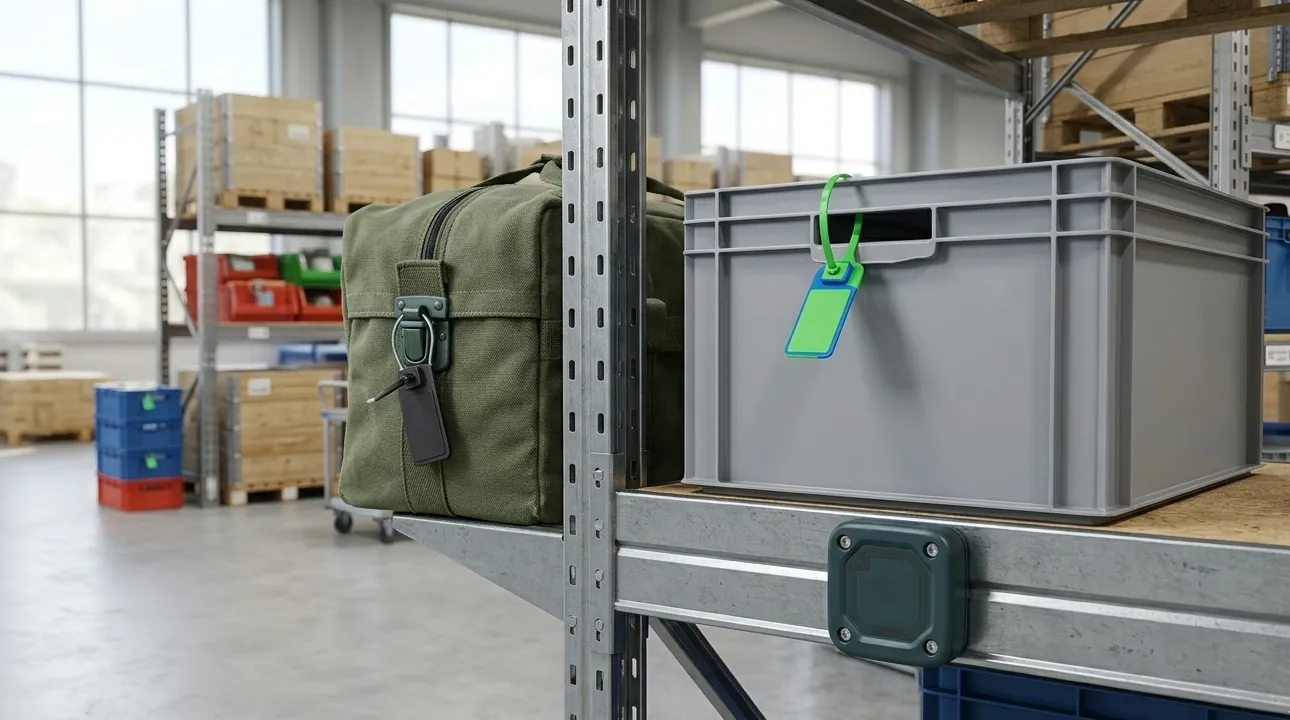
Barcode vs RFID tag decisions are not about choosing the newest technology. They are about matching the identification method to the item, scan workflow, environment, cost target, and accuracy requirement. For many buyers, the best answer is a barcode label, an RFID tag with printed backup data, or a hybrid rollout that keeps both.
Barcode and RFID are the two most common candidates, but they are not the only ones. BLE beacons and camera-based computer vision solve overlapping problems and win outright in specific conditions — those are compared in full further down.
Barcode vs RFID Tag: The Core Difference
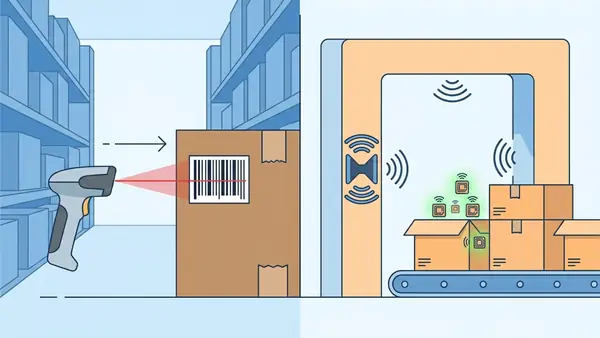
A barcode label is an optical identifier. A scanner or camera must see the printed code, decode the pattern, and send the identifier to a database. This is simple, low cost, and deliberate: one visible label, one scan event, one confirmation.
An RFID tag is a radio-frequency identifier. The tag contains a chip and antenna, and the chip can transmit stored data to a compatible RFID reader through radio waves. In many workflows, the tag does not need to be visible, and multiple tags can be read in the same read zone.
That difference changes the operating model:
- Barcodes work best when a person can easily see and scan each item.
- RFID tags work best when visibility, speed, or manual handling becomes the bottleneck.
- Hybrid RFID labels work best when automation is useful but printed backup data is still required.
For general tag categories and customization options, buyers can start with RFID tags and then narrow the choice by surface, read distance, environment, and encoding requirements.
Key Comparison: Speed, Range, Data, Durability, and Cost
| Factor | Barcode label | RFID tag |
|---|---|---|
| Data capture | Optical scan of a visible printed code | Radio-frequency read of a chip and antenna |
| Line of sight | Required | Usually not required, depending on tag and environment |
| Scan speed | One label at a time | Multiple tags can be read in bulk |
| Read range | Close and operator-controlled | From near-contact to several meters or more, depending on tag type and setup |
| Data | Usually static ID linked to a database | EPC, TID, optional user memory, serialization, and sometimes read/write data |
| Cost | Lowest label cost and simple deployment | Higher tag and setup cost, but can reduce labor and errors |
| Durability | Depends on printed label material; visual damage can stop reads | Depends on tag construction; rugged, laundry, and on-metal formats are available |
| Main limitation | Must be visible, clean, and scanned manually | Performance depends on RF behavior, placement, frequency, and environment |
RFID does not remove the need for planning. Metal can detune or reflect RF signals, liquids can absorb RF energy, dense packing can create missed reads, and overly long read ranges can capture the wrong items. Barcodes have a different failure mode: dirt, scratches, folds, fading, hidden placement, or skipped manual scans.
Cost should be compared as total operating cost, not just unit label cost. A barcode label may cost less, but manual scans can add labor, missed movements, audit delays, relabeling, and exception handling. An RFID tag costs more, but it may reduce those hidden costs when the workflow is high-volume or accuracy-sensitive.
When a Barcode Label Is Still the Better Choice
A barcode label is still the practical choice when the item is visible, the scan volume is modest, and the workflow benefits from a human-confirmed scan. Barcodes are also easier to share across suppliers, customers, retail channels, logistics partners, and mobile devices.
Choose barcode-only identification when:
- Each item is already handled by a worker.
- The label is easy to see and scan.
- The process needs deliberate item-by-item confirmation.
- The budget cannot support RFID testing or tag customization.
- The item is low value and high volume.
- Existing partners only require 1D or 2D barcode data.
- The environment makes RFID difficult and automation is not essential.
Examples include basic retail product labels, document control, small warehouse bins, low-volume asset lists, healthcare item labels, manufacturing component labels, and shipping labels where a visible code is required by the receiving party.
This is why barcode labels have not disappeared. More than 5 billion barcode scans occur globally every day, and barcode standards remain central to retail and supply-chain identification.
When an RFID Tag Is Worth the Higher Upfront Cost
RFID tags become worth the higher upfront cost when barcode scanning creates measurable friction: slow receiving, long audits, missed scans, hidden labels, tool search time, shrinkage, stockouts, or poor visibility into reusable assets.
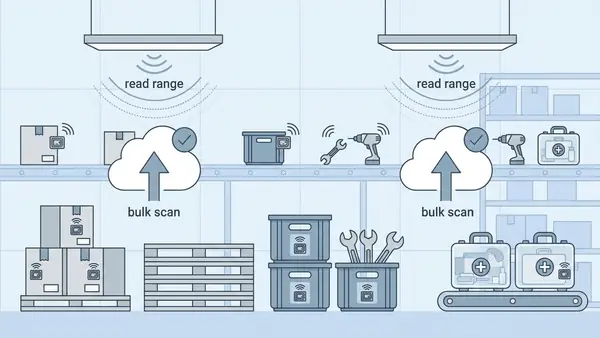
RFID is often justified in:
- Warehouse receiving and cycle counting.
- Pallet, carton, tote, and reusable container tracking.
- Apparel retail inventory and supplier compliance.
- Manufacturing work-in-progress tracking.
- Tool, equipment, and fixed asset tracking.
- Healthcare kits, trays, and medical asset workflows.
- Laundry, textile, or garment tracking.
- Harsh environments where printed labels fail.
For warehouse inventory, RFID warehouse management workflows often use RFID tags to speed receiving, counting, and movement checks. For equipment and reusable items, RFID asset tracking can help when the tag must remain readable through relocation, handling, cleaning, or repeated use.
The tag format matters. A standard wet inlay may work on a carton but fail on a metal tool. For metal equipment, RFID anti-metal tags use construction that helps maintain read performance on conductive surfaces. For washable textile workflows, RFID laundry tags are designed for repeated washing, pressure, heat, and handling stress.
Hybrid RFID and Barcode Labels: Why Many Projects Use Both
Many real projects do not replace barcodes completely. They add RFID while keeping printed barcode, QR code, human-readable serial number, SKU, logo, or shipping information on the same label.
Hybrid labels are useful because they support:
- Manual fallback when an RFID read fails.
- Legacy barcode systems at suppliers or customers.
- Human-readable exception handling.
- Retail or logistics compliance requirements.
- Carton and pallet labels that need both automated reads and printed shipping data.
- Matching a printed barcode identifier with an encoded EPC.
This is especially important during phased rollouts. A buyer may start by adding RFID labels to selected cartons, pallets, retail categories, tools, or reusable assets while keeping barcode workflows for other items. The printed barcode keeps the process compatible; the RFID inlay adds speed and automation where it matters.
Standards are also part of this decision. GS1 explains that EPC/RFID for consumer products should be used responsibly and in alignment with identification standards, privacy expectations, and supply-chain needs. In retail projects, encoded data may need to align with GTIN, UPC, SGTIN-96, or retailer-specific requirements.
Beyond Barcodes: BLE Beacons and Computer Vision
Barcode is not the only alternative buyers weigh against RFID, and a supplier that only compares the two is narrowing the question. Two other methods regularly win on their merits.
BLE beacons are battery-powered transmitters that broadcast their identity continuously. They give approximate location without a reader portal, over tens of metres, and a phone can pick them up. The trade-offs are batteries to replace, a unit cost well above a passive RFID tag, and location that is approximate rather than a definite read event. BLE suits a modest number of high-value mobile assets you need to find, not thousands of items you need to count.
Computer vision uses cameras and models to recognise items, faces, plates, or shelf gaps with no tag on the item at all. Where it works, the per-item cost is zero and there is nothing to attach or replace. The cost moves to cameras, compute, lighting, and model maintenance, and it degrades with occlusion, poor light, and visually identical items. Vision suits fixed choke points and visually distinctive items.
| RFID (passive) | Barcode | BLE beacon | Computer vision | |
|---|---|---|---|---|
| Per-item cost | Low to moderate, by tag tier | Effectively free | High, and recurring with batteries | None |
| Infrastructure cost | Readers, antennas | Scanners | Gateways or phones | Cameras, compute, lighting |
| Line of sight | Not required | Required | Not required | Required |
| Bulk read | Hundreds per second | One at a time | Continuous broadcast | Whole frame at once |
| Range | Centimetres to ~10 m | Centimetres to metres | Tens of metres | Camera field of view |
| Gives you | A definite read event | A definite scan event | Approximate location | Recognition, no attachment |
| Battery | None (passive) | None | Yes, needs replacing | Powered infrastructure |
| Weakest against | Metal, liquid, stray reads | Damage, soiling, manual labour | Cost per unit, battery life | Occlusion, light, lookalike items |
A practical way to choose: if you need to count many items fast, RFID. If you need a cheap definite scan at a single point, barcode. If you need to find a few valuable moving things, BLE. If you need identification without touching the item at all, vision. Mixed estates commonly run more than one.
RFID Tag Selection Questions Before Replacing Barcodes
Before ordering RFID tags, define the tag specification in practical terms. The best RFID tag is not the one with the longest advertised read range; it is the one that reads reliably on the actual item, in the actual environment, at the required distance.
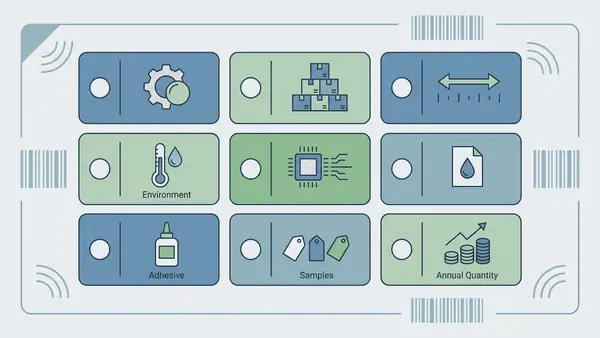
Use this RFQ checklist:
| RFQ field | What to define |
|---|---|
| Tagged item | Carton, pallet, tool, garment, container, liquid product, metal asset, document, or component |
| Surface | Cardboard, plastic, glass, metal, textile, curved surface, rough surface, or liquid-filled packaging |
| Environment | Heat, cold, moisture, dust, washing, chemicals, abrasion, outdoor exposure, or compression |
| Read distance | Required minimum distance, not only desired maximum distance |
| Read mode | Handheld scan, fixed portal, conveyor, shelf, gate, dock door, or station read |
| Frequency | LF, HF/NFC, or UHF based on application and region |
| Tag type | Passive label, rugged hard tag, anti-metal tag, laundry tag, or active tag |
| Chip and memory | EPC length, TID use, user memory, access password, kill password, or special chip requirement |
| Encoding | EPC, GTIN, SGTIN-96, serial number, batch, or customer-defined data |
| Printed content | Barcode, QR code, human-readable serial, SKU, logo, date, or shipping fields |
| Material and adhesive | Facestock, liner, adhesive, encapsulation, mounting hole, cable tie, stitching, or heat seal |
| Quantity and packaging | Rolls, sheets, pieces, encoding sequence, roll direction, core size, and annual demand |
| Testing | Sample quantity, tagged items, read positions, pass/fail criteria, and pilot conditions |
For frequency, passive UHF RFID is common for cartons, inventory, pallets, and warehouse applications because it supports longer range and bulk reads. HF at 13.56 MHz is common for cards, tickets, libraries, and short-range applications. LF around 125–134 kHz is usually used for short-range proximity applications. UHF frequency rules vary by region, so the selected tag and chip should match the target market.
For encoding, UHF Gen2 tags commonly include EPC memory, TID memory, reserved memory, and optional user memory. The EPC is usually the main identifier read in supply-chain workflows. TID is a manufacturer-assigned identifier. User memory can store additional data when needed, but it can increase chip cost and complexity. EPCglobal Gen2 UHF RFID is standardized through GS1 and ISO/IEC 18000-63, referenced by the GS1 UHF air interface protocol.
If you are comparing barcode-only labels with RFID labels, contact RFIDEcho with the tagged item, surface, read range, environment, printing content, encoding format, sample test needs, and estimated annual quantity. The custom RFID tag page sets out which of these — material, chip, frequency, printing, encoding, numbering, packaging — are configurable, and what each choice does to unit cost is covered in our guide to RFID tag costs and ROI.
FAQ
When should you use BLE instead of RFID?
Use BLE when you need to locate a modest number of high-value moving assets across a wide area without read portals. BLE beacons cost far more per unit than passive RFID tags and need battery replacement, so they suit finding things rather than counting large volumes of items.
Can computer vision replace RFID tags?
Sometimes. Vision needs no tag on the item, so per-item cost is zero, but it requires line of sight and struggles with occlusion, poor lighting, and visually identical items. It fits fixed choke points and distinctive items, not dense mixed stock.
Is RFID always better than a barcode?
No. RFID is better when bulk reading, non-line-of-sight reads, durability, serialization, or faster audits create measurable value. Barcodes are better when the workflow is visible, low cost, low volume, and requires deliberate manual confirmation.
Can an RFID tag also have a barcode?
Yes. Many RFID labels include a printed barcode, QR code, serial number, or human-readable text. This is useful for fallback scanning, compliance, customer compatibility, and exception handling.
Why do RFID tags cost more than barcode labels?
RFID tags include an inlay with a chip and antenna, and the finished tag may require encoding, special materials, anti-metal construction, rugged packaging, or sample testing. The higher cost can be justified when it reduces labor, missed scans, relabeling, or audit time.
What is the biggest RFID tag mistake when replacing barcodes?
The biggest mistake is choosing a tag before testing it on the real item. Surface, metal, liquid, orientation, density, reader setup, and required read distance can all change performance. Always test samples before a full order.