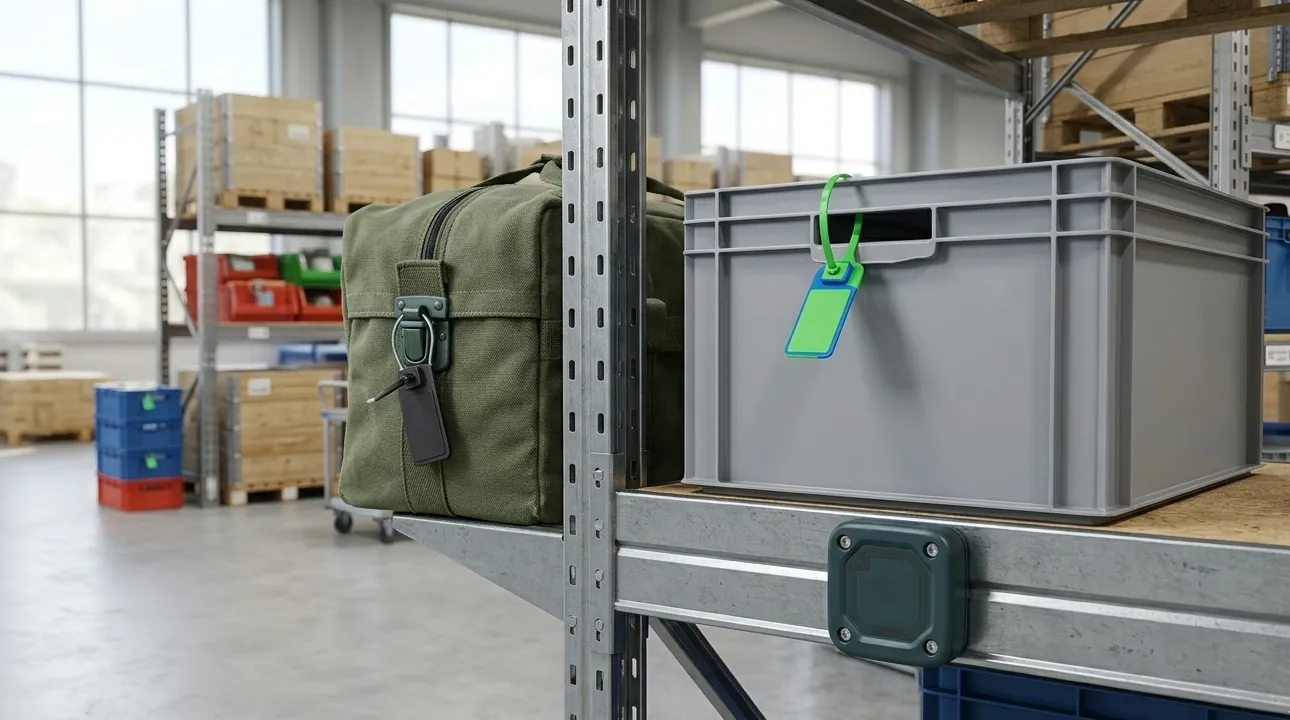
RFID tags are transforming inventory management efficiency because they change how stock data is captured. Instead of asking workers to count items manually or scan every barcode one by one, RFID lets tagged inventory be identified faster, often without direct line of sight. For buyers, the real question is: “Which RFID tag will work reliably on my products, surfaces, and workflow?”
That question is answered format by format in our guide to RFID asset tracking for tools and equipment; if you are scoping a stockroom or plant rollout, see the RFID asset tracking solution for how tags, readers, and software fit together.
Why RFID Tags Are Transforming Inventory Management Efficiency
Manual counts and barcode scans create friction wherever inventory moves quickly. A worker must find the item, see the label, scan it, and confirm the result. That becomes slow when there are thousands of cartons, mixed SKUs, high shelves, sealed boxes, or frequent audits.
RFID changes the capture method. A compatible RFID reader energizes nearby passive tags or communicates with active tags, and each tag returns its stored identifier. That means the inventory process can move from “scan every visible label” to “read many tagged items in a defined zone.”
The biggest efficiency gains usually appear in operations with:
- Frequent cycle counts or audits
- High SKU volume or item-level tracking requirements
- Cartons, pallets, bins, or garments that are hard to scan visually
- Receiving and shipping checks where speed matters
- Misplacement, shrinkage, or stockout problems caused by delayed data
RFID does not remove the need for good process design. It still depends on suitable tags, correct placement, compatible readers, and clean data handoff to inventory software. But when the tag selection is right, RFID can reduce repeated manual work and help teams see stock movement sooner.
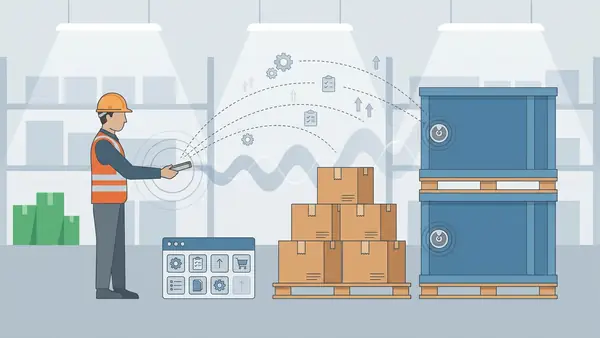
RFID vs Barcode: What Changes in Daily Inventory Work
Barcodes remain useful because they are inexpensive, familiar, and easy to verify visually. RFID becomes valuable when barcode scanning is too slow, too manual, or too dependent on visible labels.
| Workflow factor | Barcode | RFID tags |
|---|---|---|
| Line of sight | Required | Usually not required |
| Scan method | One label at a time | Multiple tags can be read in a zone |
| Labor demand | Higher for large counts | Lower for repeated bulk counts |
| Label cost | Very low | Higher than barcode labels |
| Best fit | Low-volume, visible-label workflows | High-volume, fast-moving, or hard-to-see inventory |
| Failure points | Damaged/hidden labels, missed scans | Metal/liquid interference, poor placement, read-zone issues |
| Human backup | Easy to read visually | Often paired with printed text or barcode backup |
In a warehouse, barcode scanning may still be enough for small batches, visible rack labels, or workflows where each item is already handled individually. In retail, barcode remains useful at checkout, returns, and low-cost labeling. In logistics, barcode labels are still common on shipping documents and cartons.
RFID becomes stronger when the process needs speed and visibility: counting garments on racks, confirming cartons through a dock door, tracking reusable bins, checking pallet contents, or locating assets that move across zones. Many companies use both technologies. A printed barcode and human-readable number can provide a fallback when a radio read is not the best tool.
The Efficiency Benefits Buyers Actually Care About
The practical benefits of RFID are operational, not abstract. Buyers usually care about whether RFID can reduce time, reduce errors, and make stock records more trustworthy.
Faster cycle counts and receiving
RFID can make cycle counting less disruptive because workers do not need to stop and scan each visible code. In receiving, RFID-tagged cartons or pallets can be identified as they pass through a read zone or as a worker scans a group with a handheld reader. This is especially useful when inbound goods arrive in mixed cartons or when frequent counts would otherwise interrupt picking and replenishment.
Better stock accuracy and fewer exceptions
Manual counts often lag behind actual movement. Barcode records are only as current as the last scan. RFID can support more frequent updates, which helps reduce misplaced inventory, stockouts, overstocking, and shipment exceptions. The advantage is strongest when each tagged item has a unique identifier, such as an EPC, instead of only a shared SKU code.
Lower labor pressure and fewer manual errors
RFID reduces repetitive scanning and typing. That matters in environments where workers scan hundreds or thousands of labels per shift. Fewer manual touches can mean fewer missed labels, fewer wrong scans, and less time spent reconciling count differences.
A useful way to evaluate RFID is to connect the business problem to the tag requirement:
| Inventory problem | RFID efficiency benefit | Tag selection implication |
|---|---|---|
| Slow manual cycle counts | Faster group reads | Passive UHF labels for cartons, bins, or retail items |
| Metal tools or racks miss reads | Reliable reads on conductive surfaces | On-metal RFID tags or foam-backed labels |
| Reusable logistics containers | Faster check-in/check-out | Rugged tags or seal/cable-tie tags |
| Garments or textile assets | Bulk counts and laundering traceability | Washable textile or PPS laundry tags |
| Tamper-sensitive shipments | Identification plus attachment security | RFID seal tie tags |
| Dense storage creates missed reads | Better placement and testing | Samples tested on real items before bulk order |
For broader inventory applications, see RFIDEcho’s RFID tags category and the RFID warehouse management application page.
Tag Selection Determines Whether RFID Efficiency Works
RFID efficiency depends heavily on the tag. A standard paper UHF label that works well on a carton may perform poorly on a metal tool, liquid container, outdoor cage, or washable textile.
Passive UHF labels for cartons, bins, and retail inventory
Passive UHF RFID labels are often the first choice for cartons, retail items, pallets, bins, and general warehouse inventory. They are thin, printable, and cost-effective for high-volume tagging. They can also carry printed text, a barcode, logo, or serialized number.
UHF is widely used in supply chain and inventory workflows because it supports longer read distances and bulk reads compared with close-range technologies. Standards and industry programs such as GS1 EPC/RFID and RAIN RFID help define common approaches for UHF item identification.
On-metal and rugged tags for tools, racks, and equipment
Metal can detune ordinary RFID inlays, causing weak reads or no reads. If the item is a metal shelf, tool, cylinder, machine part, returnable container, or equipment housing, buyers should consider RFID anti-metal tags or printable flexible on-metal labels.
Rugged tags are also important when the tag faces impact, outdoor exposure, abrasion, vibration, or cleaning. The housing material, adhesive, screw hole, cable tie, or embedded mounting method can matter as much as the chip.
Washable, cable-tie, and seal tags for special workflows
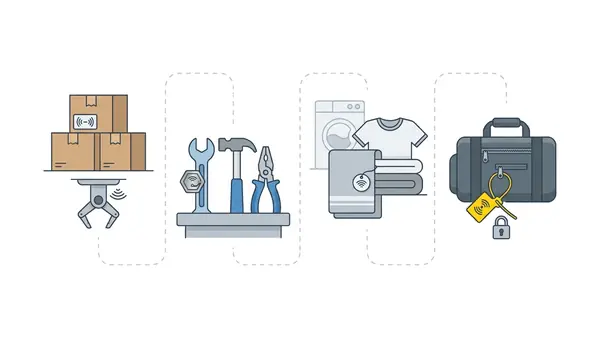
Inventory is not always a flat label problem. Laundry, cable assets, sealed bags, returnable transport items, and logistics cages often need special tag formats. Washable textile or PPS tags handle heat, pressure, and chemicals. Cable-tie tags attach around cables, pipes, or bundled assets. RFID seal tie tags support tamper-evident identification.
Common Mistakes That Reduce RFID Inventory Performance
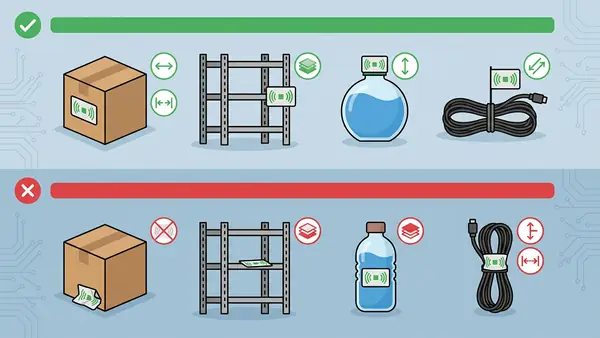
RFID problems often come from treating tags like ordinary stickers. A tag is also an antenna, so its environment affects performance.
Common mistakes include:
- Placing a standard label directly on metal without an on-metal design
- Tagging liquid-filled products without testing read distance and orientation
- Mounting the tag where the item blocks the antenna path
- Putting tags too close together in dense storage
- Ignoring regional frequency requirements
- Selecting a chip without enough memory or the required encoding format
- Forgetting printed barcode or human-readable backup where workers need it
- Ordering bulk tags before sample testing on real items
- Failing to define how duplicate reads will be filtered in the connected software
Before ordering, buyers should test sample tags on the actual product, packaging, shelf, or container. Test the intended read distance, orientation, stacking pattern, and environment. If the item will be washed, frozen, heated, bent, or exposed outdoors, include those conditions in the test.
How to Prepare an RFQ for Inventory RFID Tags
A clear RFQ helps suppliers recommend the correct samples instead of guessing. If the RFQ only says “we need RFID inventory tags,” different suppliers may quote completely different products.
Include these details when requesting a quote:
| RFQ item | What to provide |
|---|---|
| Application | Warehouse inventory, retail item tagging, logistics, tool tracking, laundry, seals, or asset tracking |
| Object details | Product size, material, packaging, flat/curved surface, metal or liquid content |
| Read requirement | Expected read distance, handheld or fixed reader, single item or bulk read |
| Region/frequency | Target market or operating region; UHF, HF/NFC, or LF if already known |
| Environment | Indoor/outdoor, temperature, moisture, chemicals, washing, impact, vibration |
| Mounting | Adhesive, screw, rivet, cable tie, embedded, hang tag, sewn-in, or seal |
| Chip and memory | EPC format, user memory, password, locking, serialization, or mandate requirements |
| Printing | Logo, barcode, QR code, serial number, color, human-readable text |
| Encoding | EPC/UPC relationship, starting numbers, data file, verification needs |
| Quantity and packaging | Sample quantity, bulk quantity, roll/core size, pieces per bag, delivery schedule |
For logistics and warehouse buyers, RFIDEcho can help confirm tag material, chip, frequency, printing, encoding, numbering, color, and packaging options. If the application involves metal, reusable containers, seals, or special environments, include photos or videos of the tagged object and the read scenario. For custom samples or procurement questions, use the contact page with as much application detail as possible.
FAQs About RFID Tags and Inventory Efficiency
Are RFID tags always better than barcodes?
No. Barcodes are still better for low-cost, low-volume, visible-label workflows. RFID is more useful when bulk reading, non-line-of-sight identification, faster counts, or more frequent inventory visibility justifies the higher tag and setup cost.
Which RFID tag type is best for warehouse inventory?
Passive UHF labels are often the best starting point for cartons, pallets, bins, and general stock. On-metal tags, rugged tags, cable-tie tags, or washable tags may be needed when the item surface or environment is difficult.
Can RFID tags work on metal shelves or liquid products?
Yes, but not with every tag. Metal and liquid can reduce RFID performance. Use on-metal or near-liquid tag designs when needed, and always test placement, orientation, and read distance before bulk production.
What should buyers test before bulk orders?
Test the tag on the real item, in the real environment, at the required read distance and orientation. Also confirm encoding, printed information, adhesive or attachment strength, and packaging format before approving mass production.