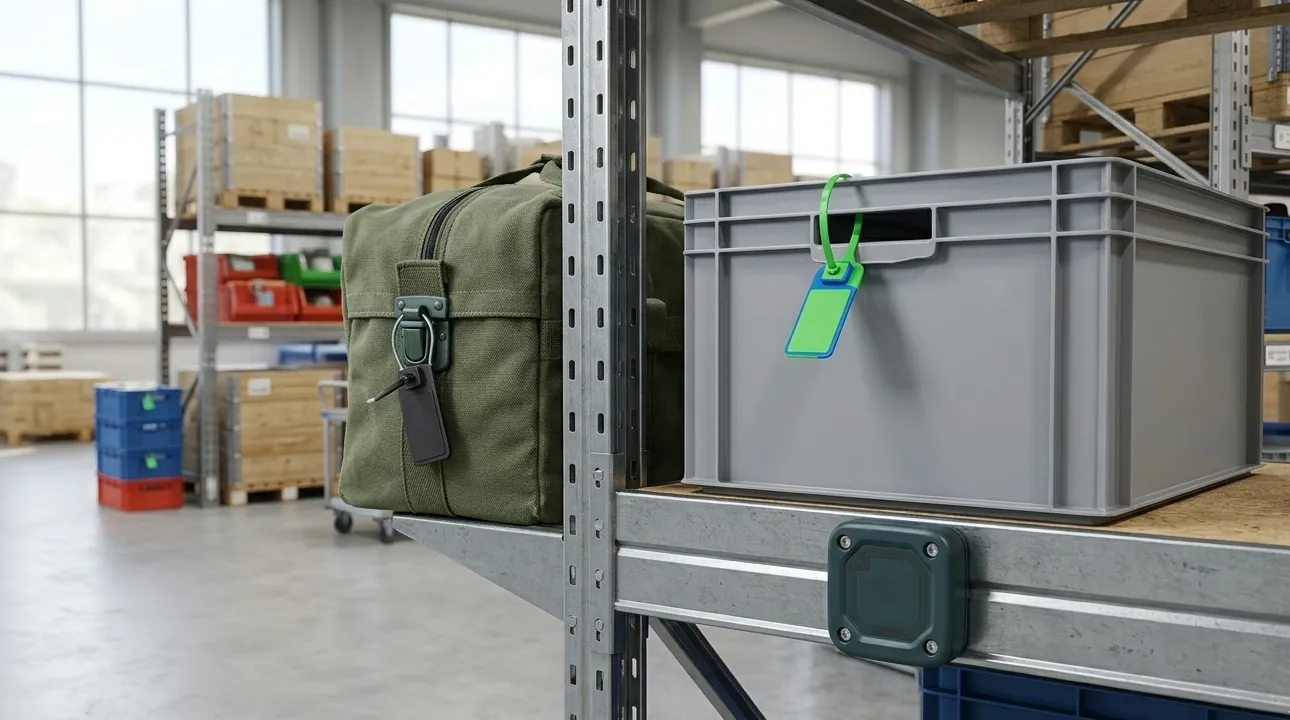
RAIN RFID operates in a frequency band shared by dozens of other wireless technologies. In the 900 MHz range — the primary operating spectrum for RAIN RFID in North America — co-channel interference is a real deployment variable, not a theoretical risk. This guide explains the sources of 900 MHz interference, how the EPC Gen2 protocol and tag design respond to it, and how to select RAIN RFID tags that hold up in RF-noisy environments.
Why the 900 MHz Band Is Shared — and Why That Causes Problems
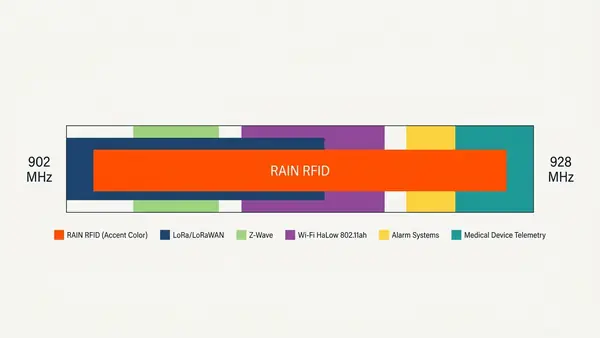
RAIN RFID in the United States operates in the 902–928 MHz ISM band under FCC Part 15. In Europe and most CEPT countries, the corresponding allocation is 865–868 MHz under ETSI EN 302 208. Both are unlicensed bands: any compliant device can transmit in them without a license and without any right to interference protection.
In the US band, RAIN RFID readers share spectrum with LoRa/LoRaWAN IoT sensors, Z-Wave home automation, 900 MHz cordless phones, alarm and security systems, smart meters and utility telemetry, Wi-Fi HaLow (802.11ah), medical device telemetry, toll transponders, and industrial wireless controls. FCC Part 15 Section 15.247 requires all devices — including RFID readers — to use frequency-hopping spread spectrum (FHSS) with at least 50 channel hops and a maximum dwell time of 0.4 seconds per 20-second period.
The fundamental interference mechanism is power asymmetry. An RFID reader transmits at up to 4 W EIRP, but the passive tag’s backscatter response can be 100 dB weaker. A co-channel RF source on the same frequency during the tag’s response window can mask that backscatter at the reader, reducing effective read range — even when the reader’s outbound transmission is unaffected. Liquid-filled packages absorb RF energy and metal surfaces reflect and detune tag antennas, compounding these effects.
Europe’s narrower 865–868 MHz allocation and mandatory Listen Before Talk (LBT) requirement reduce interference density compared to the US band, but also limit reader throughput. Buyers deploying globally should note that a tag tuned for 902–928 MHz will not perform well in the EU band without a wideband 860–960 MHz antenna design.
Common Interference Sources by Deployment Environment
Interference profiles differ significantly by environment. Identifying which co-channel sources are present at a site is the first step in determining which tags and reader settings are appropriate.
| Environment | Typical Co-Channel Interference Sources |
|---|---|
| Retail store | Wi-Fi HaLow (802.11ah), EAS anti-theft systems, cordless POS terminals |
| Warehouse / DC | LoRa sensor networks, forklift wireless communications, adjacent reader overlap zones |
| Manufacturing | Industrial wireless controls, frequency-hopping machinery telemetry, multiple simultaneous RFID readers |
| Healthcare | Medical device telemetry, cordless DECT phones, nurse-call systems, patient monitoring equipment |
In dense RFID warehouse management deployments, reader-to-reader interference is often more significant than external co-channel sources. Multiple fixed readers in a tight space transmit simultaneously, and without coordinated channel management the stronger reader signals can mask tag backscatter on shared channels.
How EPC Gen2 Handles Interference at the Protocol Level
The EPC Gen2 protocol (ISO 18000-63) provides three built-in interference mitigation mechanisms. These operate at the reader level; understanding them clarifies where tag selection becomes the critical variable.
Frequency Hopping and What It Means for Tags
In the 902–928 MHz US band, readers hop across at least 50 channels with a maximum dwell of 0.4 seconds per channel per 20-second window. This distributes read attempts across the band, reducing the probability that any single interferer consistently blocks reads. If a co-channel source is active on only a subset of channels, reads succeed on unaffected channels.
The limitation is meaningful: frequency hopping distributes interference risk but cannot eliminate it. When interference is broadband or present on many channels simultaneously — as in dense industrial or logistics environments — the reader spends more time on retries and throughput drops. If field strength at the tag falls below the chip’s activation threshold on too many channels, the tag stops responding regardless of how many retry attempts the reader makes.
Dense Reader Mode and the Q Anti-Collision Algorithm
Dense Reader Mode (DRM) addresses reader-to-reader interference specifically: it separates reader transmission frequencies from tag backscatter frequencies, preventing strong outbound reader signals from masking weaker tag responses. DRM only functions when all readers in the environment support and enable it simultaneously.
The Q algorithm manages tag-to-tag collision using slotted random-access timing. The reader adjusts the Q parameter dynamically based on collision rate, reducing the probability that multiple tags respond in the same slot. Gen2v3, released in January 2025, adds Query X and Query Y commands that allow readers to filter tags by attribute — useful for reducing clutter reads in dense tag populations — but this does not address external RF noise.
In high-interference environments, the binding constraint remains the tag’s chip sensitivity and antenna design. Protocol mitigations handle what the reader controls; tag selection determines whether a given tag can sustain reads when field strength is degraded.
Tag Characteristics That Affect Interference Resilience
Chip sensitivity (POTF threshold) is the minimum power-on-tag-forward required for the IC to activate and respond. This is measured in dBm; lower is more sensitive. When interference raises the noise floor or attenuates the reader signal reaching the tag, chips with lower POTF thresholds maintain reads that higher-threshold chips cannot. Leading IC families (Impinj R-Series, NXP UCODE, EM Microelectronic) offer passive chips with typical POTF thresholds between -20 and -22 dBm. A 3 dB sensitivity advantage translates to roughly 40% additional read range at the same conditions, or the equivalent read range under substantially more interference. Request POTF data sheets when shortlisting tags for noisy sites.
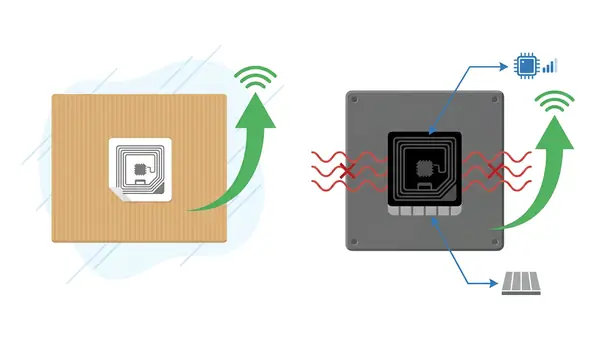
Antenna design and substrate interaction are often the dominant variables in real deployments. A standard paper label placed directly on a metal surface is severely detuned — the metal reflects the reader signal out of phase with the tag antenna, nearly eliminating read capability. Anti-metal RFID tags use a foam, ferrite, or PCB spacer layer to create a controlled gap between the antenna and the metal surface, preserving the antenna’s design characteristics. The RAIN Alliance Lessons Learned whitepaper recommends on-metal tags for metal surfaces and warns that large metal structures within the read zone degrade performance even for nearby non-metal tags.
In electrically dense industrial environments, on-metal tags offer better interference isolation than standard labels because their rigid substrate and controlled antenna geometry resist detuning by nearby reflective structures.
BAP (Battery Assisted Passive) tags add a battery that powers the IC, improving effective sensitivity by 15–20 dB. BAP tags still communicate by modulating the reader’s carrier signal — no active RF transmission — but can sustain reads where standard passive tags drop out entirely. They are appropriate for RFID asset tracking and high-value inventory in facilities where dense RF environments cause consistent passive tag read failures.
The 2025–2026 Regulatory Situation: What Buyers Should Know
The NextNav Proposal and the 902–928 MHz Band
In April 2024, NextNav Inc. filed a petition with the FCC to exchange its existing M-LMS spectrum licenses for a 15 MHz exclusive license in the 902–928 MHz band: a 5 MHz uplink at 902–907 MHz and a 10 MHz downlink at 918–928 MHz, for a terrestrial GPS backup service (5G PNT). All remaining Part 15 users — RAIN RFID, LoRa, Z-Wave, alarm systems, toll transponders — would be pushed into the residual 907–918 MHz window.
The FCC issued a public notice in August 2024 under WT Docket No. 24-240. Nearly 2,000 opposition filings were submitted, including responses from the RAIN Alliance, GS1 US, AIM Global, the US Chamber of Commerce, and multiple industry coalitions. The core technical objection: NextNav’s proposed 10 MHz downlink overlaps the most-used portion of the US RAIN RFID operating range, and a licensed high-power 5G downlink with Part 15 priority would reduce read reliability near NextNav base stations.
Practical Implications for Tag Buyers and Integrators
As of May 2026, the FCC has not issued a ruling. The petition remains pending under WT Docket No. 24-240. The 902–928 MHz band is not disrupted today; all current Part 15 RAIN RFID operations continue under existing rules.
For buyers:
- EU deployments on 865–868 MHz are not affected by this petition.
- No existing RFID tags would become hardware-obsolete if the petition were approved; impact would be on read reliability near NextNav base stations, not tag specifications.
- Buyers planning US deployments with a 5+ year horizon should monitor Docket No. 24-240 proceedings.
This regulatory question is structurally similar to broader 5G interference concerns for UHF RFID: a licensed transmitter raising the effective noise floor in bands where passive RFID operates as a secondary user.
Selecting RAIN RFID Tags for Interference-Prone Environments
The site conditions, protocol constraints, and tag characteristics above converge on a practical selection process. Use this checklist before specifying RFID tags for any environment where RF congestion is expected.
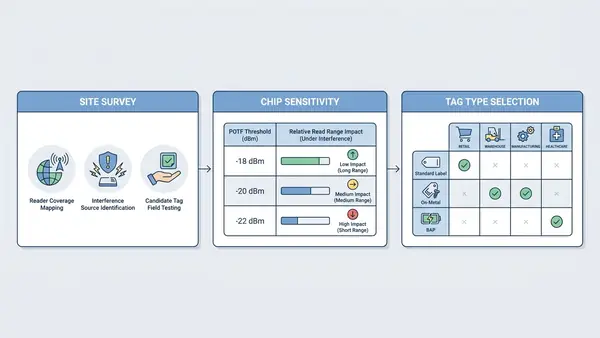
Run a site survey before committing to production volume. Map reader coverage zones, identify co-channel interference sources, and test candidate tags on actual items in actual conditions. The RAIN Alliance System Design Guidelines recommend designing read zones well within tag and reader limits — short-range coverage with margin outperforms maximum-range configurations when interference degrades signal strength.
Match tag type to surface and environment:
- Standard wet inlay / label tags: cardboard, paper, non-conductive plastics in moderate RF environments.
- On-metal tags: metal surfaces; also preferred in electrically dense industrial environments where metal structures create reflections.
- BAP tags: where read reliability is critical and passive tags fail at required range.
- Encapsulated hard tags: outdoor, high-vibration, or washdown environments.
Specify chip sensitivity in your RFQ. Request POTF threshold data (in dBm) and compare across shortlisted tags. A chip rated -21 dBm or lower provides 3+ dB of interference headroom over a -18 dBm chip at no additional cost.
For global deployments, specify wideband antennas (860–960 MHz) to maintain performance across both US and EU operating ranges.
RFQ parameters for interference-prone environments:
| Parameter | What to specify |
|---|---|
| Frequency range | 902–928 MHz (US), 865–868 MHz (EU), or 860–960 MHz (global) |
| Surface compatibility | Metal, plastic, cardboard, fabric, or mixed substrate |
| Chip POTF threshold | ≤ −21 dBm preferred for high-interference sites |
| Required read range | At stated reader power level — not maximum specification range |
| IP / ingress protection | IP67 or IP68 for washdown or outdoor use |
| Temperature range | Operating and storage limits for the deployment environment |
| Form factor | Label, hard tag, embedded, or encapsulated |
| Encoding and printing | EPC format, serial numbering, custom print, barcode overlay |
Contact RFIDEcho to confirm which tag materials, chip options, frequency ranges, and form factors are available for your specific environment and volume requirements.
FAQ
Does RAIN RFID interference affect all tags equally?
No. Tags with lower POTF thresholds maintain reads at lower effective field strength and are more resilient when interference degrades the available signal. Anti-metal tags are designed to resist detuning in metal-heavy and electrically dense environments, which adds stability independent of co-channel noise levels.
Can I use European 865–868 MHz tags to avoid 900 MHz interference in the US?
Not in practice. US RAIN RFID readers operate in the 902–928 MHz band under FCC Part 15. Tags antenna-tuned for 865–868 MHz will not perform adequately on US readers. For global deployments, specify wideband tags (860–960 MHz) that perform acceptably across both regions rather than single-band tags.
Will the NextNav FCC dispute make existing RFID tags obsolete?
No. Even if the FCC approves the NextNav petition, the impact would be reduced read reliability near NextNav base stations, not tag hardware incompatibility. No existing RAIN RFID tags would need replacement. The practical concern is degraded read range in affected urban zones — a system configuration problem.
What should I include in an RFQ for interference-prone deployments?
Include target frequency band, target surfaces (metal, plastic, cardboard), minimum chip POTF threshold (preferably ≤ −21 dBm), required read range at a stated reader power, IP rating, temperature range, form factor, and encoding or printing requirements. See the RFQ table above, then follow RAIN RFID tag encoding best practices.