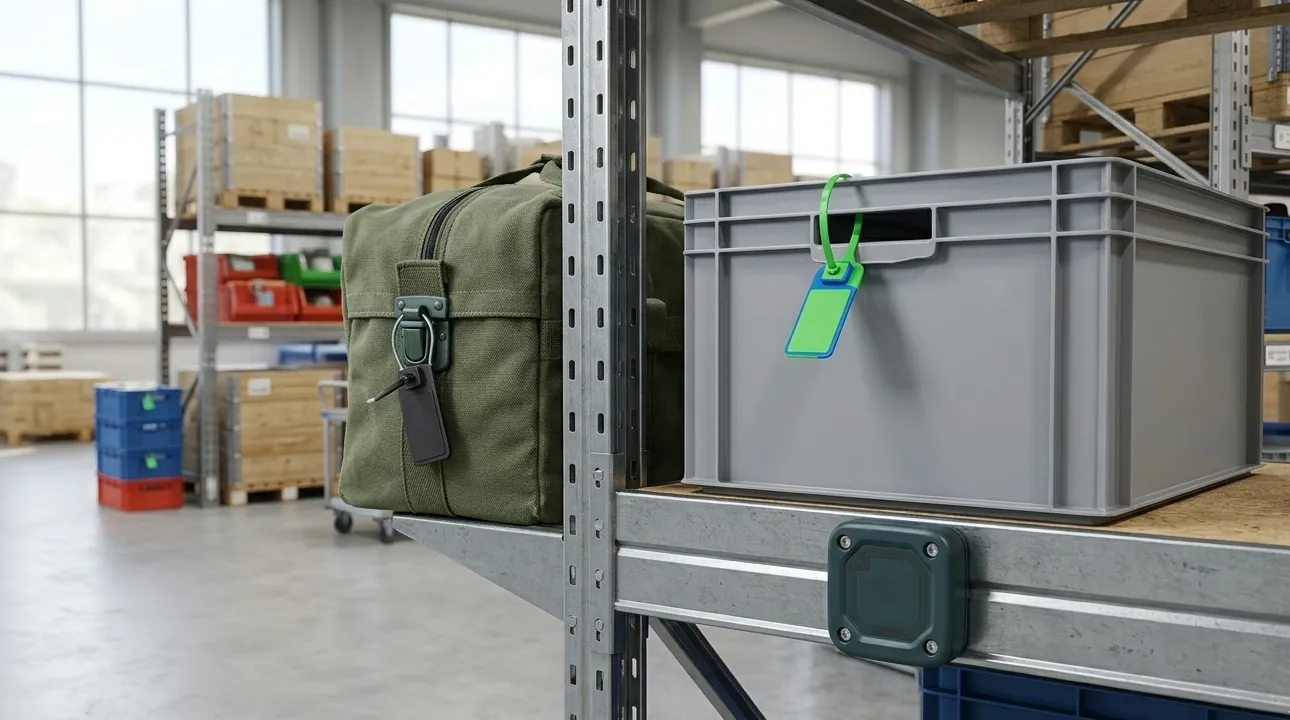
Will UHF RFID Be Interfered by 5G? In most warehouse, logistics, and factory deployments, normal 5G service will not directly stop UHF RFID tags from reading. The real answer depends on frequency overlap, transmitter power, reader density, tag mounting surface, and real-item testing.
In practice the mounting surface causes far more read failures than any nearby radio does. If reads are dropping on machinery, racking, or tooling, the fix is usually a tag built for metal rather than a spectrum problem — compare formats across our RFID tag range and the anti-metal RFID tags category.
Will UHF RFID Be Interfered by 5G?
Short Answer for Buyers
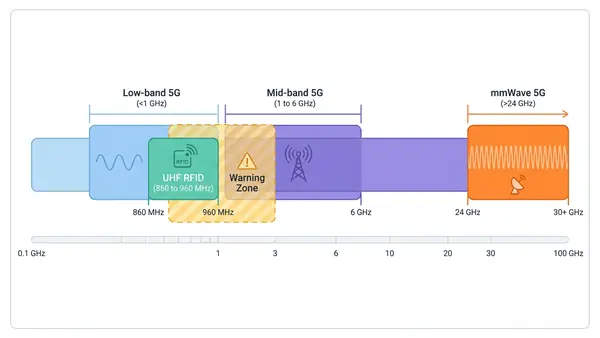
Usually, no. Standard UHF RFID tags operate in regional sub-GHz RFID bands, while most 5G networks use low-band, mid-band, or mmWave cellular spectrum that is not the same as the RFID read channel.
The risk becomes higher when one of these conditions is present:
- A private or public wireless system uses a frequency close to the local UHF RFID band.
- A high-power transmitter is installed close to the RFID read zone.
- Many RFID readers are operating near each other with overlapping read fields.
- Tags are mounted on metal, liquid-filled items, wet materials, or curved surfaces.
- Read failures began after changes to antennas, racks, reader power, or tag placement.
For tag buyers, the best approach is not to ask for a generic “5G-proof” tag. Choose the right UHF tag for the surface, read distance, regional band, and installation environment.
UHF RFID Frequencies vs Common 5G Bands
UHF RFID is commonly described as operating around 860-960 MHz. Academic research on UHF RFID tag antennas gives examples of EU 866-868 MHz and North American 902-928 MHz bands, and describes the worldwide UHF RFID band standard as 860-960 MHz in a peer-reviewed UHF RFID antenna study.
5G is broader. Sub-6 GHz 5G includes low-band and mid-band cellular spectrum, while mmWave 5G uses much higher frequencies above 24 GHz. A mid-band or mmWave 5G signal is far away from UHF RFID. A low-band cellular allocation below 1 GHz is closer, so it deserves more attention in site planning.
| Technology | Typical frequency area | Practical interference concern |
|---|---|---|
| UHF RFID | Around 860-960 MHz, depending on region | Main tag and reader operating band |
| Low-band 5G | Below 1 GHz in some markets | Possible adjacent-band concern if close to local RFID allocation |
| Mid-band 5G | Roughly 1-6 GHz | Usually separated from UHF RFID |
| mmWave 5G | 24 GHz and above | Usually far from UHF RFID, but short range and dense infrastructure can affect site layout |
| Wi-Fi/Bluetooth | 2.4 GHz, 5 GHz, 6 GHz depending on technology | More relevant for active 2.4 GHz tags than ordinary passive UHF tags |
If you are selecting tags for asset, pallet, tool, or warehouse tracking, start from the verified UHF tag category and intended object surface. RFIDEcho’s RFID tags page is a useful starting point.
When 5G or Other Wireless Signals Can Become a Risk
Direct Frequency Overlap and Adjacent-Band Problems
The highest risk appears when another system shares, overlaps, or sits very close to the UHF RFID band used in that country. This is why “5G” is too broad as a diagnosis. Mid-band 5G at several GHz is different from a low-band deployment near the 900 MHz region.
In the United States, UHF RFID commonly uses the 902-928 MHz band. Industry discussions around proposed higher-power use in that region show why adjacent-band planning matters. If a nearby service raises the noise floor or overloads RFID reader reception, the reader may miss the weak backscatter response from passive tags.
High-Power Transmitters, Dense Reader Sites, and Private Networks
A private 5G installation may coincide with RFID problems even when it is not the direct cause. New cabling, antennas, cabinets, access points, metal structures, or power changes can alter the RF environment. Dense RFID reader sites can also interfere with themselves.
Risk level depends on the full site picture:
| Scenario | Risk level | What to check first |
|---|---|---|
| Consumer phone using mid-band or mmWave 5G near tags | Low | Tag surface, orientation, reader settings |
| Private cellular equipment installed near RFID portals | Medium | Frequency plan, antenna distance, reader power, read-zone overlap |
| High-power service near the local UHF RFID band | High | Spectrum allocation, filtering, reader receiver behavior, pilot test data |
| Multiple RFID readers close together | Medium to high | Dense reader settings, channel plan, antenna direction, power level |
| Tags on metal racks, liquid containers, or wet products | High | Tag construction and mounting method |
Why Metal, Liquids, and Multipath Are Often Bigger Issues
Many read failures blamed on 5G are actually caused by basic UHF RFID physics. Metal reflects signals. Liquids absorb energy. Forklifts, shelving, doors, machinery, and concrete floors can create multipath reflections. If the tag antenna is detuned by the mounting surface, a stronger reader signal may not solve the problem.
For metal assets, compare standard labels with RFID anti-metal tags. The right tag construction usually matters more than the presence of a distant 5G base station.
How to Diagnose UHF RFID Read Failures Near 5G Equipment
Check the Tag, Surface, and Orientation First
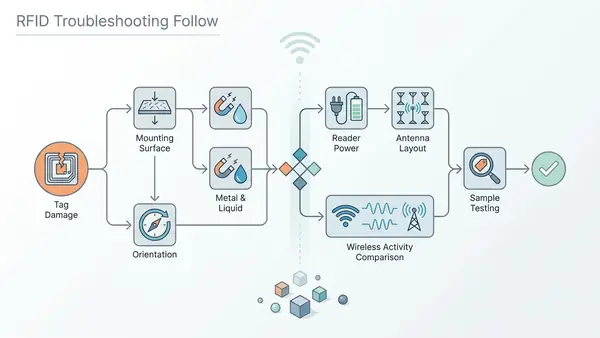
Start with the simplest tests. Read the tag in free air, then on the real item. Rotate it 90 degrees. Test it on a dry carton, then on a metal or liquid-filled object if that matches your application. If performance changes dramatically, the issue is probably tag detuning, polarization, or absorption rather than 5G.
Also check whether the tag is damaged, poorly encoded, too small for the read distance, or placed under shrink wrap, inside packaging, behind metal, or on a curved surface.
Compare Reads With and Without Nearby Wireless Activity
If failures truly correlate with nearby wireless equipment, test in two conditions:
- Normal site operation with 5G, Wi-Fi, machinery, and RFID readers active.
- Controlled operation with the suspected wireless source inactive or farther away, if safe and authorized by the site owner.
Record read rate, missed reads, ghost reads, distance, orientation, and reader power. A real interference problem should show a repeatable pattern.
Record Reader Settings, Antenna Layout, and Failure Pattern
Even though RFIDEcho focuses on tag selection and customization, reader-side conditions still affect tag choice. Document antenna type, read distance, reader power, portal width, number of readers, and whether the read zone is handheld, conveyor, doorway, cabinet, or shelf-based.
For inventory and asset workflows, the same tag may behave differently in open space and dense storage.
Tag Selection Tips for Sites With 5G, Wi-Fi, or Heavy RF Activity
Choose Tags for Surface and Environment, Not Only Frequency
A correct UHF frequency label is not enough. Choose tag construction according to the object:
- Cardboard cartons and plastic bins: standard UHF labels may work well.
- Metal tools, racks, and equipment: use on-metal, ceramic, PCB, or hard tags.
- Wet products or liquid containers: test spacing, waterproofing, and label position.
- Outdoor assets: check UV, temperature, impact, adhesive, and housing requirements.
- Long-range logistics: confirm tag antenna size and mounting position.
For rugged metal assets, options such as ceramic UHF anti-metal tags or ABS hard tags may perform more consistently than a standard wet inlay.
Consider Antenna Design, Chip Sensitivity, and Label Material
The research shows that antenna design can change tag gain and read range significantly. The same principle applies in procurement: a larger or better-tuned antenna, a more sensitive chip, and a material stack matched to the surface can improve reliability.
Useful tag details to compare include:
- Regional UHF band support.
- Chip model and memory needs.
- Antenna size and orientation sensitivity.
- On-metal or non-metal construction.
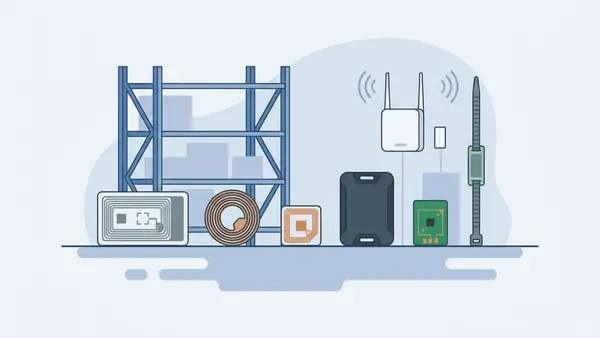
- Adhesive, foam spacer, housing, or cable-tie mounting.
- Printing, encoding, numbering, and packaging needs.
Test Samples Before Bulk Orders
Always test samples on the real item, not only on a desk. Include the expected read distance, reader type, tag angle, item movement, nearby racks, and normal wireless activity. For large logistics assets, a long-range UHF RFID seal tag may be appropriate, but the final choice should still be validated in the real route or gate.
What to Include in an RFQ if 5G Interference Is a Concern
A strong RFQ turns the interference concern into clear tag requirements. Include:
| RFQ item | What to provide |
|---|---|
| Country or region | Required UHF band and regulatory market |
| Nearby wireless systems | Public 5G, private 5G, LTE, Wi-Fi, Bluetooth, other RFID readers |
| Tagged object | Metal, plastic, glass, carton, liquid, textile, cable, tool, pallet, vehicle |
| Mounting position | Flat, curved, recessed, exposed, under wrap, near liquid, near metal edge |
| Read requirement | Distance, speed, direction, handheld or fixed read zone |
| Tag specification | Chip, memory, EPC encoding, size, printing, numbering, adhesive, housing |
| Environment | Temperature, humidity, washing, chemicals, UV, impact, outdoor exposure |
| Sample test | Quantity, test surface, success criteria, read-rate target, test schedule |
Do not simply write “site has 5G.” State where the 5G or private cellular equipment is located, whether it is low-band or mid-band if known, and whether read failures happen only near that area. RFIDEcho can help confirm tag material, chip, frequency, printing, encoding, and packaging options through the contact page.
FAQs About UHF RFID and 5G Interference
Can a 5G phone stop a UHF RFID tag from reading?
In normal conditions, a 5G phone is unlikely to stop a passive UHF RFID tag from reading. If a tag fails near a phone, check the tag surface, distance, orientation, and reader settings first.
Is 5G-A passive IoT the same as UHF RFID?
No. 5G-A passive IoT and ambient IoT discussions may use passive or battery-free device concepts, but they are not the same as ordinary UHF RFID tags used with standard UHF RFID readers. Some 5G-A passive IoT concepts use cellular bands, new protocols, and new tag designs.
Should I choose HF or NFC instead of UHF near 5G equipment?
Not automatically. HF and NFC can be better for short-range, close-tap, liquid-heavy, or item-level authentication use cases. UHF remains better for longer read range and bulk scanning. Choose the frequency based on workflow, read distance, material, and reader compatibility.
What is the safest procurement step?
Order samples before bulk production. Test two or more tag constructions on the real object, in the real read zone, while normal wireless equipment is active. That test is more useful than relying on a generic interference claim.