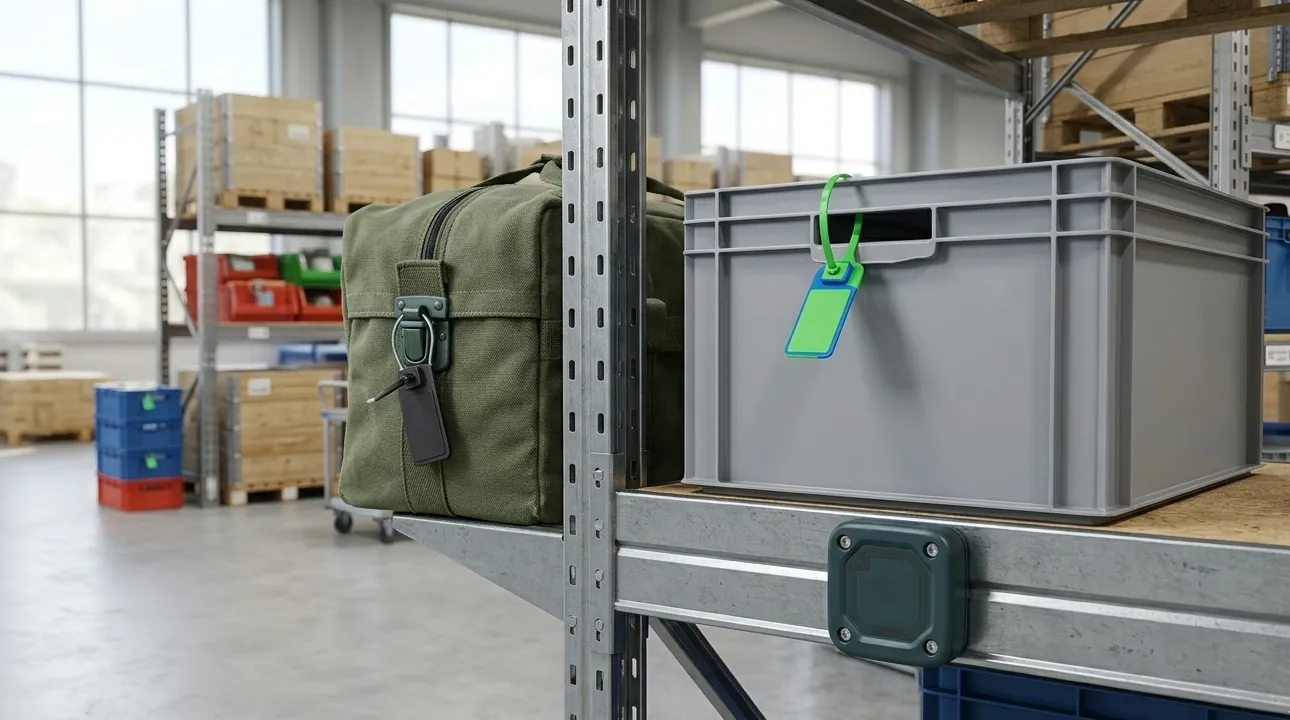
Metal asset tracking requires on-metal RFID tags because ordinary RFID labels are not designed to operate directly against conductive surfaces. When a standard label is attached to steel, aluminum, racks, tools, machinery, or containers, the metal can detune the antenna and collapse the usable read range.
For buyers, engineers, and integrators, the question is not simply “Does RFID work on metal?” It is “Which tag construction will stay readable on this asset, in this environment, with this read workflow?”
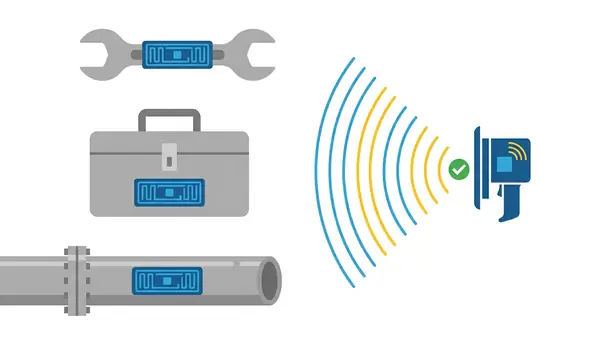
Why Standard RFID Tags Struggle on Metal
A passive RFID tag depends on its antenna to harvest energy from a reader signal and send back a response. That antenna is tuned for a specific operating environment. A paper or PET UHF label may work well on cardboard, plastic, or packaging, but direct contact with metal changes the antenna’s electrical behavior.
Metal creates three common problems:
- Reflection: RF energy bounces off the metal surface and can create multipath or dead zones.
- Absorption and shielding: conductive surfaces can reduce the energy available to the tag chip.
- Antenna detuning: the metal surface changes the antenna resonance, so the chip and antenna no longer match efficiently.
Atlas RFIDstore gives a clear practical explanation of this issue in its guide to RFID tags on metal surfaces: the challenge is different when a tag is attached directly to metal versus when metal objects are merely present in the surrounding environment.
This distinction matters. A metal cart near a read zone may reduce performance, but a normal RFID label stuck directly onto a steel tool can become unreadable. That is why metal asset tracking usually requires RFID anti-metal tags rather than standard labels.
What Makes an On-Metal RFID Tag Different
An on-metal RFID tag is engineered so the antenna can operate predictably on or near a conductive surface. Depending on the tag design, it may use a spacer, foam layer, ferrite material, shielding backplane, tuned antenna, ceramic substrate, PCB structure, or rugged encapsulated housing.
Some designs isolate the antenna from the metal. Others are tuned with the metal surface as part of the expected RF environment. This is why a tag optimized for metal may not perform the same way on plastic, wood, or cardboard unless it is designed as a universal tag.
Common formats include:
| Tag format | Best fit | Typical tradeoff |
|---|---|---|
| Flexible on-metal label | Metal tools, IT assets, cylinders, equipment plates | Lower profile, but less rugged than hard tags |
| Rugged hard tag | Containers, machinery, outdoor equipment, pallets | Durable, but thicker and usually higher cost |
| Ceramic or PCB mini tag | Small tools, molds, electronics, limited mounting space | Compact, but read range may be shorter |
| Hang tag or cable-tie tag | Assets with handles, pipes, cages, reusable items | Avoids direct metal contact, but can move or swing |
| Battery-assisted or active tag | High-value assets needing longer range or stronger response | Higher cost and battery management |
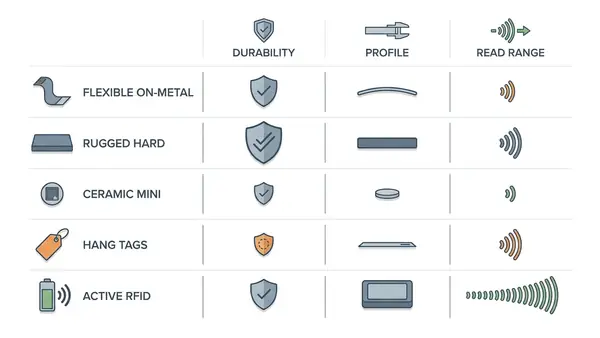
For a broader starting point, buyers can compare the main RFID tags category before narrowing the choice to anti-metal, hard tag, label, or customized formats.
When Metal Asset Tracking Requires On-Metal Tags
A true on-metal RFID tag is normally required when the tag must be mounted directly to a metal surface and remain readable during daily operation. Typical examples include:
- metal tools and molds
- industrial machines and maintenance assets
- steel containers, bins, and returnable transport items
- server racks and IT equipment
- kegs, gas cylinders, and tanks
- vehicle parts and automotive components
- oil, gas, railway, construction, and energy assets
However, not every asset that contains metal requires the same tag. The final mounting point is the deciding factor.
| Asset situation | Tag approach |
|---|---|
| Tag mounted directly on steel, aluminum, or other conductive surface | Use an on-metal RFID tag |
| Tag mounted on a plastic handle, rubber grip, or non-metal plate | A standard tag may work after testing |
| Tag attached to packaging rather than the asset | Standard RFID label may be enough |
| Tag hangs from a cable, handle, or loop away from metal | Hang tag or zip-tie tag may work |
| Dense metal environment but tag is not on metal | Test placement, orientation, and reader setup carefully |
This is especially important in RFID asset tracking projects, where missed reads can create false inventory records, lost-tool searches, duplicate audits, or unreliable maintenance logs.
How to Choose the Right On-Metal RFID Tag
Match tag format to the asset
Start with the asset shape and mounting area. A flat steel plate can accept a different tag than a curved pipe, small tool, server rack, or vibrating machine. Larger tags often provide longer read range because they can use a larger antenna, but the best tag is the one that fits the asset and survives the workflow.
Ask these questions first:
- Is the mounting surface flat, curved, painted, oily, rough, or exposed?
- How much space is available for the tag?
- Will the tag be hit, scraped, washed, heated, frozen, or exposed to chemicals?
- Does the tag need printing, numbering, barcode, QR code, logo, or color coding?
- Will the asset be read one at a time or in groups?
Define read range and workflow
Read range is not a fixed number from a datasheet. It depends on the tag, asset, reader antenna, power setting, orientation, local frequency band, nearby materials, and read workflow.
UHF RFID is usually preferred for metal asset tracking when buyers need longer range or multi-tag reading. HF or NFC on-metal tags may be better for short-range maintenance checks where a technician intentionally scans one asset at close distance.
RAIN Alliance resources also discuss RFID deployment lessons around materials, read zones, and tag selection. For standards and ecosystem context, see the RAIN Alliance resources library.
Check durability and attachment
A tag that reads well in a desktop test can still fail if it falls off, cracks, absorbs moisture, or cannot tolerate the cleaning process. For industrial metal assets, specify the attachment method as carefully as the chip or frequency.
Common attachment options include:
- industrial adhesive
- foam adhesive for spacing or uneven surfaces
- screws or rivets
- cable ties
- welding-compatible mounting points
- embedded or recessed mounting
- custom housing or overmolding
For warehouse or rack-heavy environments, RFID warehouse management workflows may also require testing for stray reads from neighboring shelves or containers.
Common Mistakes in Metal RFID Tag Selection
The most common mistake is testing a tag in the wrong condition. A standard label may read well in the hand and fail after it is attached to a metal asset. Buyers should test samples after final mounting, not before.
Other mistakes include:
- choosing a normal RFID label because it is cheaper, then discovering it cannot read on metal
- selecting only by maximum read range instead of asset fit and durability
- ignoring tag orientation relative to the reader antenna
- overlooking regional UHF frequency differences
- assuming adhesive will survive oil, heat, vibration, or outdoor use
- forgetting encoding, serialization, and printed ID requirements until after tag selection
- describing passive RFID tags as “real-time tracking” devices
Passive on-metal RFID tags enable reliable identification events when compatible RFID readers capture them. They do not provide continuous location by themselves. If an application needs RTLS-style location, active RFID or another location technology may be involved, but that is a different system design decision.
RFQ Checklist Before Ordering Samples
Before requesting samples or a quote, prepare enough information for the tag supplier to recommend a realistic construction. A useful RFQ includes:
| RFQ detail | Why it matters |
|---|---|
| Asset photos or drawings | Shows surface, size limits, and mounting constraints |
| Surface material | Confirms whether on-metal construction is required |
| Mounting area and curvature | Affects tag size, flexibility, and attachment method |
| Read distance and workflow | Determines UHF, HF/NFC, passive, BAP, or active direction |
| Indoor/outdoor environment | Affects housing, adhesive, UV, and moisture resistance |
| Temperature and chemicals | Affects material and adhesive selection |
| Reader type or workflow | Helps align tag performance with the buyer’s infrastructure |
| Frequency region | UHF bands vary by country and market |
| Printing and encoding | Prevents mismatch between physical ID and digital record |
| Sample test criteria | Defines pass/fail before bulk ordering |
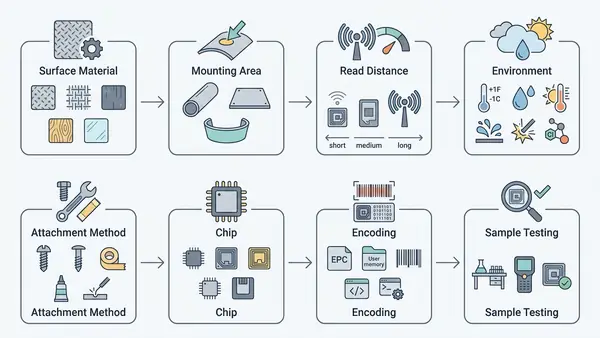
For custom projects, contact RFIDEcho with asset photos, mounting requirements, read workflow, frequency region, printing artwork, encoding format, quantity, and sample test goals. RFIDEcho can help confirm tag material, chip, frequency, size, printing, encoding, numbering, color, and packaging options for use with compatible RFID readers and management software selected by the buyer or integrator.
FAQ
Can regular RFID tags work on metal?
Not when a standard label is mounted directly on metal. It may work if placed on a non-metal part, on packaging, hung away from the surface, or separated by a spacer. For direct metal mounting, use an on-metal RFID tag and test it on the actual asset.
Are on-metal RFID tags always passive UHF tags?
No. Many metal asset tracking projects use passive UHF because it supports longer read range and multi-tag reading, but HF/NFC on-metal tags, battery-assisted passive tags, and active tags can also be used depending on the workflow.
Do on-metal RFID tags provide real-time location?
Passive on-metal RFID tags provide identification when read by compatible RFID readers. They do not continuously report location by themselves. Real-time location requires suitable reader infrastructure, software, and sometimes active tags or RTLS technology.
How should buyers test an on-metal RFID tag before bulk ordering?
Mount samples on the actual asset or a representative surface. Test the intended read distance, orientation, reader workflow, neighboring metal, handling, cleaning, vibration, and environmental exposure. Confirm both read performance and attachment durability before production orders.