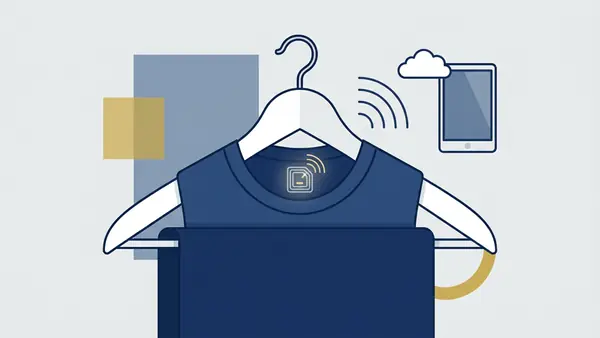

Sewn in RFID tags for apparel give each garment a durable digital identity without relying on a removable hang tag. For buyers, the main question is not simply “can this tag be sewn in?” It is whether the tag format, frequency, placement, and durability match the garment’s real lifecycle.
What Are Sewn-In RFID Tags for Apparel?
Sewn-in RFID tags are small RFID identifiers integrated into a garment by stitching them into a seam, hem, care label, brand label, or fabric pouch. They can support apparel inventory, uniform tracking, rental garment control, source tagging, authentication, and textile lifecycle records.
Common formats include:
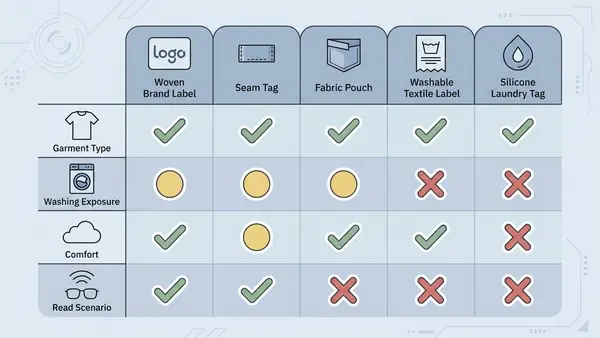
| Format | Typical use | Buyer note |
|---|---|---|
| Woven RFID care label | Garment identification and retail apparel | Comfortable, brand-friendly, and suitable for care-label integration |
| Seam tag | Discreet source tagging in apparel and accessories | Good when the tag should be hard to remove casually |
| Fabric pouch | Uniforms, linens, and textile services | Adds protection and can improve sewing flexibility |
| Washable textile label | Workwear, rental garments, and laundry workflows | Specify wash cycles, temperature, chemicals, and drying conditions |
| Silicone or PPS laundry tag | Harsh laundry or industrial textile use | More rugged, but may be less suitable for fashion comfort or appearance |
HID describes textile RFID tags as discreet devices that can be inserted into seams and hems, heat-sealed directly onto fabrics, or sewn into small pouches. Sensormatic’s 2026 sewn-in source-tagging announcement also shows why apparel brands are revisiting embedded tags: the goal is to preserve garment aesthetics while supporting item-level visibility, loss-prevention context, and authenticity signals.
When Sewn-In Tags Make More Sense Than Hang Tags
A hang tag is often enough when the RFID identity only needs to support retail inventory before checkout. It is easy to attach, easy to remove, and usually simple for stores and distribution centers. Sewn-in RFID is more useful when the identity should stay with the item.
Choose a sewn-in format when the project needs:
- A permanent or semi-permanent garment identity.
- Source tagging during garment production.
- A discreet tag that does not change the product’s look.
- Reduced risk of casual tag removal.
- Uniform, workwear, or rental garment tracking.
- Washable textile identification.
- Brand authentication or return-fraud investigation support.
For retail apparel deployment planning, the sewn-in tag decision should connect to the broader tagging strategy. A brand evaluating store operations may also need to compare tagging formats against the deployment challenges covered in apparel retail RFID deployment projects. If the buyer is still comparing barcode and RFID workflows, this barcode vs RFID tag guide is a useful starting point.
The important tradeoff is permanence. Sewn-in tags can support lifecycle visibility, but they also require earlier coordination with the garment factory. The buyer should confirm whether the tag will be sewn during production, added after production, or supplied to a service bureau or trim supplier.
Key Specifications to Choose Before Ordering Samples
Sewn-in RFID tags should be specified like a garment component and an RF component at the same time. A label that feels good but reads poorly will fail. A tag that reads well but irritates the wearer or disrupts the seam will also fail.
Frequency and read behavior
For bulk apparel inventory, UHF RAIN RFID is usually the practical choice because it supports longer-range and multi-item reads. A sewn-in UHF garment tag can be read in store, warehouse, carton, or production workflows when the reader setup and placement are suitable.
HF or NFC at 13.56 MHz is better for short-range tap interactions or specific textile/laundry requirements. Older sewn-in clothing guidance often referenced HF tags with a read range under 3 feet, while newer apparel source-tagging and garment label products increasingly use UHF for bulk identification. Buyers should choose based on the read scenario, not on the words “sewn-in” alone.
Material, size, and sewing zone
Ask for the tag’s physical size, material, thickness, sewing zone, and recommended placement. A woven RFID label may fit a care-label stack, while a silicone or PPS laundry tag may be better for heavy wash exposure but too bulky for fashion apparel.
For garment-focused sourcing, review RFIDEcho’s RFID Clothing Care Tag for Garments as a relevant product category example. For stronger laundry or textile-service applications, compare options under RFID laundry tags, see the RFID for laundry and uniform rental guide for frequency and attachment selection, or see the RFID laundry management solution page for hotel, healthcare, and rental-uniform workflows.
Chip, memory, and encoding
Many apparel projects only require a serialized EPC that points to a record in the buyer’s system. Others need TID capture, printed serial numbers, barcode or QR matching, logo printing, batch packaging, or locked encoding.
Before sampling, define:
- UHF or HF/NFC requirement.
- Chip family or memory requirement.
- EPC serialization format.
- Whether TID must be recorded.
- Whether the visible barcode or QR must match the encoded ID.
- Whether the tag needs logo, care text, numbering, or color customization.
The encoding plan should be confirmed before production. This RAIN RFID tag encoding best practices guide can help buyers prepare the data side of the tag order.
Placement, Sewing, and Production Checks
Placement is where many sewn-in RFID projects succeed or fail. The tag must be readable after it is sewn into the garment, and it must not create a comfort or quality issue.
Good production checks include:
- Confirm the supplier’s approved sewing zone.
- Do not stitch through the antenna or chip area.
- Avoid sharp folds, repeated crease points, and high-pressure finishing zones.
- Keep the tag away from locations that irritate skin.
- Check whether ironing, pressing, dyeing, or finishing could damage the tag.
- Test the tag after it is sewn into the actual garment material.
- Confirm that the tag can still be read in the expected orientation and distance.
A seam tag may work well for discreet source tagging, but the same placement might not be ideal for high-speed carton reads. A fabric pouch can protect the tag, but it adds bulk. A care-label RFID tag can feel natural to the wearer, but the antenna size and orientation still matter.
Factory workflow also matters. Source tagging can reduce later labor because the tag is added during normal garment production. Post-production retrofit gives more flexibility for pilots, but it can add handling cost and inconsistent placement. Buyers should ask the supplier for sample tags early enough to test with the real factory sewing method.
Testing Sewn-In RFID Tags Before Bulk Production
Do not approve bulk production based only on loose-tag samples. Test finished garment samples, then test the garments in the workflow where they will be used.
A practical test plan includes:
| Test area | What to check |
|---|---|
| Loose tag | EPC, TID, baseline read, dimensions, material, print quality |
| Sewn sample | Read performance after sewing, comfort, seam quality, label appearance |
| Care exposure | Washing, drying, ironing, pressing, chemicals, bending, and abrasion as relevant |
| Operational read | Store count, receiving, packing, carton read, uniform issue/return, or laundry scan |
| Data match | EPC file, visible serial number, barcode/QR, packaging sequence, and sample records |
Laundry-grade products may advertise 100 or 200+ wash cycles, but a fashion apparel label may only need home-laundry tolerance. Conversely, uniforms, workwear, hospitality garments, and rental clothing may need stricter commercial-laundry testing. The buyer should describe the actual care program instead of asking for a generic “washable RFID tag.”
Performance claims should also be treated carefully. Read range depends on tag design, placement, garment material, reader power, antenna setup, packing density, and workflow. A tag that reads well in open air may behave differently when sewn into a thick waistband, folded in a stack, or packed in cartons.
RFQ Checklist for Custom Sewn-In Apparel RFID Tags
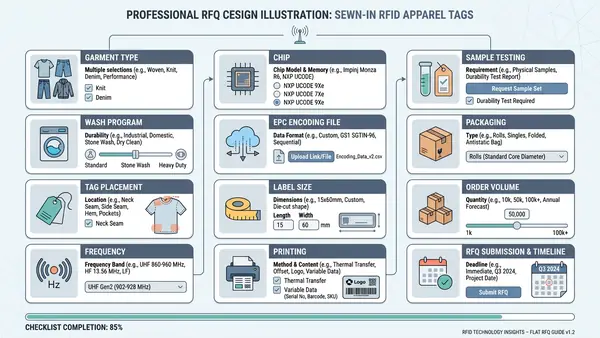
A clear RFQ helps the tag supplier recommend the right construction before samples are made. Include these details:
- Garment type: fashion apparel, uniform, workwear, sportswear, rental garment, or washable textile.
- Fabric and construction: material, thickness, stretch, lining, and intended tag location.
- Attachment method: sewn label, seam tag, hem tag, pouch, heat-seal, or other.
- Care conditions: home wash, commercial laundry, drying, ironing, pressing, sterilization, chemicals, or no wash requirement.
- RFID requirement: UHF, HF/NFC, chip preference, memory, protocol, and expected read distance.
- Data requirement: EPC format, TID recording, encoding file, QR/barcode, serial number, locking, or password protection.
- Customization: size, material, logo, care-label text, color, numbering, packaging, and roll/bundle format.
- Testing requirement: sample quantity, test garments, wash cycles, read points, and approval criteria.
- Commercial details: target quantity, destination market, lead time, and annual forecast.
RFIDEcho can help buyers confirm tag material, chip, frequency, size, printing, encoding, numbering, and packaging options for sewn-in apparel RFID tags. If you are comparing samples for a real garment program, share your garment details through the RFIDEcho contact page so the tag specification can be matched to the application.
FAQs About Sewn-In RFID Tags for Apparel
Can RFID tags be sewn into clothing?
Yes. RFID tags can be sewn into seams, hems, care labels, brand labels, or fabric pouches. The tag must be designed for the sewing method and garment use case.
Are sewn-in RFID tags washable?
Some are washable, but not all sewn-in tags have the same durability. A retail sewn-in source tag may only need normal garment handling, while uniforms or laundry textiles may require commercial wash-cycle, heat, chemical, and pressure testing.
Do sewn-in RFID tags affect comfort?
They can if the tag is too stiff, too thick, or placed in a skin-contact area. Buyers should test real sewn samples for comfort, seam quality, and garment appearance before bulk approval.
Should apparel use UHF RFID or NFC/HF?
Use UHF when the workflow needs bulk inventory reads, carton reads, or longer-range identification. Use HF/NFC when the project needs short-range tap interaction or a specific HF textile requirement.
What should I send when requesting custom samples?
Send the garment type, fabric, placement, wash program, frequency, chip/memory needs, encoding file requirements, printing needs, sample quantity, packaging preference, and expected order volume.