RFID blocking cards for NFC payment cards are popular because they promise a simple fix: place one thin card in a wallet and reduce unwanted contactless reads. For buyers and engineers, the useful question is not only whether they work, but what kind of NFC or RFID card format fits the actual application.
Most projects that start with a blocking card end up needing a card that carries an identity rather than suppresses one — access, membership, staff ID, or asset labelling. Those formats are in our RFID tag range, and specification options are on the custom RFID tag page.
Do RFID Blocking Cards for NFC Payment Cards Work?
Yes, an RFID blocking card can interfere with many NFC payment-card reads when it is placed close enough to the protected cards. Most contactless payment cards use short-range 13.56 MHz communication. A blocker works by absorbing, reflecting, detuning, or otherwise disrupting the reader field so the payment card cannot complete the exchange.
That does not mean every product protects every wallet layout. Performance depends on:
- The distance between the blocking card and the payment card
- Whether the protected card is in front of, behind, or far away from the blocker
- Wallet thickness, metal parts, and card-stack orientation
- Whether several contactless cards are stacked together
- The strength and antenna geometry of the reader being used
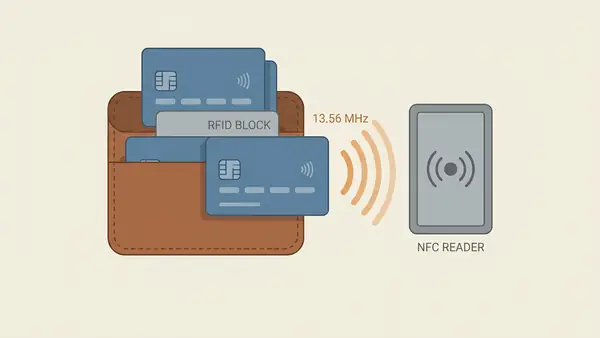
The risk also needs context. Unwanted proximity reads are possible, but modern payment fraud is more often linked to phishing, compromised merchants, stolen card details, or terminal skimmers. An RFID blocking card is best viewed as a low-friction shielding layer, not complete payment security.
NFC Payment Cards Are HF, Not UHF RFID
A common source of confusion is the word “RFID.” NFC is a type of RFID, but not all RFID is NFC. Most NFC payment cards, NFC business cards, transit cards, and many smart cards operate at 13.56 MHz in the high-frequency band. This is different from UHF or RAIN RFID, which usually operates around 860–960 MHz and is widely used for inventory, logistics, and item-level tracking.
| Technology | Typical frequency | Typical use | Practical read behavior |
|---|---|---|---|
| LF RFID | 125 kHz or 134.2 kHz | Animal ID, some access cards | Very short range, tolerant near water |
| HF/NFC RFID | 13.56 MHz | Payment cards, NFC tags, smart cards | Short range, near-field coupling |
| UHF/RAIN RFID | 860–960 MHz | Inventory, warehouse, logistics | Longer range, fast multi-tag reading |
For standards, NFC and contactless cards commonly relate to ISO/IEC 14443, ISO/IEC 15693, ISO/IEC 18092, and ISO/IEC 21481. UHF/RAIN RFID is usually discussed under EPC Gen2 and ISO/IEC 18000-63. GS1 US explains the practical split between NFC and RFID in its RFID versus NFC overview.
This distinction matters when sourcing. A shield intended for NFC payment cards should not be assumed to block UHF inventory tags. Likewise, a custom NFC anti-metal tag is designed to remain readable near metal; it is not the same product as a wallet-blocking card.
Blocking Cards vs Sleeves vs RFID Wallets
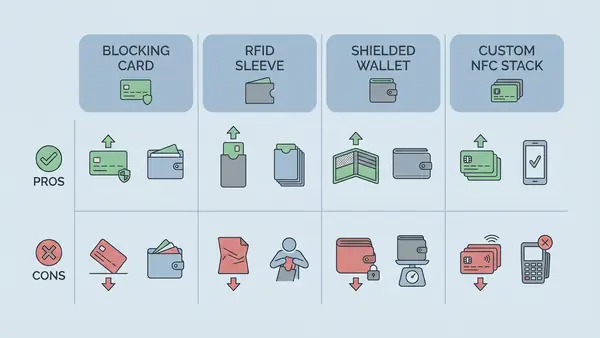
Different formats solve different problems. The best choice depends on whether you want convenience, predictable shielding, branding, or intentional NFC interaction.
| Format | Strength | Limitation | Best fit |
|---|---|---|---|
| Blocking card | One card may protect nearby cards | Depends on placement and claimed radius | Everyday wallet protection |
| RFID sleeve | More predictable per-card shielding | Card must be removed for use | Travel documents, occasional-use cards |
| RFID-blocking wallet | Built-in shielding and durability | May prevent intentional tap-to-pay | Consumer carry products |
| Custom NFC card/tag | Designed for intentional reads | Needs chip, antenna, and material selection | Access, marketing, authentication, patrol, branded cards |
For a single payment card, a sleeve can be more deterministic because it surrounds the card. For a wallet with several cards, a blocking card is more convenient but should be tested in the exact stack. For B2B projects, custom NFC or HF tags are usually the better discussion because the tag is supposed to read reliably in a defined workflow.
If your project involves surface-mounted NFC or RFID identification rather than payment-card shielding, review relevant tag families such as RFID anti-metal tags or broader RFID tag options.
How to Choose a Blocking or NFC Card Format
Start with the workflow, not the product name. “RFID card” could mean a passive access card, an NFC marketing card, a payment card, a blocking insert, or a UHF card-style tag. Each requires a different specification.
For consumer-style wallet protection, define:
- Whether one blocker must cover the entire wallet or only one card
- Which cards must remain usable without removal
- Acceptable wallet thickness and card count
- Expected lifespan and bending resistance
- Whether the product is passive shielding or an active-style interference card
For branded NFC cards or custom HF tags, define:
- Frequency and standard: usually 13.56 MHz, ISO/IEC 14443 or ISO/IEC 15693
- Chip family: NTAG, ICODE, MIFARE, DESFire, or another compatible option
- Memory size and whether data will be locked after encoding
- Material: PVC, PET, ABS, epoxy, PPS, paper, wood, or special construction
- Printing, numbering, QR code, UID handling, and packaging
- Whether the tag must work on metal, in moisture, outdoors, or inside packaging
For industrial and procurement teams, this is where RFIDEcho can help with tag selection and customization: material, chip, frequency, size, printing, encoding, numbering, color, and packaging. If the application is asset identification rather than payment-card protection, pages like RFID asset tracking and factors that affect the cost of RFID tags are more relevant than consumer wallet claims.
Testing, Limits, and Common Mistakes
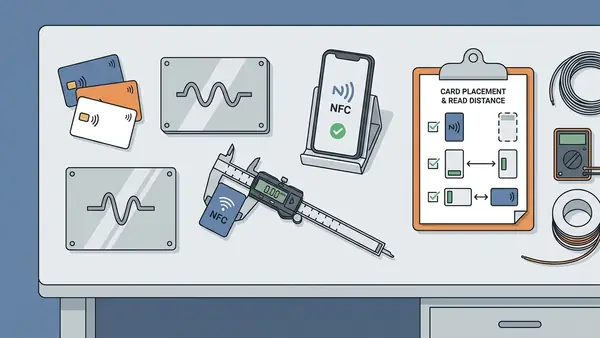
A quick phone test is useful, but it is not a full validation method. Phone NFC antennas vary by model, and payment terminals or access readers can behave differently. A better test repeats the same scenario across several orientations and real-use conditions.
Use this simple checklist:
- Test the card alone first to confirm it reads normally.
- Add the blocking card, sleeve, wallet, or packaging.
- Test front, back, edge, rotated, and stacked positions.
- Repeat with the actual phone, terminal, or access reader type.
- Record both read distance and read/no-read behavior.
- For bulk orders, test multiple samples before approval.
Common mistakes include assuming one successful phone test proves universal blocking, forgetting that metal wallet parts may change behavior, and ignoring card clash when several contactless cards are together. Another mistake is over-blocking: if a user expects to tap a transit card or access badge without removing it, strong shielding may create daily friction.
For custom NFC products, test the opposite outcome. The tag should read reliably when it is supposed to. Anti-metal backing, thick lamination, special printing, or packaging can all change read distance.
What to Include in an RFQ for NFC/HF Card Projects
A useful RFQ should describe the application and the technical constraints clearly. Include:
- Application: access, authentication, marketing, asset ID, patrol point, shielding, or packaging insert
- Frequency and standard: for example, 13.56 MHz NFC/HF, ISO/IEC 14443 or ISO/IEC 15693
- Chip and memory requirement, or the data payload to be encoded
- Read environment: phone model, reader type, metal surface, liquid exposure, outdoor use, or wallet stack
- Card/tag dimensions, thickness, shape, and material
- Printing artwork, color requirements, serial numbers, QR codes, or UID mapping
- Encoding, locking, password protection, and data format
- Sample test criteria before mass production
- Packaging, labeling, and batch separation requirements
If you are unsure whether the project needs an NFC card, an anti-metal NFC tag, a UHF tag, or a shielding insert, describe the workflow and environment first. You can also contact RFIDEcho to confirm tag material, chip, frequency, printing, encoding, and packaging options.
FAQ
Can RFID blocking cards stop all NFC payment fraud?
No. They can reduce proximity reads under the right conditions, but they do not stop phishing, online card-not-present fraud, terminal skimmers, data breaches, or physical wallet theft.
Do I need one blocking card for every payment card?
Not always. Some blocking cards are marketed to protect several nearby cards, but performance depends on placement and wallet layout. If you need predictable protection for one specific card, an individual sleeve may be more reliable.
Will a blocking card interfere with access badges or transit cards?
It can. If the access badge or transit card uses a compatible HF/NFC frequency and sits near the blocker, intentional reads may fail. Test the exact wallet or badge holder before daily use.
Are NFC blocking cards the same as anti-metal NFC tags?
No. A blocking card is meant to interfere with reading. An anti-metal NFC tag is engineered so the NFC tag can still be read when mounted on or near metal. They solve opposite problems.