NFC labels for trailer axles can make axle identification faster, cleaner, and less dependent on faded printed stickers. The challenge is that a trailer axle is a harsh metal environment, so the label must be selected for on-metal performance, outdoor durability, and real maintenance workflows.
An axle is one of the hardest surfaces in this category, but the failure mode is the same one seen across machinery, racking, and tooling: a standard label detunes against metal and stops reading. Formats built for that case are collected in our RFID tag range and the anti-metal RFID tags category.
Why trailer axles need more than a basic NFC sticker
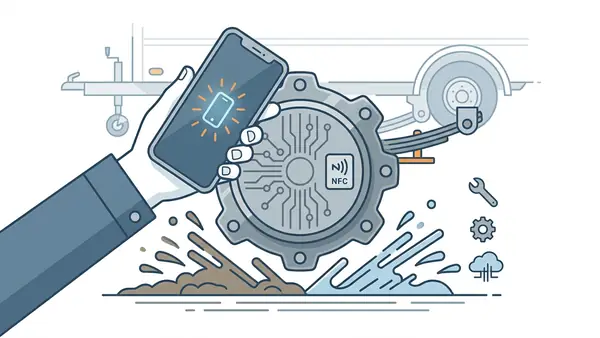
A trailer axle label often carries the information needed to identify the axle, confirm replacement parts, and access service documentation. Traditional printed labels can become dirty, scratched, unreadable, or hard to reach under the trailer. NFC adds a smartphone-readable layer: a technician taps the label and opens an asset record, part lookup page, inspection form, or maintenance instruction.
But a normal NFC sticker is not enough for most axle locations. NFC works at 13.56 MHz and relies on close-range magnetic coupling. When a standard NFC inlay is placed directly on steel, the metal can detune the antenna and absorb energy that should power the chip. The result is a tag that reads on the workbench but fails on the axle.
That is why trailer axle applications usually need an on-metal NFC label, a rugged NFC hard tag, or a protected embedded tag. Fleet and asset teams can also compare NFC with broader RFID asset tracking approaches when they need both tap access and longer-range identification.
NFC label options for trailer axle identification
The right format depends on whether the tag is applied by an axle manufacturer, retrofitted by a fleet, or added by an integrator for inspection and maintenance workflows.
| NFC label or tag format | Best fit | Main tradeoff |
|---|---|---|
| On-metal NFC label | Low-profile axle ID, printed serial numbers, QR+NFC labels | Needs clean surface preparation and adhesion testing |
| Rugged NFC hard tag | Exposed outdoor assets, high-touch service areas, impact risk | Thicker and usually higher cost than a label |
| Hub-cap embedded NFC tag | OEM axle identification and spare-part lookup | Requires controlled manufacturing or replacement process |
| Cable-tie or banded NFC tag | Tubular structures, retrofit mounting, surfaces unsuitable for adhesive | More visible and may need mechanical clearance checks |
| QR+NFC combination label | Smartphone tap plus visual fallback | QR portion still needs to remain clean and readable |
| Dual-frequency UHF+NFC tag | Tap access plus longer-range RFID workflows | More complex specification and compatibility validation |
For most retrofit projects, the starting point is a custom NFC anti-metal tag or another durable format from the RFID anti-metal tags category. NFC is best when the workflow requires a deliberate tap at the axle. If the goal is to scan many trailers from a distance, UHF RFID or dual-frequency tags may be more suitable.
Key specifications to check before ordering
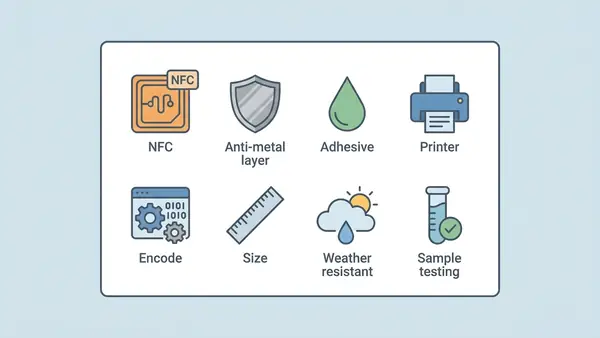
A good RFQ should define both the NFC electronics and the physical label construction. Do not specify only “NFC sticker.” For trailer axles, the supplier needs to know the mounting surface, environment, attachment method, data payload, and testing expectations.
Chip and memory
For simple axle identification, an NTAG213-class chip is often enough because the tag usually stores a short URL, app deep link, or asset ID. Larger chips such as NTAG215, NTAG216, or ICODE SLIX2 may be useful when the payload is longer or when the project requires a different NFC Forum tag type.
More memory does not automatically improve read performance. In many fleet and maintenance workflows, the better design is to store detailed axle specifications, service history, photos, and documents in the connected system, while the NFC label stores a compact pointer.
Standards and phone compatibility
NFC labels are commonly based on 13.56 MHz HF RFID. Many smartphone-readable labels use NFC Forum Type 2 / ISO 14443A chips such as NTAG21x. NFC Forum Type 5 / ISO/IEC 15693 options can be relevant for some asset and logistics use cases. The safest procurement question is: which phones, apps, and encoding format must read the tag?
The NFC Forum specifications describe the standards architecture behind NFC tag types and NDEF data. For a trailer axle label, NDEF compatibility matters because it lets phones interpret the tag as a URL, text, app link, or other standard record.
On-metal construction and adhesive
On-metal NFC labels normally use a ferrite or isolation layer between the antenna and metal surface. Avery Dennison explains that ferrite-based NFC inlays can isolate the magnetic field from a metal surface and redirect energy back toward the tag instead of losing it in the metal. That is the core reason anti-metal construction matters.
Adhesive is equally important. Trailer axles may expose the label to water, salt, dust, oil, grease, pressure washing, vibration, and curved surfaces. Ask about surface preparation, cure time, operating temperature, synthetic facestock, edge sealing, and whether a hard tag or mechanical fastening is safer than adhesive.
Where to place NFC labels on trailers and axles
The best location balances scan access, protection, and maintenance logic. The tag should be close enough to the axle to support identification, but reachable enough for a technician to tap safely with a phone.
Common candidate locations include:
- Hub cap or hub-cap cover
- Protected flat area near the axle label
- Chassis member close to the axle assembly
- Suspension bracket with enough clearance
- Banded tag on a tubular structure
- Nearby non-metal cover if it still clearly identifies the axle
SAF-HOLLAND’s NFC axle approach places chips in both hub caps so workshops can scan with a smartphone and access axle-specific documentation. Its documentation notes that NFC helps when dirty underbody conditions make QR codes difficult to scan, and that the phone detects the chip at a distance of a few centimeters. This is a useful model: place the tag where service teams naturally work, not just where the label is easiest to apply.
Avoid areas with direct stone impact, moving suspension parts, brake heat, repeated tool contact, or heavy grease buildup. Also check whether the phone can physically reach the tag when the trailer is loaded, parked, or inspected without a pit. For fleets with broader movement and yard workflows, RFID logistics tracking may complement axle-level NFC identification.
Encoding and workflow decisions
Before ordering labels, decide what happens when someone taps the tag. The physical label and the digital workflow should be designed together, even if different vendors provide the tag, phone app, and maintenance system.
Common encoding options include:
- A URL that opens an axle information page
- An app deep link that opens the correct asset record
- A serial number or asset ID stored as text
- A UID reference mapped in the backend system
- A QR+NFC pair using the same asset identifier
For most buyers, a short URL or asset ID is better than storing detailed data on the chip. The NDEF format is widely used for smartphone-readable NFC actions, but multiple-record payloads should be used carefully because many apps prioritize the first record.
Decide whether the labels should be rewritable during setup or locked after production encoding. Rewritable tags are convenient for pilot programs. Locked or password-protected tags are better when the axle identity should not change after installation.
Pilot testing and RFQ checklist
Pilot testing should use real trailers, real phones, and real axle locations. Do not approve a label only because it scans on a sample card.
Test the following before bulk production:
| Test area | What to verify |
|---|---|
| On-metal read performance | Scan success on the actual axle, hub cap, or bracket |
| Phone compatibility | iPhone and Android models used by technicians |
| Placement ergonomics | Whether a technician can tap safely and consistently |
| Adhesion | Cleaned surface, cure time, curved surface, edge lift |
| Outdoor durability | Rain, humidity, dust, salt, UV, and temperature change |
| Service exposure | Grease, oil, pressure washing, abrasion, tool contact |
| Encoding | Correct URL, asset ID, UID mapping, and lock status |
| Print quality | Serial number, QR fallback, logo, warning text, and legibility |
A U.S. Forest Service label test found that rough surfaces let water enter under labels, causing adhesive loss and peeling, while paper and non-synthetic labels suffered water damage. Polyester and other synthetic labels performed better in harsh conditions. For axle labels, that supports using synthetic materials, strong adhesive, and real surface testing.
Include these details in the RFQ:
- Trailer and axle type, with mounting-location photos
- Metal or non-metal surface, curvature, coating, and cleanliness
- Required NFC chip, memory, and NFC Forum type if known
- NDEF payload, URL format, app link, or asset ID structure
- Encoding, numbering, QR fallback, and locking requirements
- Label size, shape, print artwork, and readable text
- Adhesive, ferrite layer, hard-tag housing, or mechanical attachment
- Environmental exposure: heat, cold, water, salt, oil, grease, vibration
- Sample quantity and acceptance criteria
- Packaging, roll/fanfold/singulated delivery, and production serialization
RFIDEcho can help buyers confirm tag material, chip, anti-metal construction, printing, encoding, and packaging options. For custom samples, share trailer photos, mounting location, expected scan workflow, and environmental requirements through the contact page.
FAQs about NFC labels for trailer axles
Can NFC labels work directly on metal trailer axles?
Yes, but only if the label is designed for on-metal use. A standard NFC sticker may fail on steel because the metal interferes with the antenna. Use ferrite-backed on-metal NFC labels or rugged anti-metal tags.
Is NFC better than a QR code for axle identification?
NFC is better when labels get dirty, when the workflow requires a deliberate tap, or when users should open a record without aiming a camera. QR codes are inexpensive and useful as a visual fallback, but they need line of sight and readable print.
What chip is best for NFC trailer axle labels?
For simple URL or asset ID use, NTAG213 is often sufficient. If the payload is larger, the project may need NTAG215, NTAG216, ICODE SLIX2, or another chip. Confirm phone and app compatibility before ordering.
Should the NFC label store all axle data?
Usually no. Store a short pointer, such as a URL or asset ID, and keep detailed axle specifications, service history, and documents in the connected system. This makes updates easier and reduces chip memory requirements.