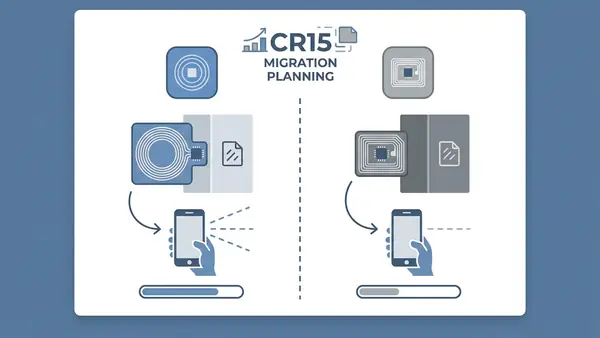
NFC Forum CR15 certification migration matters because Release 15 changes the baseline expectation for certified NFC operating volume. For NFC tag buyers, the practical question is not only “does CR15 support 20 mm?” but “will this tag design still read reliably on my product, with my devices, after sourcing and production changes?”
Certification level is one line on a specification. If you are writing the rest of that specification — inlay, antenna, substrate, encoding, and artwork — see how those choices are set out for custom RFID and NFC tags.
What CR15 Changes in NFC Forum Certification
NFC Forum Release 15 extends the operating volume for certified compliant NFC interactions from the older OV5 baseline, about 5 mm, toward OV20, up to 20 mm under the relevant certification conditions. NFC Forum describes this as a fourfold range increase intended to reduce failed taps, make alignment less precise, and support use cases such as digital keys, wearables, transit, access control, wireless charging negotiation, and Digital Product Passport labels.
Certification Release 15, or CR15, is the companion test program for certifying products against NFC Release 15. NFC Forum’s CR15 launch explains that the certification program lets businesses test for the extended 20 mm read range for generic device classes and demonstrate conformance to the latest functional standards. See the NFC Forum CR15 launch announcement for the official standards context.
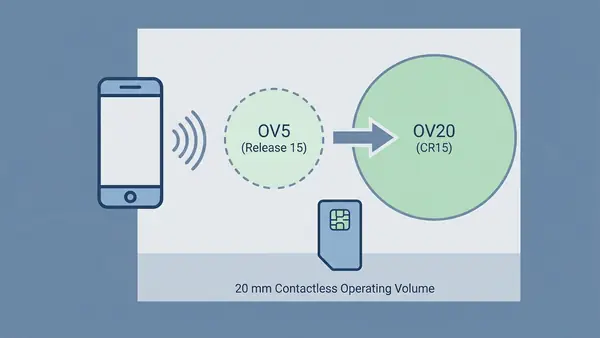
For sourcing teams, the key caution is that “up to 20 mm” is not a universal promise for every NFC label. The certified operating volume depends on the product class, antenna design, phone or reader position, tag material stack, and test conditions. A small embedded tag on metal will not behave like a large card-format inlay on plastic.
Who Needs to Plan a CR15 Migration?
CR15 planning is most urgent for teams designing new NFC Forum-compliant devices, NFC modules, access products, automotive digital key products, transport devices, wearables, or smartphone reader-mode interactions. Industry coverage of CR15 reports that new Mobile, Reader, Card Emulation, and Universal device classes are expected to support OV20, while very small tag devices may face physical limits and may have OV20 or OV5 choices depending on the category.
Previously certified or deployed NFC products do not suddenly stop working. A major CR15 theme is backward compatibility with OV5 devices already in the field. That means buyers should plan for a transition period: new devices may target OV20 while many installed phones, modules, or existing NFC products still perform closer to the older range.
NFC tag buyers should review CR15 when:
- the product is entering a certification or recertification cycle;
- the tag must support digital key, DPP, access control, transport, or authentication use cases;
- the tag is small, embedded, curved, or placed near metal or liquid;
- the brand wants more forgiving tap behavior;
- the supplier may change chip, antenna, adhesive, ferrite, or converter process.
RFIDEcho’s role in this type of project is tag customization and procurement support. Buyers can review broad NFC and RFID tag options under RFID tags, then confirm the official certification path with NFC Forum resources or an Authorized Test Lab when certification is required.
Certification Paths: Full, Inheritance, Rename, and Updates
The NFC Forum certification resources describe certification releases, device requirements, Authorized Test Labs, Test Case Category List documents, policy files, and pricing references. The right path depends on whether the product is new, based on certified components, rebranded, updated through software, or tested by an approved first-party lab.
| Path | When it may apply | Buyer question |
|---|---|---|
| Full Certification | New product or implementation requiring complete testing | Which Certification Release and device class apply? |
| Inheritance | Product uses certified subsystems or prior certified implementation | Which analog or digital test cases can be inherited? |
| Rename | Already certified product is renamed or rebranded | What certificate or listing is being referenced? |
| OS update | Certified device receives software update with no hardware change | Does the update affect NFC stack, ICS, IXIT, or test cases? |
| First Party Lab | Eligible member operates approved internal lab | Is this path available to the supplier or device maker? |
For tag procurement, avoid treating “CR15-ready” as a complete answer. Ask whether the claim refers to the NFC chip, inlay, finished label, module, reader device, or the buyer’s full product. Also ask whether any test report is from an Authorized Test Lab and whether a design change would require revalidation.
What CR15 Means for NFC Tag Selection
Extended range makes tag engineering more visible. The chip matters, but the antenna and finished construction often matter more. NFC Forum commentary on Release 15 notes that extending range while keeping compact antenna designs requires careful physical and technical tradeoffs. In real products, performance depends on chip type, antenna geometry, label size, product material, phone antenna position, tag orientation, and manufacturing consistency.
For example, controlled third-party testing has shown ISO15693 Type 5 tags such as SLIX2 or ST25TV512 can achieve longer read distances than common ISO14443-A Type 2 chips, but Type 5 can trade range for slower throughput. For many consumer labels, Type 2 remains practical because it is widely supported and fast for short NDEF records. The right choice depends on payload, device compatibility, scan distance, and user behavior.
Surface material is equally important. Standard NFC labels placed directly on metal can become unreadable because metal disrupts 13.56 MHz inductive coupling. For metal products, compare custom NFC anti-metal tags with a normal label plus a spacer. Ferrite-backed tags can help, but buyers should still test the final stack because on-metal construction may reduce range compared with a normal tag on non-metal material.
Migration RFQ Checklist for NFC Tags and Labels
A CR15 migration RFQ should combine standards language with practical tag manufacturing details. The supplier cannot decide your official certification obligation, but they can provide the tag specifications and samples needed for engineering validation.
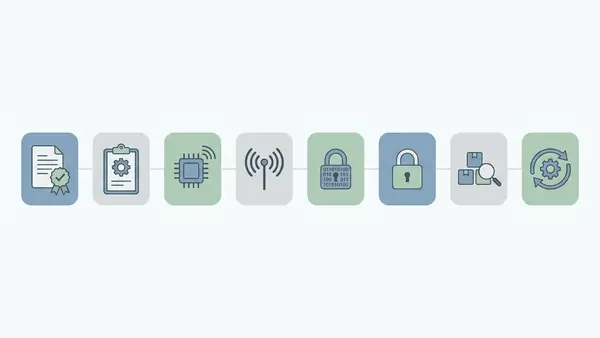
Include these items in the RFQ:
| RFQ area | Details to request |
|---|---|
| Standards context | Target NFC Forum release, device class, certification evidence needed, test lab involvement |
| Chip and memory | Chip model, NFC Forum tag type, ISO standard, memory size, UID handling |
| Antenna | Finished size, antenna geometry, expected read distance, recommended tap location |
| Encoding | NDEF record type, URL or payload length, serialization file, locking plan |
| Security | Password, originality signature, authentication, privacy or anti-cloning needs |
| Materials | Product surface, adhesive, ferrite, spacer, temperature, curvature, packaging format |
| Validation | Sample quantity, test phones or readers, pass/fail distance, orientation, aging tests |
| Change control | Rules for chip, antenna, converter, adhesive, or ferrite substitutions |
For durable field tags such as patrol, asset inspection, or traceability points, review product examples like NFC patrol point tags. If the project involves brand protection or lifecycle traceability, NFC tags can also support workflows connected to RFID security and traceability when used with compatible reader devices and software chosen by the buyer.
Common CR15 Migration Mistakes
The first mistake is assuming every NFC tag will read at 20 mm because CR15 mentions OV20. A tiny tag, a weak antenna, a metal surface, or a poor phone tap position can still limit range.
The second mistake is changing the tag construction after validation. A different chip, antenna supplier, ferrite layer, adhesive thickness, or die-cut size can change read behavior. Freeze the validated construction or require supplier notice before any substitution.
The third mistake is confusing tag customization with official certification. RFIDEcho can help buyers specify NFC/RFID tag material, chip, frequency, printing, encoding, numbering, and packaging options. It should not be treated as an NFC Forum testing authority or full compliance authority. For official certification, use NFC Forum documents and Authorized Test Labs.
The fourth mistake is skipping real-product tests. A lab card test is useful, but it cannot replace samples mounted on the final package, device housing, metal asset, textile, or consumer product. For a supplier review or custom sample request, use the RFIDEcho contact page with product surface photos, target phones, payload requirements, and expected scan distance.
FAQ
Is CR15 mandatory for every NFC tag project?
No. CR15 matters when a product needs NFC Forum certification or when the buyer wants Release 15 compatibility planning. Many ordinary NFC label projects only need reliable performance with the buyer’s chosen devices and use case.
Do older NFC products stop working after CR15?
No. CR15 emphasizes backward compatibility with OV5 devices already in the field. Migration is about new certification expectations and better user experience, not breaking older products.
Can an NFC tag supplier guarantee 20 mm read range?
A supplier can provide sample test data and design recommendations, but real read range depends on phone model, antenna alignment, tag size, material, metal proximity, encoding, and production quality. Always validate on the actual product.
Does RFIDEcho provide NFC Forum certification?
No. RFIDEcho focuses on NFC/RFID tag customization, including chip, antenna, material, printing, encoding, numbering, and packaging options. Official certification should be confirmed with NFC Forum resources or an Authorized Test Lab.