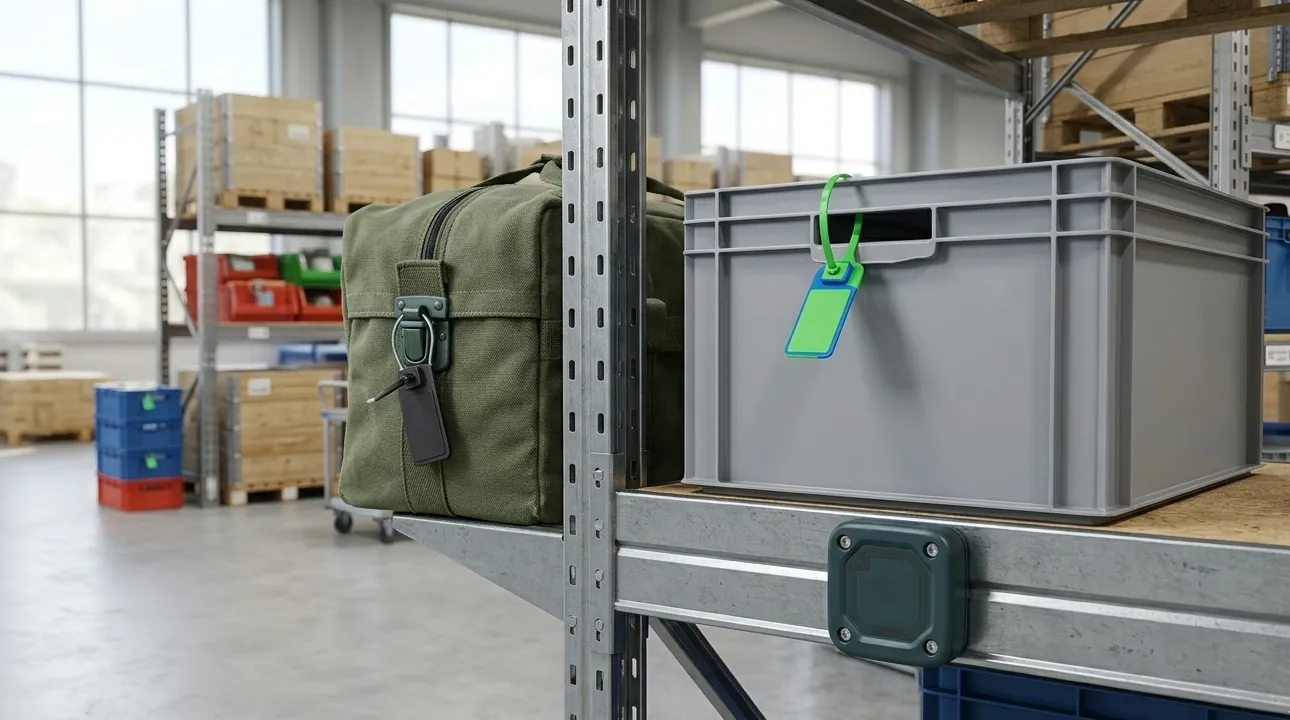
Guide to Selecting RFID Tags for Effective Inventory Control
A practical guide to selecting RFID tags for effective inventory control should start with the inventory workflow, not the tag catalog. The best tag for a cardboard retail carton may fail on a metal tool, a reusable plastic crate, a liquid-filled container, or an outdoor asset exposed to UV and vibration. A good selection process connects the tagged item, read scenario, surface, environment, memory, encoding, and attachment method before any high-volume order is placed.
RFID can improve inventory control because tags can be read without line of sight and many items can be captured in one pass. But read accuracy depends heavily on tag selection. RFIDEcho supplies and customizes RFID tags for different surfaces, frequencies, chips, printing, encoding, and packaging requirements, so the buyer’s specification should be clear before samples are requested.
Start With the Inventory Workflow, Not the Tag Catalog
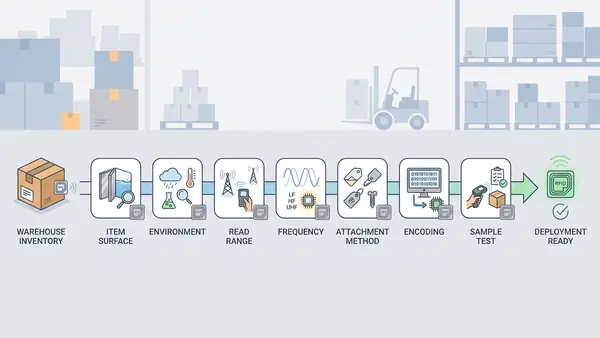
Begin by defining what the inventory event must prove. A cycle count in a retail stockroom is different from confirming pallets at a dock door, locating metal tools, tracking reusable totes, or identifying goods on high warehouse racks.
Document these details first:
- Item type: individual product, carton, pallet, bin, tool, cage, tote, rack, or reusable transport item.
- Read point: handheld count, shelf read, conveyor, portal, packing station, receiving dock, or outdoor yard.
- Read volume: one item at a time, a carton stack, a pallet load, or hundreds of tags in a zone.
- Required read distance: the minimum distance that must work, not the longest distance desired.
- Surface and environment: cardboard, plastic, metal, liquid, glass, cold chain, chemicals, abrasion, UV, or vibration.
- Data requirement: EPC only, serialized GTIN, batch data, user memory, barcode print, QR code, or human-readable serial number.
- Tag lifespan: disposable label, shipment label, reusable container tag, or multi-year asset tag.
This workflow definition prevents two common mistakes: choosing the cheapest label for every item, and choosing a long-range tag that creates stray reads where short, controlled reads are needed.
Choose Frequency and Power Source for the Read Scenario
Most inventory-control projects start with passive UHF RFID because it is cost-effective, battery-free, and suited to bulk reads across warehouses, logistics, and retail operations. Passive UHF tags commonly support item, carton, pallet, and asset visibility when they are paired with compatible RFID readers and inventory management software.
Other choices still matter:
| Choice | Best fit | Main limitation |
|---|---|---|
| LF RFID | Very short-range reads near metal, liquids, animals, or people | Short read distance and limited bulk-read capability |
| HF/NFC | Controlled close-range item confirmation, cards, libraries, healthcare items | Not ideal for long-range warehouse bulk scans |
| Passive UHF | Retail inventory, cartons, pallets, warehouse bins, asset audits | Sensitive to metal, liquids, placement, and dense stacking |
| Semi-passive/BAP | Longer range or sensor-assisted workflows such as cold-chain monitoring | Higher cost and battery considerations |
| Active RFID | Vehicles, yards, high-value assets, very long read distances | Larger tag, higher cost, battery maintenance |
For warehouse and retail inventory, passive UHF is usually the scalable default. For water-rich products, dense metal environments, or short-range verification, LF, HF, or a specialized UHF construction may be a better fit.
Match RFID Tag Type to Item Surface and Environment
Surface compatibility often matters more than claimed read range. A datasheet read distance measured in open air may not apply when the tag is attached to steel, wrapped around a curved container, packed near liquid, or exposed to freezing condensation.
Use this matrix as a starting point:
| Inventory condition | Better tag choice | Selection notes |
|---|---|---|
| Cardboard cartons or paper packaging | Printable UHF label or wet inlay | Good for high-volume disposable inventory labels |
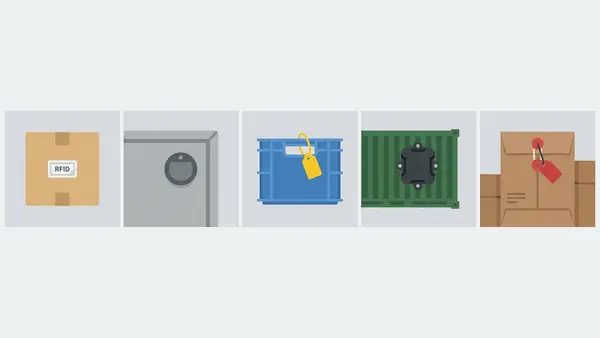
| Plastic bins or reusable totes | UHF label, hard tag, or zip-tie tag | Confirm adhesive, curvature, and handling durability |
| Metal tools, racks, equipment, or containers | RFID anti-metal tags | Use on-metal construction or spacing to prevent detuning |
| Liquid-filled goods or wet environments | Flag tag, spaced label, HF/LF option, or liquid-tolerant UHF tag | Test placement away from the liquid volume |
| Cold chain or outdoor storage | Rugged encapsulated tag with suitable adhesive or mechanical fixing | Check temperature, moisture, UV, and IP rating |
| Cages, pipes, returnable crates, and cable bundles | RFID zip tie tags or hard tags | Useful where adhesive labels may peel or break |
| Sealed shipments or tamper-sensitive logistics | Seal tie tag | Combines identification with a physical sealing function |
Auburn RFID Lab’s tagging guidance notes that metal, foils, and water-based liquids can significantly affect RFID inlays, and that tag location should be evaluated across sales floor, backroom, display, lockup, and case-pack conditions. It also warns against staples, die cuts, folding, and metallic packaging features that can damage or block an inlay. See the Auburn RFID Lab tagging guidelines for practical placement examples.
Confirm Read Range, Memory, Encoding, and Compliance
Read range should be written as a requirement. “Long range” is vague; “read every pallet tag through a dock-door portal at 3 meters while avoiding adjacent-door reads” is useful. Handheld cycle counts, rack reads, conveyor reads, and portal reads all create different tag requirements.
Also confirm the data structure before ordering printed or encoded tags. UHF EPC Gen2 tags typically include four memory areas:
- Reserved memory: access and kill passwords.
- EPC memory: the primary identifier most inventory systems read.
- TID memory: a permanent manufacturer-assigned identifier.
- User memory: optional space for extra data, depending on chip type.
Many inventory programs only need a unique EPC linked to product data in software. Others require GS1 structures such as SGTIN-96, serialized numbering, or retailer-mandated inlays and placement rules. The U.S. Federal Highway Administration’s RFID standards appendix summarizes EPC memory elements such as a 96-bit EPC, tag identifier, access password, kill password, and optional user memory in its RFID tag standards overview.
Before production, specify whether tags should be blank, pre-encoded, printed, serialized, or packed by SKU/location. If EPC uniqueness is not guaranteed, the buyer or tag supplier must define an encoding process before the tags enter the inventory workflow.
Test Samples Before Scaling the Inventory Program
Never approve inventory tags only from a datasheet. Test samples on the real item, in the real location, with the same reader type and movement pattern the operation will use.
A practical test should include:
- Multiple tag candidates: compare at least two or three label or hard-tag options.
- Real surfaces: test cardboard, plastic, metal, liquid containers, painted surfaces, and curved items separately.
- Placement variations: edge, center, cap, sidewall, spacer, hanging point, or cable-tie location.
- Read scenarios: handheld scan, shelf count, rack read, portal pass, conveyor read, or dense stack.
- Handling stress: abrasion, impact, washing, condensation, freezing, heat, chemicals, or outdoor exposure where relevant.
- Attachment survival: adhesive peel, cable-tie strength, screw/rivet fit, epoxy bond, or embedded placement.
- Encoding validation: confirm EPC format, uniqueness, barcode/QR match, and software lookup.
For RFID warehouse management, test for both missed reads and stray reads. A tag that reads too far may capture inventory in the wrong zone. For RFID asset tracking, test whether the tag remains readable after handling, relocation, cleaning, and long-term mounting.
RFQ Checklist for RFID Inventory Tags
A strong RFQ helps the tag supplier recommend samples that match the application. Include enough detail to avoid generic recommendations.
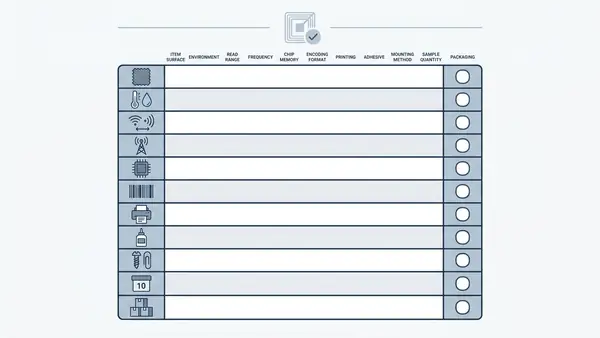
| RFQ field | What to specify |
|---|---|
| Application | Retail inventory, warehouse cartons, pallets, reusable containers, tools, racks, cold chain, or outdoor assets |
| Item details | Material, size, shape, surface finish, available tag area, and expected lifespan |
| Environment | Temperature, humidity, liquid exposure, metal proximity, UV, chemicals, vibration, abrasion |
| Read workflow | Handheld, portal, shelf, conveyor, rack, dock door, or outdoor read point |
| Performance target | Required read distance, minimum read rate, tag density, and stray-read tolerance |
| Frequency and chip | LF, HF/NFC, UHF, EPC Gen2 / ISO 18000-6C, ISO 15693, chip model, EPC/user memory |
| Encoding | Blank, EPC, SGTIN-96, serial range, TID use, user memory, lock/password requirements |
| Printing | Human-readable serial, barcode, QR code, logo, color, label size, roll direction |
| Attachment | Adhesive, foam spacer, cable tie, screw, rivet, epoxy, hanging, embedded, or sewn-in design |
| Packaging | Roll quantity, sequence, SKU grouping, location grouping, sample quantity, and annual volume |
| Acceptance criteria | Test method, sample approval process, durability requirement, and production inspection needs |
RFIDEcho can help confirm tag material, chip, frequency, size, printing, encoding, numbering, adhesive, mounting, and packaging options. If you already know the reader type or software data format, include that information so the tags can be selected to work with compatible equipment.
FAQ
Which RFID tag is best for inventory control?
For high-volume warehouse, retail, and carton inventory, passive UHF labels are usually the best starting point. Metal assets, reusable crates, outdoor items, and cold-chain goods may require anti-metal, rugged, zip-tie, or encapsulated tags.
Are passive UHF RFID tags enough for warehouse inventory?
Often yes. Passive UHF supports fast bulk reads and low tag cost, which makes it suitable for many warehouse workflows. However, metal racks, liquids, high shelves, dense pallets, and portal layouts should be tested before rollout.
Do RFID tags work on metal inventory items?
Yes, but standard labels often lose performance on metal. Use anti-metal tags, spacers, or tag placements designed for conductive surfaces, and test the required read distance on the actual asset.
What information should I send for an RFID tag quote?
Send the item type, surface material, environment, read workflow, required read distance, frequency, memory and encoding needs, print requirements, attachment method, quantity, sample request, and acceptance criteria. For procurement support, contact RFIDEcho with photos or drawings of the tagged item.