How Much Do RFID Tags Cost?
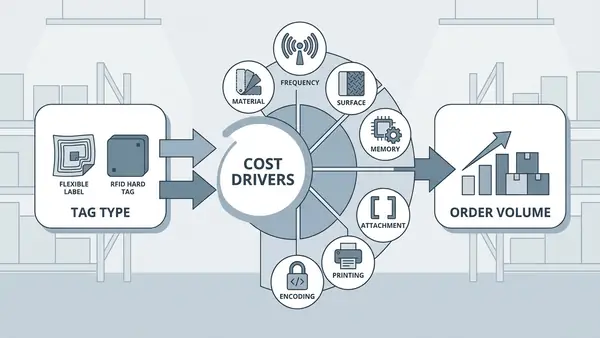
There is no list price for an RFID tag, and any single number you find online is answering a different specification than yours. Unit price is set by the tag construction you actually need, then adjusted by volume, chip, material, printing, encoding, and packaging. The same project can quote at very different prices depending on which of those the workflow forces.
What is stable is the ordering. Tag classes fall into predictable cost tiers, and knowing which tier your application lands in is usually enough to scope a budget before you request a quote.
| Tag class | Relative unit cost | What you are paying for |
|---|---|---|
| Passive UHF label / inlay | Lowest | Inlay, facestock, adhesive; no housing, highest volume efficiency |
| Passive HF / NFC label | Low | Smaller antenna, close-range use, often card or sticker format |
| Passive on-metal / hard tag | Substantially higher | Antenna redesign, spacer or shielding, housing, mounting |
| Encapsulated laundry / autoclave tag | Substantially higher | Sealed construction rated for repeated heat, pressure, chemicals |
| Active RFID tag | Highest by a wide margin | Battery, transmitter, longer range, plus replacement over life |
The gap between the tiers is large — moving from a plain label to a tag that survives metal, heat, or washing is a step change, not a small increment. That is why specification discipline matters more than negotiation: choosing a tier you do not need costs far more than any unit-price haggling will recover.
A low-cost paper label can be the right choice for cartons in a clean warehouse, and the same label will fail on metal equipment, wet packaging, outdoor containers, or washable textiles. The goal is not the cheapest tag; it is the lowest-cost tag that works reliably in the real workflow. RFIDEcho quotes against your specification — the custom RFID tag page sets out which options are configurable, and the RFID tags catalogue shows the formats each tier covers. The RFQ checklist at the end of this guide lists what we need in order to price accurately on the first pass.
What an RFID System Costs Beyond the Tags
Tag unit price is the number buyers ask for first, and it is rarely the number that decides the project. On a first deployment the tags are often a minority of year-one spend.
| Cost line | What drives it | When it dominates |
|---|---|---|
| Tags | Unit price × item count × replacement rate | High item counts, disposable or consumable tagging |
| Readers | Handheld vs fixed portal; number of read points | Many fixed read zones, dock doors, or portals |
| Antennas, cabling, mounting | Read-point count and site conditions | Fixed infrastructure across a large site |
| Software and integration | Middleware, WMS/ERP integration, custom development | Any system that must talk to existing inventory software |
| Labelling and application labour | Who applies tags, and where in the process | Retrofitting an existing asset base |
| Pilot and testing | Sample rounds before bulk commitment | Difficult surfaces, dense stacking, liquids, metal |
The practical consequence: cutting a fraction of a cent from tag price rarely rescues a project’s business case, and choosing a tag that reads unreliably will sink it. Specify for read performance first, then optimise unit cost within the format that works.
What Scale Makes RFID Pay Back?
The most useful question is not “what does a tag cost” but “at what volume and turnover does tagging return more than it costs”. A workable break-even sketch needs only four inputs:
- Item count — how many items carry a tag, and how often tags are replaced.
- Cycle frequency — how many times per year each item is counted, checked out, or reconciled.
- Labour saved per cycle — minutes saved per count versus manual or barcode scanning, times loaded labour rate.
- Loss and error reduction — shrinkage, misplaced assets, write-offs, and billing disputes avoided per year.
Annual benefit is roughly (cycles per year × labour saved per cycle) + annual loss avoided. Set that against tag cost + amortised reader and software cost + application labour. Three patterns come out of that arithmetic:
- High item count, low item value, frequent counting — retail stock, linen, cartons. Payback comes from labour per cycle, so it needs cheap tags and high cycle frequency to work.
- Low item count, high item value, infrequent counting — tools, instruments, moulds. Payback comes from loss avoidance and downtime, so a several-dollar rugged tag is easily justified.
- Low item count, low value, infrequent counting — the case where RFID usually does not pay back, and barcodes or a manual process remain the right answer.
When RFID Is the Wrong Choice
RFID has real disadvantages, and a buyer who hears none of them from a supplier is being sold to rather than advised:
- Metal and liquid degrade read performance. Both are solvable with the right tag format, but the solution costs more and needs testing on the actual item.
- Unit cost is higher than a printed barcode, which is effectively free. At very high item counts and low value, that gap can decide the case.
- It is a system, not a sticker. Readers, integration, and process change are required before any benefit appears.
- Reads can be too good. Stray reads from adjacent zones, or tags read through a wall, create false inventory records unless read zones are controlled.
- Retrofitting an existing asset base is labour-heavy, and that labour is often underestimated in the business case.
Barcode, BLE, and computer vision each beat RFID in specific conditions; our comparison of barcode versus RFID tags covers where the line falls.
Tag Type and Power Source Change the Baseline Price
The first price driver is the tag type. Passive RFID tags are usually the lowest-cost option because they do not contain a battery. They draw power from the RFID reader’s signal and respond only when they are in the read field. This makes passive tags practical for inventory labels, cartons, pallets, tools, documents, and many asset-tracking applications.
Semi-passive or battery-assisted passive tags add a battery to power internal circuitry. They can improve sensitivity or support sensing functions, but they cost more and require battery-life planning. Active RFID tags include a battery and transmitter, so they can broadcast over longer distances or support real-time location use cases. That extra capability increases tag cost, size, and maintenance requirements.
| Tag type | Cost impact | Common fit | Buying note |
|---|---|---|---|
| Passive label or inlay | Low | Retail items, cartons, files, packaging, warehouse inventory | Best starting point when checkpoint or handheld reads are enough |
| Passive hard tag | Medium | Tools, reusable containers, equipment, outdoor assets | Higher cost comes from housing, mounting, and durability |
| Semi-passive / BAP tag | High | Cold chain, sensing, improved sensitivity, specialty workflows | Useful only when the added battery function is needed |
| Active RFID tag | Highest | Vehicles, yards, high-value mobile assets, real-time location | Higher unit cost plus battery replacement considerations |
Many cost pages quote broad price ranges, but exact pricing depends on volume, chip, material, and customization. Treat public price examples as budget signals, not final RFQ pricing.
Frequency, Chip, and Memory Affect Both Cost and Fit
Frequency changes the tag design and the use case. LF tags are used for short-range identification, animal ID, and some liquid or metal-sensitive conditions. HF and NFC tags are common for cards, libraries, access, healthcare items, and close-range confirmation. Passive UHF is often the scalable choice for warehouse, retail, logistics, and asset workflows because it supports longer read ranges and bulk reads.
Chip choice also affects cost. A simple inventory tag may only need a unique EPC number linked to product data in software. A more demanding project may need larger EPC memory, user memory, password protection, a specific chip model, high sensitivity, or compliance with a retailer or industry program.
UHF Gen2 RFID tags commonly use these memory areas:
- EPC memory: the primary identifier read by inventory or asset systems.
- TID memory: a permanent chip identifier assigned by the manufacturer.
- User memory: optional programmable space for extra data.
- Reserved memory: access and kill passwords for control functions.
The GS1 UHF air interface protocol covers EPC/RFID Gen2 technical foundations for UHF systems. Buyers do not always need advanced memory or security features, but they should define EPC format, uniqueness, user memory, locking, and password requirements before ordering encoded tags.
Material, Surface, and Environment Can Raise Unit Cost
A basic RFID label is economical because it uses a simple inlay, facestock, and adhesive. Costs rise when the tag must survive difficult surfaces or environments. Metal can detune or block a standard RFID antenna. Liquids can absorb RF energy. Outdoor use may require UV resistance, waterproofing, impact resistance, and stronger adhesive. Laundry or industrial washing requires encapsulation and repeated heat, pressure, and chemical resistance.
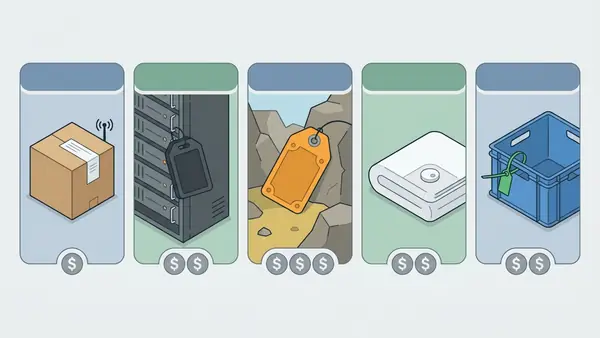
| Condition | Lower-cost option may work when | Higher-cost tag may be needed when |
|---|---|---|
| Cardboard or paper packaging | Indoor, dry, flat surface, disposable use | High abrasion, cold chain, special adhesive, long storage |
| Plastic bins or totes | Smooth surface and moderate handling | Curved plastic, washing, impact, reusable transport cycles |
| Metal assets | Tag can be spaced away from metal | Direct mounting on steel tools, racks, cylinders, or equipment |
| Liquid-filled goods | Tag placement is away from liquid mass | Water-rich goods, wet environments, short tag area, dense packing |
| Outdoor assets | Short life and sheltered placement | UV, rain, dust, vibration, impact, temperature cycling |
| Textiles and laundry | One-time or light handling | Repeated washing, drying, ironing, pressure, and chemicals |
For metal items, RFID anti-metal tags use designs that tolerate conductive surfaces better than standard labels. For washable textile workflows, RFID laundry tags are built for repeated cleaning stress. For crates, cables, and reusable items where adhesive is unreliable, zip tie tags can reduce attachment failure.
GS1 support notes that metal reflects and diffracts electromagnetic waves, while water absorbs electromagnetic waves and can reduce RAIN RFID tag performance. See its note on RFID around metal and water for a concise technical explanation.
Customization, Encoding, Printing, and Packaging Add Cost
Customization is often necessary, but every extra step can affect price. A blank standard roll is usually cheaper than a printed, encoded, serialized, inspected, re-rolled, and SKU-grouped order. That does not mean customization should be avoided; it means buyers should specify only what the workflow needs.
Common cost-adding options include:
- Printing: logo, text, human-readable serial number, barcode, QR code, color, or compliance mark.
- Encoding: EPC, SGTIN-96, custom asset ID, user memory, access password, kill password, or chip locking.
- Serialization: unique number range, SKU matching, barcode-to-EPC matching, or database association.
- Materials: facestock, adhesive, foam spacer, hard case, ceramic, silicone, PPS, ABS, or textile encapsulation.
- Attachment: adhesive, cable tie, screw, rivet, magnet, epoxy, sewn-in design, or embedded construction.
- Packaging: roll direction, roll quantity, re-rolling, sequence preservation, SKU grouping, and location grouping.
Encoding deserves special attention. Tags may arrive blank or with a generic value, and that value may not be unique for the buyer’s operation. If the inventory system needs unique EPCs, GS1 structures, or a defined serial range, encoding and verification should be part of the RFQ.
Quantity, Sampling, and Quality Control Shape Real Cost
Order quantity has a major effect on unit price. Large orders can spread setup, material sourcing, printing, and encoding work across more tags. Small custom batches, urgent samples, unusual chip requirements, and special materials usually cost more per tag.
But volume discounts only help if the selected tag works. A large order of unsuitable tags can create missed reads, replacement labor, relabeling, delayed rollout, and wasted packaging. For RFID warehouse management, a tag that reads poorly in dense cartons may slow cycle counts. For RFID asset tracking, a cheap label that peels from equipment may cost more than a rugged tag over the asset’s life. For RFID tool management, a standard label that fails on a steel wrench or mold usually costs more in re-tagging labor than paying for an anti-metal tag up front.
Quality control is also part of real cost. RF performance is not visible by looking at a label. A tag can appear normal but still have poor sensitivity, inconsistent read range, damaged bonding, or incorrect encoding. Voyantic explains that RFID label quality depends on RF performance and production variance, not visual inspection alone, in its discussion of why RFID label quality matters.
Before scaling, test samples on the actual item with the expected reader type, placement, and movement pattern. Include multiple tag candidates and compare performance across surface, orientation, read distance, stack density, handling, temperature, moisture, and attachment survival.
RFQ Checklist for RFID Tag Pricing
A clear RFQ helps suppliers quote the right tag instead of guessing from a generic “RFID tag price” request.
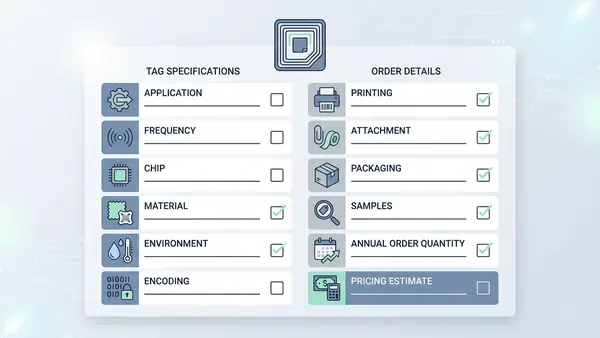
| RFQ field | What to specify |
|---|---|
| Application | Inventory, warehouse, logistics, asset tracking, laundry, tools, containers, retail, access, or anti-counterfeit use |
| Tagged item | Material, size, shape, surface finish, available tag area, and expected service life |
| Environment | Indoor/outdoor, temperature, moisture, chemicals, UV, washing, abrasion, vibration, impact, metal, or liquids |
| Read workflow | Handheld, portal, conveyor, shelf, rack, dock door, machine station, or close-range confirmation |
| Performance target | Required read distance, read rate, tag density, stray-read tolerance, and durability target |
| Frequency and chip | LF, HF/NFC, UHF, chip model, EPC size, user memory, sensitivity, and standards requirements |
| Encoding | Blank, EPC, SGTIN-96, custom serials, TID use, user memory, lock/password, barcode or QR matching |
| Printing | Logo, human-readable serial, barcode, QR code, color, label dimensions, and print durability |
| Attachment | Adhesive, foam spacer, cable tie, screw, rivet, epoxy, magnet, sewn-in, embedded, or hanging design |
| Packaging | Roll direction, roll quantity, sequence, SKU grouping, location grouping, sample quantity, and annual volume |
| Quality control | Encoding verification, sample approval, RF performance requirement, inspection report, and acceptance criteria |
RFIDEcho can help confirm tag material, chip, frequency, size, printing, encoding, numbering, adhesive, mounting, and packaging options. If the buyer already knows the reader model, software data format, or compliance requirement, including it early can reduce quote revisions and sample cycles.
FAQ
How much does a passive RFID tag cost?
Passive tags are priced per specification, not from a list. A plain label is the lowest-cost format; a passive hard tag built for metal, heat, or washing costs substantially more, because the housing and antenna redesign cost more than the chip. Volume, encoding, and printing then adjust the quote.
How much does a UHF RFID tag cost?
Passive UHF labels are the lowest-cost RFID format. UHF on-metal and hard tags cost substantially more because they need antenna redesign, spacing, and a protective housing to work on conductive surfaces. Send the item, surface, environment, and annual volume to get an accurate quote.
How much does an RFID inventory management system cost?
Tags are usually a minority of year-one cost. Budget also for readers, antennas and mounting, software integration with existing inventory systems, tag application labour, and a pilot round. On a first deployment, integration and readers commonly outweigh tag spend.
At what scale does RFID pay for itself?
It depends on item count, how often items are counted, and item value. High-count, frequently counted stock pays back through labour saved per cycle. Low-count, high-value assets pay back through loss avoidance. Low-count, low-value, rarely counted items usually do not justify RFID.
What are the disadvantages of using RFID tags?
Metal and liquid reduce read performance, unit cost is higher than a barcode, and RFID only works as a system of tags, readers, and integration. Stray reads can create false records, and retrofitting an existing asset base is labour-heavy.
What is the biggest factor affecting RFID tag cost?
The biggest factor is usually tag construction: passive label, hard tag, on-metal tag, battery-assisted tag, or active tag. Material, environment, chip, memory, customization, and quantity then adjust the final price.
Are passive RFID tags always cheaper than active RFID tags?
Passive RFID tags are usually cheaper per tag because they do not include a battery or transmitter. Active tags cost more but may be justified for long-range or real-time tracking of high-value assets.
Why do RFID tags for metal cost more?
Metal can detune or block standard RFID labels, so on-metal tags need special antenna design, spacing, shielding, housing, or materials. That extra engineering and construction increases unit cost.
How can buyers reduce RFID tag cost without choosing the wrong tag?
Define the workflow clearly, avoid unnecessary memory or ruggedness, order realistic volumes, test samples before scaling, and include complete RFQ details for surface, environment, encoding, printing, attachment, and packaging.