Apparel retail RFID deployment challenges often look like software, workflow, or store-training problems. In practice, many failures start earlier: the wrong tag format, weak placement, poor encoding, or insufficient sample testing. For apparel buyers and integrators, tag selection is one of the first ways to reduce rollout risk.
The same tag decisions apply whenever garments carry an identity through handling, storage, and return cycles — the tag formats and attachment methods described here are the ones used in RFID garment and linen tracking programs. For the full system-selection and tag-attachment picture across laundry and apparel programs, see the RFID for laundry and uniform rental guide.
Why apparel RFID deployments fail in practice
RFID can improve inventory visibility, store cycle counts, omnichannel fulfillment, and loss prevention. But apparel retail is a difficult RF environment. Garments are folded, stacked, tried on, returned, re-packed, hung near metal fixtures, and moved between store zones all day.
Common failure points include:
- Tags placed where folds or hangers shield the antenna
- Low read rates on dense stacks of jeans, coats, or boxed footwear
- Duplicate, missing, or incorrectly encoded EPCs
- Tags that detach during handling or returns
- Source-tagging processes that do not match store workflows
- Staff losing trust because system inventory still disagrees with the shelf
Auburn RFID Lab’s deployment guidance notes that inventory accuracy is the foundation for other retail RFID benefits, and pilot studies have raised accuracy above 95% when implemented well. That is why tag choice should be tested against the real store process, not only against a reader in a clean lab setup.
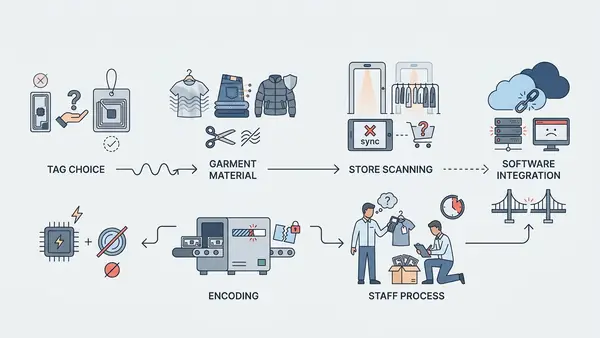
Challenge-to-tag-specification matrix
The table below connects common apparel RFID deployment challenges to the tag decisions that can reduce risk.
| Deployment challenge | Tag specification decision | What to test before rollout |
|---|---|---|
| Inconsistent reads in store counts | UHF inlay size, antenna design, placement, and tag orientation | Read rate by SKU, rack type, and folded/hanging state |
| Poor reads in dense stacks | Larger or higher-sensitivity inlay; avoid shielded placement | Jeans, sweaters, coats, and boxed footwear in realistic stack depth |
| Tags removed too early | Hang tag vs sewn-in label vs adhesive packaging label | Returns, exchanges, and post-sale workflow |
| Incorrect inventory records | EPC encoding scheme and barcode/EPC association | Duplicate EPC rate, print/encode verification, manifest accuracy |
| Loss prevention gaps | RFID+EAS hard tag or compatible retail label format | Exit-zone reads, removal workflow, false alarms |
| Returns and circularity needs | Durable sewn-in or washable textile tag | Wash cycles, comfort, post-wash read range, seam durability |
| High source-tagging cost | Roll, fanfold, or singulated delivery; print/encode process | Labeling speed, packaging fit, reject rate |
For buyers comparing RFID with barcode inventory workflows, RFIDEcho’s guide to RFID asset tracking for tools and equipment is a useful companion because it explains selection factors beyond apparel.
Choosing the right apparel RFID tag format
Most item-level apparel retail projects use passive UHF RFID because it supports bulk reading without line of sight. The best tag format depends on whether the tag is only needed before sale, should support return processing, or must remain with the garment for washing or lifecycle tracking.
| Tag format | Best fit | Main tradeoff |
|---|---|---|
| RFID hang tag or price ticket | Standard fashion retail, source tagging, boutiques, department stores | Easy to remove, so it may not support returns after tag loss |
| Adhesive RFID label | Packaging, shoes, accessories, cartons, temporary re-tagging | Adhesive and surface compatibility matter |
| Sewn-in care-label-style RFID tag | Garments needing persistent identity | Requires comfort, placement, and durability testing |
| Washable textile RFID tag | Uniforms, workwear, rental garments, laundry-heavy apparel | Higher validation burden for wash cycles and heat |
| Reusable hard tag or RFID+EAS tag | Anti-theft and reusable store workflows | Requires removal, reuse, and checkout process control |
RFIDEcho’s RFID clothing care tag for garments is relevant when the RFID identity needs to be integrated into a garment label rather than attached as a disposable paper ticket. For apparel that must survive repeated washing, compare garment-label options with washable textile RFID laundry tags and broader RFID laundry tag formats.
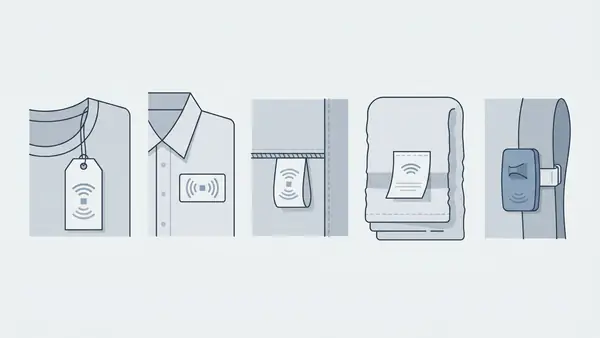
Hang tags and price tickets
Hang tags are usually the easiest format for new retail deployments. They support branding, barcode printing, EPC encoding, and high-volume source tagging. They are also easy for customers or store teams to remove, which is acceptable for inventory and checkout use cases but less suitable for post-sale returns or product lifecycle tracking.
Sewn-in and care-label-style tags
Sewn-in RFID tags keep the digital identity with the garment. They can help with returns, authentication, uniforms, and future circular-economy workflows. The main questions are comfort, antenna bending, wash resistance, and whether the tag location is readable when the garment is folded or worn.
Reusable hard tags and EAS workflows
Reusable hard tags can combine RFID identity with anti-theft workflows. They work best when the retailer already has a controlled remove-and-reuse process at checkout. They are less appropriate when suppliers need a low-cost source tag that travels through the supply chain and leaves with the garment.
Pilot testing before rollout
A pilot should measure the tag’s performance in the real apparel workflow. Do not approve a tag because it reads once on a sample table.
Strong pilot metrics include:
- Read rate by SKU, size, color, fabric, and tag format
- Read rate on hanging items, folded items, dense stacks, and cartons
- Count time compared with barcode or manual counting
- Inventory accuracy before and after RFID counting
- Duplicate EPCs, unreadable tags, and incorrect EPC-to-barcode links
- Tag detachment, bending, or damage during handling
- Exception rate during receiving, cycle count, checkout, and returns
- Staff time needed to resolve unread or mismatched items
If the store uses metal shelves, foil packaging, dense backroom racks, or RFID gates, include those conditions in the test. If the project covers warehouse or omnichannel fulfillment, test receiving and picking as well as front-of-store counts. RFIDEcho’s RFID warehouse management solution page gives context for warehouse-side tag use cases, while RFID asset tracking covers broader tracking environments.
Encoding, standards, and privacy considerations
For item-level apparel retail, encoding quality is as important as physical tag performance. Many retailers and trading partners expect EPC-enabled RFID aligned with GS1 identification practices. GS1 case studies describe apparel items encoded with a Serialized Global Trade Item Number (SGTIN), linking the RFID identity to the barcode and product attributes used at retail checkout.
Useful external references include the GS1 apparel item-level tagging case study, the GS1 US and MIT retail RFID evolution whitepaper, and NIST guidance on securing RFID systems.
Before ordering production tags, confirm:
- EPC scheme and serialization responsibility
- Chip memory requirements
- Barcode, human-readable text, and printed artwork
- Print-and-encode verification process
- Duplicate EPC prevention
- Whether tags are removed, retained, deactivated, or used after sale
- Regional frequency and reader compatibility requirements
Privacy expectations depend on whether the tag leaves the store with the customer. Disposable hang tags usually create fewer post-sale concerns because they are removed. Embedded or washable tags can support returns, recycling, or authentication, but they require clearer consumer communication and data-minimization practices.
RFQ checklist for apparel RFID tags
A strong RFQ helps the supplier recommend a tag that fits the application, not just the cheapest inlay. The trade-offs behind that unit price — chip, memory, material, and customization — are broken down in what actually drives RFID tag cost.
Include the following:
- Application goal: inventory accuracy, source tagging, checkout, returns, EAS, laundry, authentication, or circularity.
- Garment category: shirts, denim, coats, lingerie, shoes, accessories, uniforms, or mixed apparel.
- Tag format: hang tag, adhesive label, sewn label, washable textile tag, or reusable hard tag.
- Frequency and protocol: usually passive UHF / RAIN RFID for item-level apparel retail.
- Chip and memory: EPC memory, user memory if needed, and any retailer mandate.
- Encoding data: EPC format, SGTIN or other scheme, barcode link, serialization rules.
- Printing: logo, barcode, SKU, size, color, care information, numbering, or variable data.
- Attachment method: string, pin, adhesive, sewing, heat seal, pouch, or hard-tag fixture.
- Testing conditions: read distance, dense stacks, folding, packaging, washing, returns, and store fixtures.
- Delivery format: rolls, fanfold, singulated pieces, cartons, packaging sequence, and sample approval process.

For custom tag discussions, buyers can contact RFIDEcho through the contact page with garment photos, target read conditions, encoding needs, and expected order volume.
FAQs about apparel retail RFID deployment challenges
What is the biggest RFID deployment mistake in apparel retail?
The biggest mistake is treating the RFID tag as a generic label. Apparel tags must be selected and placed for the garment format, read environment, encoding workflow, and store process.
Are hang tags enough for apparel RFID?
Hang tags are enough for many standard retail inventory and checkout workflows. If the project needs returns verification, laundering, rental tracking, or post-sale product identity, sewn-in or washable formats may be better.
Why do RFID tags read well in samples but fail in stores?
Store conditions add dense stacks, metal fixtures, folded garments, mixed orientations, packaging, and human handling. Pilot tests must reproduce those conditions before rollout.
Should RFID clothing tags store detailed product data?
Usually no. In many apparel deployments, the tag stores a unique EPC and the product details live in the retailer’s system. Store additional memory only when the use case requires it.